

Europe’s elongated skulls: the Huns, migration and a forgotten body tradition
Hundreds of deliberately elongated skulls have been excavated from fifth-century European cemeteries, and one region of France was still producing them when the camera arrived. The European record is why an elongated skull cannot, by itself, mean anything unusual about its owner.
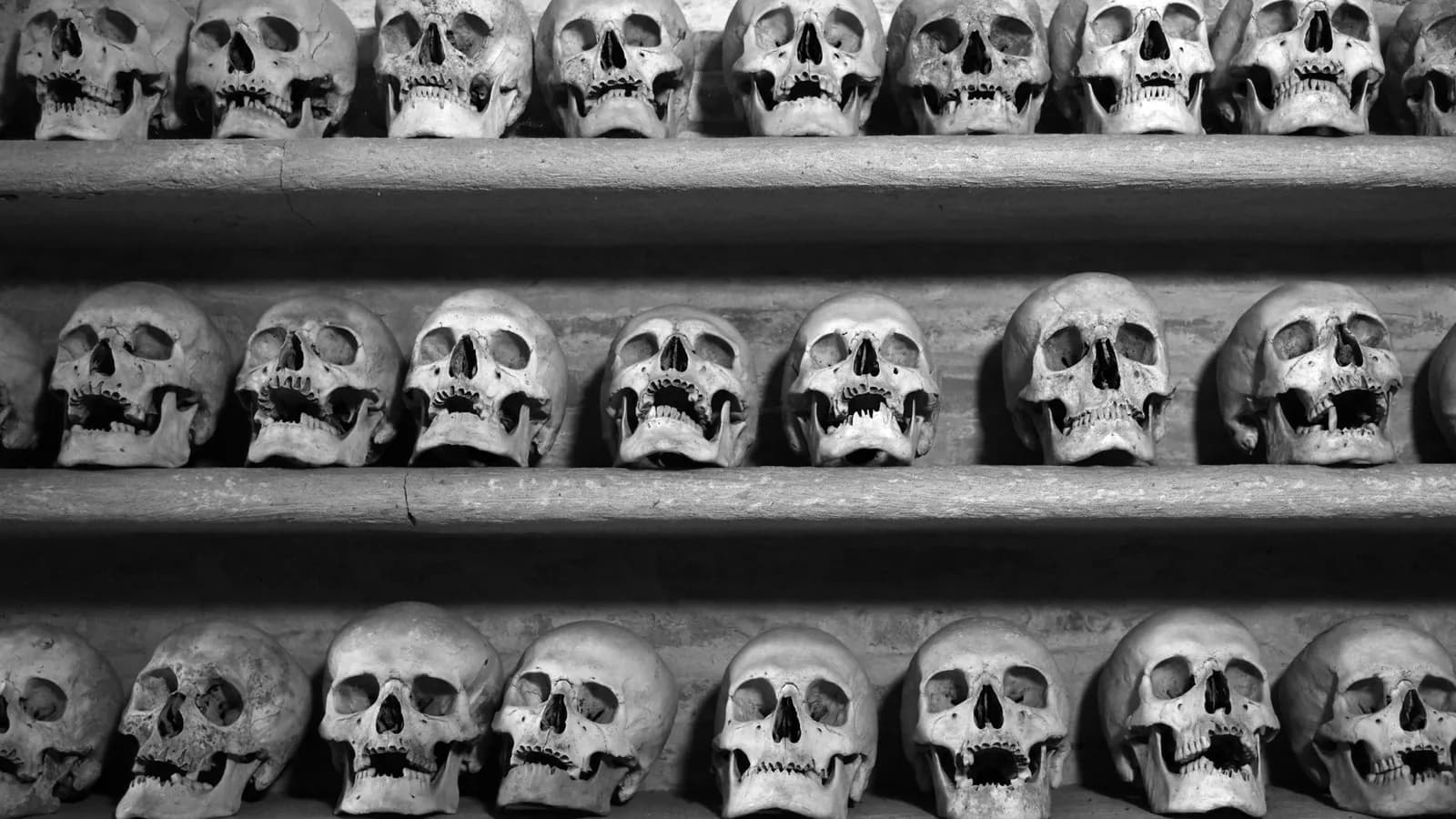
Photo by Serena Koi on Pexels
Elongated skulls are usually discussed as a Peruvian problem. They are not. Europe has hundreds of them, they are securely dated, and in one part of France the custom that produces them survived into the twentieth century — late enough to be photographed.
That last fact is the reason this article exists. Almost every extraordinary claim about elongated skulls depends on the idea that they are remote, exotic and poorly understood. The European record is none of those things.
What was found
From roughly the 420s onwards, cemeteries across the Carpathian Basin, Austria, southern Germany, eastern France and northern Italy begin to contain adults whose skulls slope backwards from the brow in a continuous line, with the widest point pushed up and back. The cranial sutures are normal. The bone is normal. The shape is the result of pressure applied to an infant skull with bandages and pads, held for months while the bone was still growing.
The mechanism is not in dispute and has been quantified. Binding redistributes growth rather than restricting it: the vault lengthens where it is free to expand and flattens where the wrapping presses, and the face and skull base respond as connected modules rather than independently. Volume is broadly conserved. Nothing is added and nothing is removed.
Where the custom came from
It was not a European invention. The practice is attested far earlier across the Eurasian steppe and Central Asia, and the standard reconstruction — set out by Molnár and colleagues in a 2014 review in Neurosurgical Focus of deformed crania from north-eastern Hungary — has it moving west with steppe populations from around AD 200: first in the Kalmyk steppe, then the Crimea, then into central and western Europe during the fourth and fifth centuries.
That westward movement coincides with the arrival of the Huns in Europe, which is why the skulls acquired the label they still carry. It is a period label. It is not an ethnic identification, and treating it as one has caused a great deal of confusion.
A community that adopted it
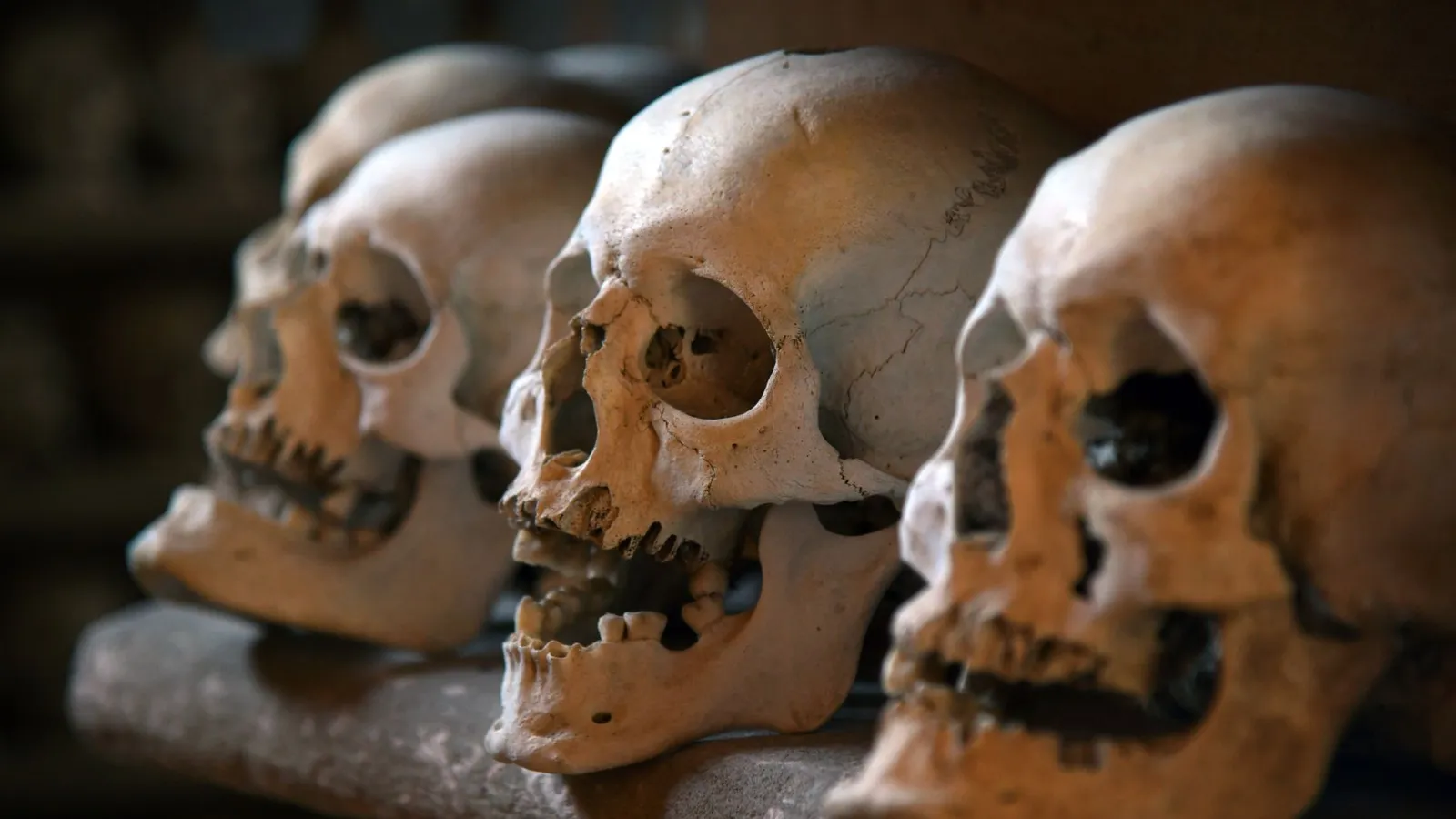
The cemetery at Mözs-Icsei dűlő in Hungary is the clearest single case, and it is published in full and open access. Ninety-six graves, in use for roughly two to three generations between about 430/440 and 470/480. Fifty-one of the individuals buried there have artificially shaped skulls — one of the largest concentrations known anywhere in the Carpathian Basin.
Strontium isotopes from tooth enamel show that about a third of the adults grew up elsewhere, while the children cluster tightly in a local range. Read alongside the burial groups, the excavators argue the site was founded by one population, joined within a generation by newcomers, after which the founding community began shaping its own children’s heads.
Modified skulls at Mözs are found on adult men, adult women, adolescents and children alike. In the group founded last, the proportion of modified children is higher than anywhere else on the site. This is a custom being taken up, not imported ready-made.
A community that received it
Bavaria, a century later, shows the opposite pattern, and this is where genetics settles something that bones alone could not.
Veeramah and colleagues sequenced 41 individuals, mostly from the late fifth and early sixth centuries, from cemeteries including Altenerding, Straubing and Burgweinting. The men look like modern northern and central Europeans. The women do not: their ancestry is strikingly varied, ranging from western Europe to, in one individual, roughly a fifth East Asian.
The women with clearly modified skulls — nine of them, with five further individuals showing an intermediate degree — cluster genetically towards south-eastern Europe. Pigmentation predicted from their genomes also separates them from the rest of the cemetery, which trends towards blue eyes and fair hair.
The problem with the word “Hunnic”
The people buried with these skulls in the west were not Huns in any straightforward sense. The cemeteries are Gothic, Gepid, Alan, Roman-provincial and, later, Bavarian. Mözs sits in a former Roman province and contains Roman-style graves alongside newcomer burials.
The archaeological argument of the last twenty years — Susanne Hakenbeck’s work on this material is the clearest statement of it — is that these skulls do not mark membership of a people at all. They mark a period in which populations were mixing rapidly, and in which the body itself became a place where a new, shared identity could be displayed.
The tradition Europe forgot
The custom did not stop in the sixth century. In the region around Toulouse in southern France, infants were routinely bound with a head band and a tight outer bandage — the bandeau, applied by midwives in the days after birth. It was widespread among the rural population, and it was still being done in the early twentieth century.
French anthropologists noticed. Paul Broca and his colleagues at the Société d’Anthropologie de Paris discussed cases through the second half of the nineteenth century, and the resulting head shape became known in the literature as the déformation toulousaine.
In 2022 Galiay and colleagues went back to it with modern methods, and the material they used is the point. They took 31 frontal and 70 lateral photographs of living people with Toulouse-type deformation from two nineteenth-century French photographic archives, and ran a geometric morphometric analysis on the soft tissue.
The French sources describe the binding as protective: a wrapped head was thought to shield a newborn from knocks. On that reading the shape was a by-product of a medical custom rather than its purpose. Whether the shape was also valued is a separate question, and the record is not clear enough to answer it.
What this does to the alien-skull claim
It removes the premise rather than the conclusion, which is a stronger move.
The claim that an elongated skull indicates unusual biology requires that such skulls be rare, ancient and unexplained. In Europe they are common, dated to the century, found in ordinary cemeteries with ordinary grave goods, produced by a method that is documented in medical literature, and — in the Toulouse case — visible in photographs of named living people.
What we know
Intentional cranial modification was practised across Europe from the late fourth century onwards, most densely in the Carpathian Basin, and reached western Europe with steppe and post-Hunnic population movement.
At Mözs-Icsei dűlő, 51 of 96 burials are modified, across both sexes and all ages, in a community that isotopes show was mixed and that appears to have taken up the custom within a generation.
In early medieval Bavaria the modified individuals are almost all women, genetically distinct from the men beside them, and most plausibly incomers from south-eastern Europe.
And a version of the same practice survived in southern France into the era of photography.
What we don’t know
Why the practice spread west when it did, rather than a century earlier or later. Contact alone does not explain adoption; plenty of customs travel and are refused.
What the women in the Bavarian cemeteries understood themselves to be. Genetics gives ancestry, not identity, and no text records how they were regarded by the community that buried them.
Whether the Toulouse custom is a survival of the Migration Period tradition, an independent reinvention out of ordinary swaddling, or something in between. There is a gap of a thousand years in the middle of that story and nothing yet fills it.
Buried Evidence
Continue the investigation
- 01Yonaguni: a submerged monument, or a very tidy rock?Off the coast of a Japanese island lies a formation with terraces, right angles and what look like steps. Two credentialled scientists have looked at the same rock and reached opposite conclusions. Here is what each of them is actually arguing.
- 02Bimini Road: the prophecy that found what it went looking forA line of squared blocks under shallow Bahamian water, found in 1968 — exactly when a famous psychic had predicted Atlantis would begin to reappear. The geology is settled. The story of how it was found is the interesting part.
- 03Stonehenge: what has actually been establishedThe most examined prehistoric monument in the world, and the popular account is still mostly wrong. Here is what excavation and geochemistry have actually settled — including a finding from 2024 that changed the map.
What we could not settle
Loose ends we are still working on.
- 01
Why did the women move west and the men stay put?
In the Bavarian cemeteries almost everyone with a shaped head is a woman who grew up somewhere else. Marriage across a frontier is the obvious answer, but it is an assumption, and there are other ways a group of women ends up hundreds of miles from home.
- 02
Did anyone in Toulouse in 1900 know they were doing what the Huns did?
French doctors were writing about it and comparing notes with archaeologists. Whether the families themselves saw it as an ancient custom, a piece of local common sense, or simply what a midwife does, nobody seems to have asked at the time.
- 03
Why did Europe stop?
A practice that lasted fifteen hundred years in some form ended almost entirely within living memory. Something changed — medicine, midwifery, fashion, or just the people who knew how. Working out which would tell us a lot about how these customs end everywhere else.
Got something to add?
A question, a source we missed, a correction, or something you saw yourself — all of it is welcome here. You do not need to be an expert, and you are allowed to disagree with us.
Nobody has yet — go on.
See also
Everything this piece touches
Topic
artificial cranial modification
Reshaping an infant skull by binding or boards. Documented on five continents over 12,000 years.
Topic
Mözs-Icsei dűlő
Fifth-century Pannonian cemetery where 51 people — men, women and children — had modified skulls.
Topic
Altenerding
Early Medieval Bavarian cemetery whose modified skulls belonged to women born in south-eastern Europe.
Sources
Open them and check for yourself. Where a record is public, it is linked.
Knipper et al., PLOS ONE 15(4): e0231760 · 29 Apr 2020
Veeramah et al., PNAS 115(13), via PubMed Central
Galiay et al., Journal of Stomatology, Oral and Maxillofacial Surgery, via HAL
Morphological consequences of artificial cranial deformation: modularity and integration
PubMed Central
Natural History Museum, London
Related
Archaeological Mysteries
Elongated skulls: why did ancient humans change the shape of their heads?
Thousands of them, across five continents and twelve thousand years. Nobody serious disputes that people did this to their own children, or how. The argument is about why — and the answer everyone repeats turns out to be the least documented one.
Archaeological Mysteries
Why did cultures across the world bind their children's skulls?
Palaeolithic Italy, Iron Age Scythia, the Andes, the Maya lowlands, the Congo, Vanuatu, the Columbia River and rural France. Laid side by side, the cases answer a sharper question than "why" — did anybody teach anybody else?

Archaeological Mysteries
The Paracas skulls: what do we actually know?
Hundreds of elongated crania from a real excavation, and a set of extraordinary claims attached to a handful of them decades later. Taken one at a time: who said it first, was anything published, and can it be checked.

Archaeological Mysteries
Did ancient people shape their heads to resemble their gods?
It is the most repeated explanation for head binding and it is almost never sourced. Run it as a test instead: what would count as evidence, and how many of the societies that shaped heads actually meet the standard?
0 comments