

Stonehenge: what has actually been established
The most examined prehistoric monument in the world, and the popular account is still mostly wrong. Here is what excavation and geochemistry have actually settled — including a finding from 2024 that changed the map.
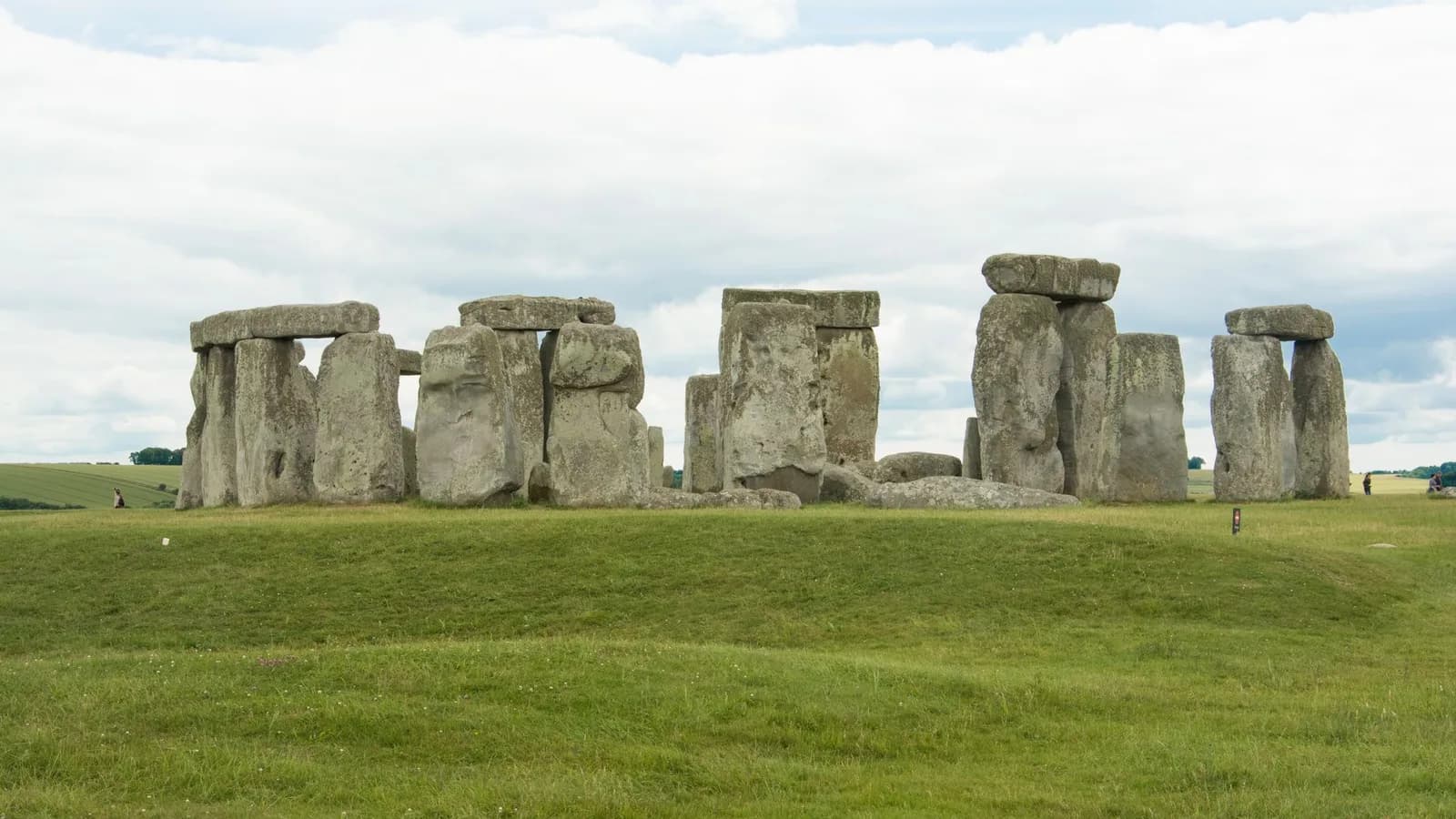
The sarsens came from West Woods on the Marlborough Downs, about twenty-five kilometres away.
Stonehenge is not one monument. It is a sequence of them, built and rebuilt on the same spot over roughly fifteen hundred years, and almost every confident statement about it applies to only one phase.
The sequence
Around 3000 BC: a circular ditch and bank with a ring of pits inside it. At this stage there are no large standing stones. Cremated human remains were placed in and around the pits.
Around 2500 BC: the sarsens arrive. The great trilithons and the outer circle with its continuous lintel ring are erected. This is the monument everyone pictures.
The bluestones — the smaller stones — are moved and rearranged repeatedly across the whole span, which is one reason the site is so hard to read.
Where the stones came from
The sarsens were traced in 2020 by geochemical fingerprinting to West Woods on the Marlborough Downs, roughly twenty-five kilometres north. Fifty of the fifty-two surviving sarsens share a chemical signature, meaning they came from one place at one time.
The bluestones come from the Preseli Hills in Pembrokeshire, around 250 kilometres away, and specific outcrops have been identified. Quarrying evidence has been excavated at Craig Rhos-y-felin and Carn Goedog.
And in August 2024 the Altar Stone — the large recumbent sandstone at the centre — was shown by mineral analysis to come not from Wales but from the Orcadian Basin in north-east Scotland, some 750 kilometres away.
Why the Altar Stone finding matters
Because it changes the scale of the network rather than the mechanics.
A stone moved from northern Scotland to Salisbury Plain in the third millennium BC implies contact, coordination and probably sea transport across the whole length of Britain. That is a statement about Neolithic society, and it was produced by looking at zircon grains under a microscope.
It is also a good demonstration of how this field actually moves: not by a new theory, but by a new measurement overturning something everyone had assumed for a century.
Durrington Walls
Three kilometres from Stonehenge is a henge enclosure that held one of the largest Neolithic settlements known in northern Europe.
Excavation found house floors, hearths, and enormous quantities of animal bone and pottery — evidence of feasting on a scale that implies people gathering from a wide area.
Isotope analysis of the cattle and pig bones shows animals brought from across Britain, some from hundreds of kilometres away. Tooth analysis of pigs indicates midwinter slaughter.
The picture that emerges is of a landscape rather than a monument: a place of the living in timber at Durrington, a place of the dead in stone at Stonehenge, connected by the river and by avenues, with people travelling to it in midwinter.
The astronomy, stated carefully
The solstitial axis is real and is not in dispute. The monument is aligned on the midsummer sunrise in one direction and the midwinter sunset in the other.
Evidence from nearby Durrington Walls — animal bones showing midwinter slaughter — suggests the midwinter alignment was the important one, which inverts the modern festival emphasis.
Join the discussion
Still open on this one:
- 01
How was the Altar Stone transported?
Sea transport around the coast is the likeliest route and is not demonstrated. It is now the single most interesting open question at the site.
Be the first to comment
Sources
Open them and check for yourself. Where a record is public, it is linked.
Stonehenge, Avebury and Associated Sites
UNESCO World Heritage Centre
The National Heritage List for England
Historic England
Related
Psychic Phenomena
The Nine: who — or what — were they?
On New Year’s Eve 1952, in a laboratory in Maine, a voice announced itself as one of nine. Over the next forty years it reached a credentialled scientist, a celebrity psychic, a bestselling book and the creator of Star Trek. This is what is documented, and what is not.
Psychic Phenomena
New Year’s Eve 1952: the first session with the Nine
The founding event of the whole Nine phenomenon happened in a Maine farmhouse on 31 December 1952. Here is what the record supports about that evening, and how much of the familiar account was written down much later.
Psychic Phenomena
D. G. Vinod: the man at the beginning of the Nine
Every version of the Nine story starts with Dr D. G. Vinod in a trance in Maine. He is also the person that story then almost entirely forgets. Why the first channel is the biggest hole in the record.

Psychic Phenomena
Andrija Puharich: the doctor who kept turning up
A qualified physician, an inventor with real patents, an army medical officer — and the constant in forty years of the strangest story in American parapsychology. Puharich is the reason the Nine keep touching institutions.
0 comments