

Akhenaten’s elongated head: anatomy, art or symbolism?
The pharaoh is shown with a long skull, a long face and a heavy body, and so are his wife and daughters. Three explanations compete — real anatomy, artistic convention, religious symbolism — and one skull that can actually be measured decides more than any of the arguments.
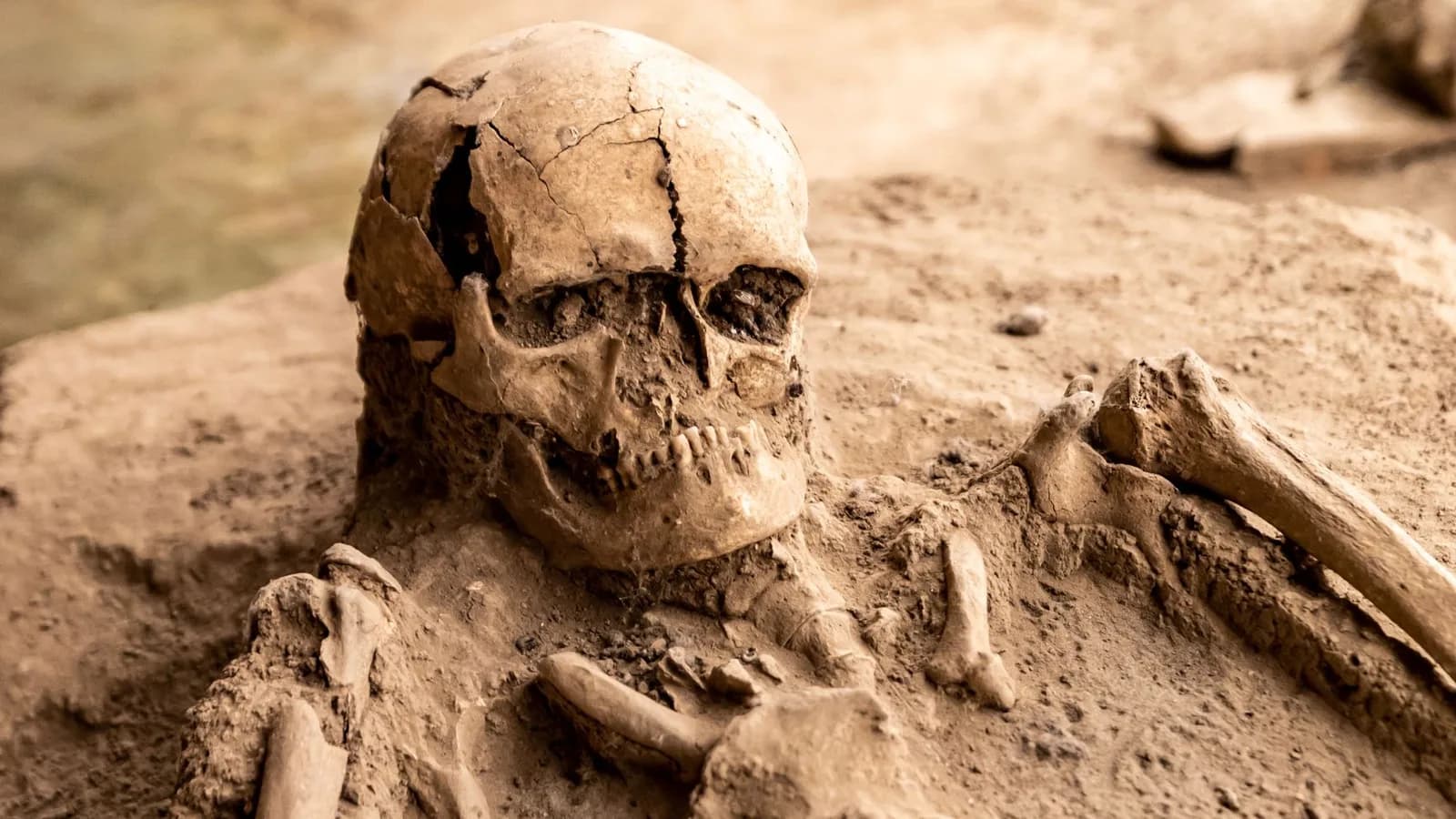
Photo by Zehra Rekibe Başol on Pexels
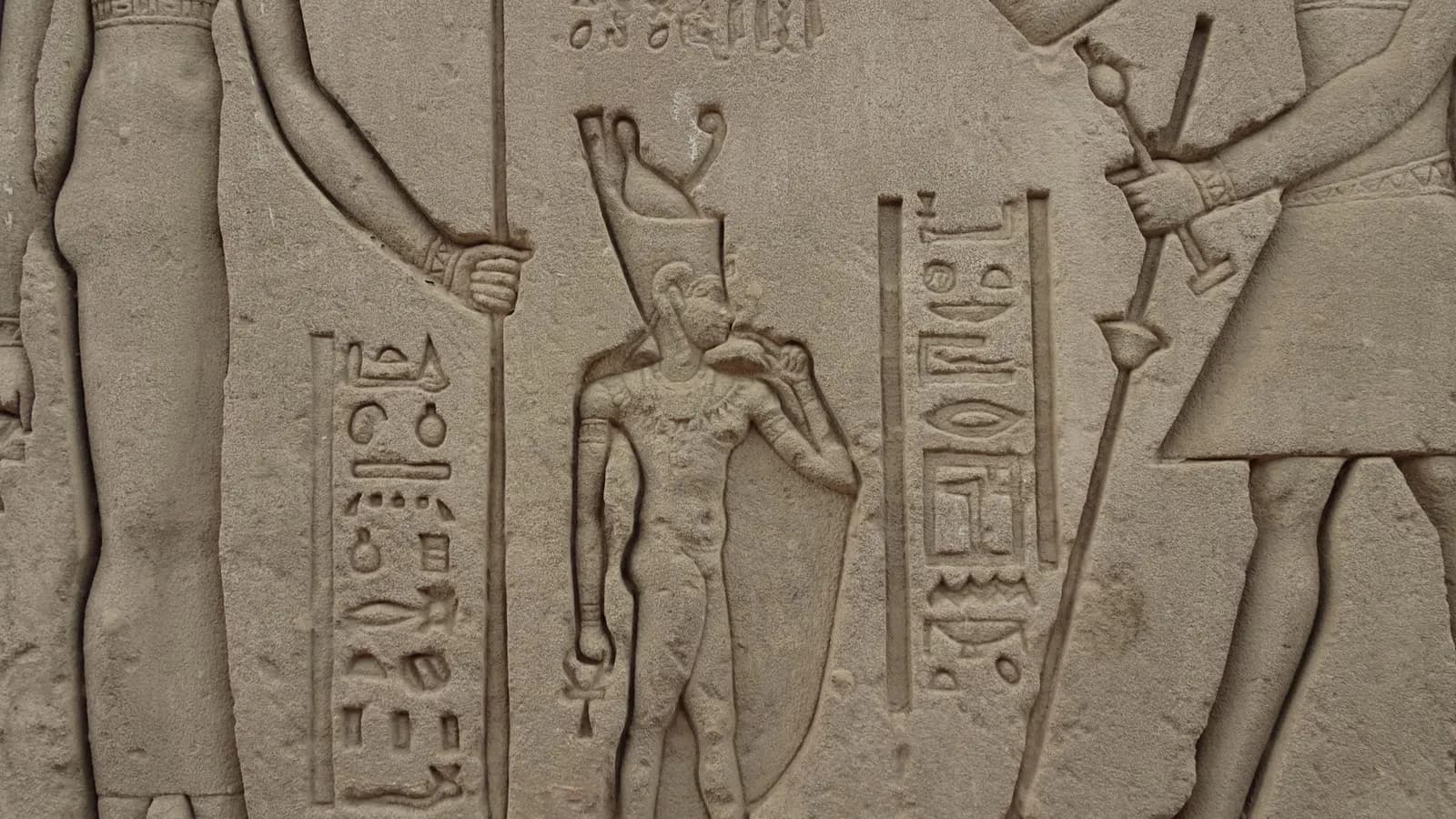
For about seventeen years in the fourteenth century BC, Egyptian royal art broke its own rules. Amenhotep IV, who renamed himself Akhenaten, moved his capital to a virgin site in Middle Egypt and had himself depicted in a way no pharaoh had been depicted before: elongated skull, long narrow face, heavy thighs, a soft belly, narrow sloping shoulders. His wife Nefertiti and their daughters were shown the same way, with markedly extended crania.
Three explanations have been offered, and they are not equally testable.
Explanation one: he really looked like that
The medical case was put most carefully in 2009, when Braverman, Redford and Mackowiak published an analysis in the Annals of Internal Medicine arguing that the features were realistic and shared across several members of the eighteenth dynasty.
Their proposal was either aromatase excess syndrome combined with sagittal craniosynostosis syndrome — the second of which would produce a genuinely elongated skull by fusing the mid-line suture early — or a variant of Antley–Bixler syndrome caused by a novel mutation in genes controlling the P450 enzymes.
It is a serious paper and it made a testable prediction. Then it was tested.
What the bodies say
In 2010 Hawass and colleagues published the results of CT scanning and genetic work on eleven royal mummies in JAMA. Their conclusion on this specific question is unambiguous: "No signs of gynecomastia and craniosynostoses (eg, Antley-Bixler syndrome) or Marfan syndrome were found, but an accumulation of malformations in Tutankhamun’s family was evident."
The same study identified the mummy from tomb KV55 and the "Younger Lady" from KV35 as the parents of Tutankhamun, and the team took KV55 to be Akhenaten.
The measurement almost nobody quotes
Set the identity question aside for a moment, because the skull itself is informative either way.
R. G. Harrison’s anatomical examination of the KV55 remains, published in the Journal of Egyptian Archaeology in 1966, recorded an endocranial volume of about 1,672 millilitres — comfortably normal — and a cephalic index of 81.0. A cephalic index above 80 means the skull is slightly broad relative to its length. Tutankhamun’s has been given as 83.9.
That is a stronger finding than any of the diagnostic arguments, because it does not depend on getting a syndrome right. It only requires that a picture of a long head should be matched by a long head.
Explanation two: it was cranial modification
The obvious next thought, given how much of this series is about head binding, is that the Amarna royals bound their children’s heads.
A 2023 review in Cureus went through the case and came down against it, treating the elongation as artistic and symbolic — intended to set the king apart from ordinary humanity rather than to record a procedure.
The archaeology supports that reading in a negative but useful way. Akhenaten’s city was excavated, including its ordinary dead: the Amarna Project dug the South Tombs Cemetery between 2005 and 2013, recovering 381 graves and the full or partial remains of some 494 people, out of an estimated 6,000 burials. The published picture is of a poor, hard-worked population — low adult stature, frequent enamel hypoplasia, severe spinal trauma, heavy degenerative joint disease, most bodies rolled in stick mats rather than coffined.
What those reports do not describe is artificial cranial modification. Head shaping is not attested as a custom in dynastic Egypt in the way it is attested in Peru, the Andes or the Carpathian Basin. So there is no community practice at the capital for the royal family to have been participating in.
Explanation three: it was theology, and it was directed
The third explanation is the strongest, and it has a primary source behind it.
A rock stela at Aswan shows the sculptor Bek with his father Men, who had served Amenhotep III. On it Bek describes himself as the apprentice whom his majesty taught. The chief royal sculptor is stating, in his own inscription, that the king personally instructed him.
That is as close as Egyptology gets to a signed statement that the style was designed rather than observed. And a designed style can be read.
Akhenaten’s religion made the Aten the sole god and the king its only interpreter. A body shown as neither ordinary man nor ordinary woman — swollen hips and belly, an extended cranium, a face unlike any subject’s — makes a theological claim in stone: this person is not in the same category as you.
The style also changed. The most extreme treatment belongs to the earliest years, in the colossal statues from his Aten temple at Karnak. At Akhetaten itself, in the later years, the same features are markedly softened; Thutmose’s workshop there produced the Nefertiti bust, which is not exaggerated at all. A congenital syndrome does not moderate over a decade. A house style does.
When did he become an alien?
The claim that the Amarna images record a non-human or hybrid pharaoh is now a fixture of ancient-astronaut television and of a large recycled literature online.
We tried to find where it started, and could not. There is no identifiable first publication, no named originator and no date that we could verify. It appears already formed, cited to nobody. That is worth stating plainly rather than papering over: the earliest source for one of the most repeated claims about Akhenaten is, on our search, simply missing.
The rule this case exists to teach
Never use artwork as evidence of anatomy without saying that is what you are doing.
Egyptian art was a system of conventions, not a camera. Kings were shown young and athletic into old age; enemies were shown small; the same body could be drawn in profile with a frontal eye and shoulders. The Amarna style broke with the earlier conventions and immediately established new ones. Reading it as photography is a category error whichever conclusion you reach with it.
What we know
That the Amarna royal images are stylistically consistent, deliberate, and — on the sculptor’s own inscription — instructed by the king. That the style was at its most extreme early and was softened later. That the 2010 CT and genetic study found no gynaecomastia, no craniosynostosis and no Marfan syndrome in the mummies it examined. That the KV55 skull is normal in volume and slightly broad rather than elongated. That artificial cranial modification is not a documented dynastic Egyptian practice.
What we do not know
Who KV55 is. Whether Akhenaten’s body survives at all. What he actually looked like, since no securely identified remains exist to be examined. Whether any of the physical peculiarities in the images corresponds to something real in a family that we now know was closely inbred — the 2010 study recorded an accumulation of malformations in the lineage, and that finding has not gone away.
And who first said he was not human. That one should be findable, and we could not find it.
Buried Evidence
Continue the investigation
- 01Did ancient people shape their heads to resemble their gods?It is the most repeated explanation for head binding and it is almost never sourced. Run it as a test instead: what would count as evidence, and how many of the societies that shaped heads actually meet the standard?
- 02Yonaguni: a submerged monument, or a very tidy rock?Off the coast of a Japanese island lies a formation with terraces, right angles and what look like steps. Two credentialled scientists have looked at the same rock and reached opposite conclusions. Here is what each of them is actually arguing.
- 03Bimini Road: the prophecy that found what it went looking forA line of squared blocks under shallow Bahamian water, found in 1968 — exactly when a famous psychic had predicted Atlantis would begin to reappear. The geology is settled. The story of how it was found is the interesting part.
What we could not settle
Loose ends we are still working on.
- 01
If the art was ordered by the king, what was he trying to say?
His own chief sculptor wrote that the king taught him. So the strange bodies were a decision, not a diagnosis. What would you be trying to tell people if you had yourself drawn as neither a man nor a woman and nothing like your subjects?
- 02
Who first claimed Akhenaten was not human?
The idea is everywhere and nobody cites anyone for it. We searched and came up empty. Somewhere there is a first book, article or broadcast that said it, and finding it would settle a lot.
- 03
Is the body in tomb KV55 Akhenaten or not?
It has been argued about since 1907, mostly over how old the man was when he died. One side says early twenties, which rules him out. The other says middle-aged. The bones are still there and the question is still open.
Got something to add?
A question, a source we missed, a correction, or something you saw yourself — all of it is welcome here. You do not need to be an expert, and you are allowed to disagree with us.
Nobody has yet — go on.
See also
Everything this piece touches
Sources
Open them and check for yourself. Where a record is public, it is linked.
Ancestry and pathology in King Tutankhamun’s family
Hawass et al., JAMA, 2010
Akhenaten and the strange physiques of Egypt’s 18th dynasty
Braverman, Redford and Mackowiak, Annals of Internal Medicine, 2009
Turner, Cureus, 2023
The Amarna Project
Biological age of skeletonized mummy from Tomb KV 55 at Thebes (Egypt)
Strouhal, Anthropologie, 2010
Related
Egypt
The Dendera "light bulb": what the inscription beside it says
A relief in a crypt at Dendera resembles an electric lamp. It is one of the few ancient-technology claims that can be checked directly, because the Egyptians wrote the answer on the wall next to it.
Egypt
The Sphinx water erosion hypothesis: the argument and the objections
A geologist argued the weathering on the Sphinx enclosure was made by rain, requiring a date thousands of years earlier than Egyptology allows. The argument is real and published. So are the reasons it has not been accepted.
Archaeological Mysteries
Why did cultures across the world bind their children's skulls?
Palaeolithic Italy, Iron Age Scythia, the Andes, the Maya lowlands, the Congo, Vanuatu, the Columbia River and rural France. Laid side by side, the cases answer a sharper question than "why" — did anybody teach anybody else?
Archaeological Mysteries
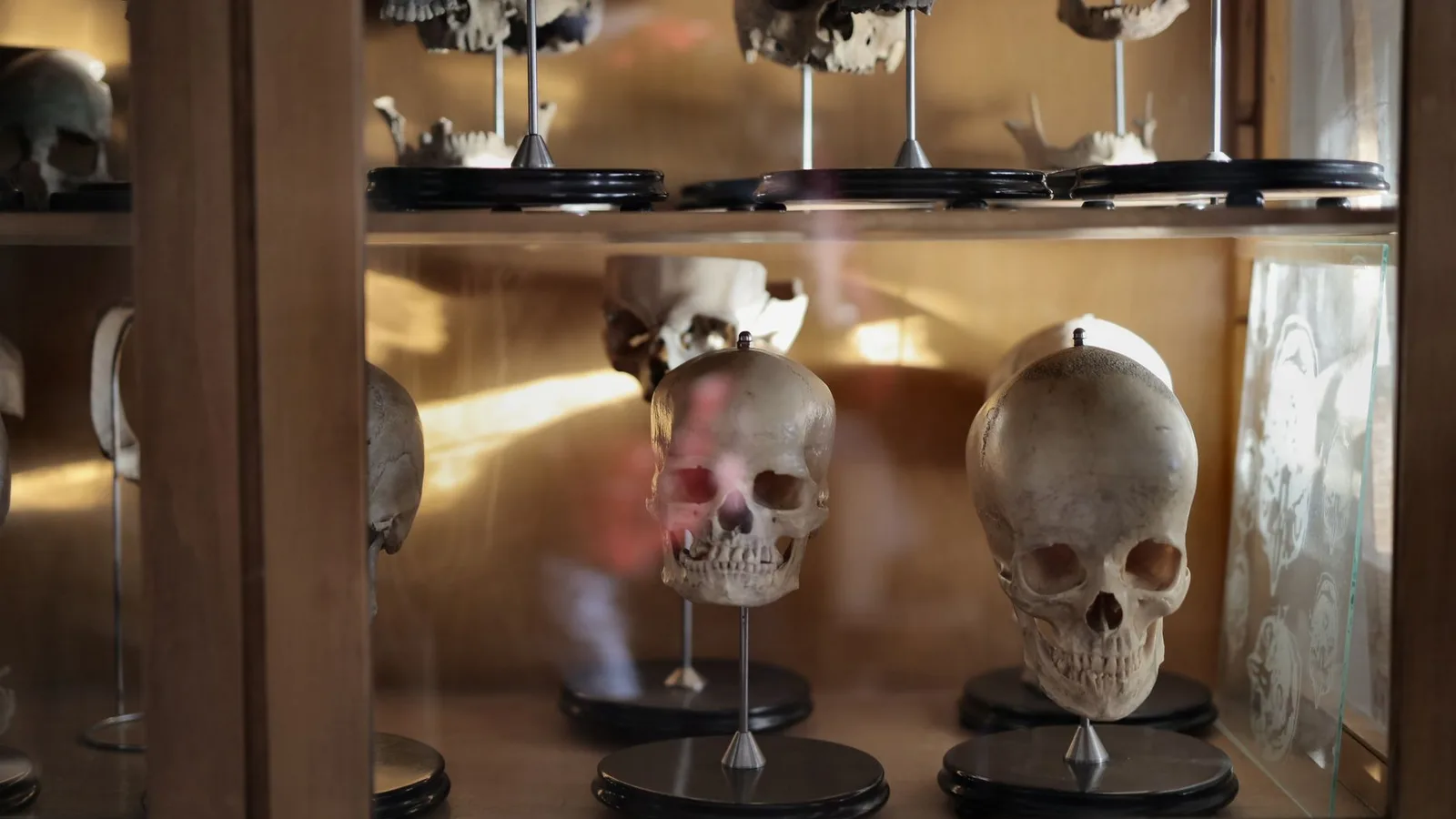
Elongated skulls: why did ancient humans change the shape of their heads?
Thousands of them, across five continents and twelve thousand years. Nobody serious disputes that people did this to their own children, or how. The argument is about why — and the answer everyone repeats turns out to be the least documented one.
0 comments