

The Dendera "light bulb": what the inscription beside it says
A relief in a crypt at Dendera resembles an electric lamp. It is one of the few ancient-technology claims that can be checked directly, because the Egyptians wrote the answer on the wall next to it.
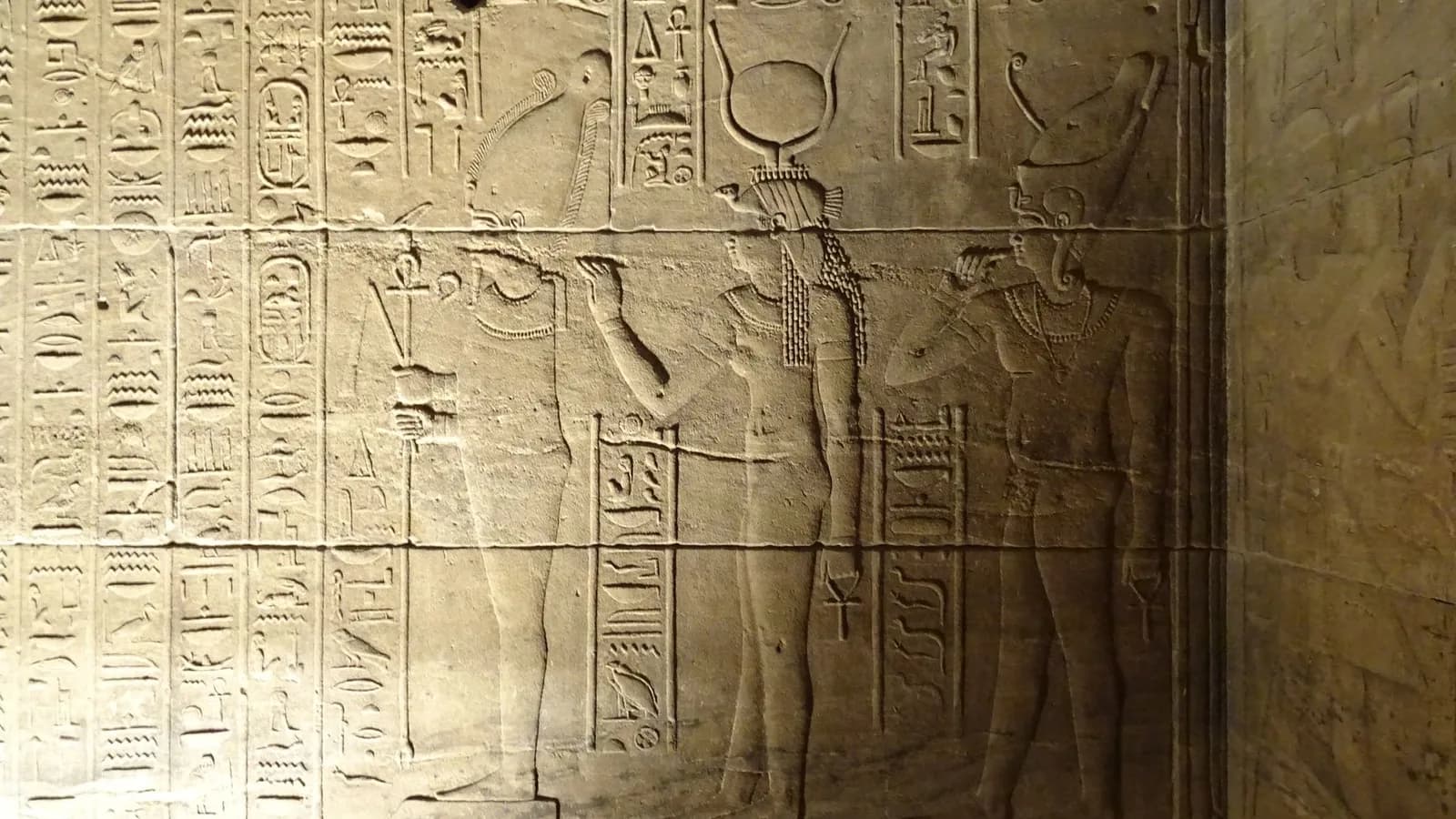
Reliefs in Egyptian temples are almost always accompanied by texts identifying what is shown.
In a crypt beneath the Temple of Hathor at Dendera there are reliefs showing an elongated bulb-like shape containing a snake, resting on or emerging from a stylised lotus flower, with a supporting pillar figure beside it.
The resemblance to a Crookes tube or an early incandescent lamp is genuine, and the reading that this depicts electrical technology has been in circulation for decades.
It is unusually easy to test, because Egyptian temple reliefs are captioned.
What is documented
The temple is Ptolemaic, largely first century BC, built over a much older sacred site. The crypts held cult objects and their walls carry ritual scenes.
The reliefs are accompanied by hieroglyphic text. The text is legible, has been translated, and describes a creation scene: the lotus from which the sun emerges, the serpent as a form of the newborn sun god, and the djed pillar supporting it.
The bulb
The enclosing shape has been read as a glass envelope. In Egyptological terms it is generally understood as a representation of the lotus flower or of the primeval hill and waters from which creation emerges — the serpent contained within the thing that produces it.
The "cable" running to it is the lotus stem, which is drawn the same way in scenes that contain no bulb at all.
How Egyptian tombs were actually lit
The soot argument is worth taking apart properly, because it is the one piece of the case that is not about the relief.
Egyptian lamps burned oil, usually castor or sesame, with a wick of twisted linen. Adding salt to the oil substantially reduces smoke, and the practice is described in classical sources.
Soot has in fact been identified in tombs, examined and published — including deposits that have been radiocarbon dated to establish when work was carried out. The premise that tombs are soot-free is simply incorrect.
Polished copper or bronze mirrors were also used to reflect daylight down passages, relayed from one to the next. It works, it has been demonstrated in situ, and it leaves no residue at all.
The engineering objections
Separate from the text, and worth stating because they stand alone.
An electric lighting system requires a power source, conductors, an evacuated envelope and a filament. No component of any of these has been recovered from Egypt. No workshop, no failed prototype, no waste from manufacture, no text describing production.
The argument usually advanced for electric light — that tombs show no soot — has a documented answer. Egyptian lamps burned oil with salt added, which greatly reduces smoke, and soot deposits have in fact been found in tombs and studied. Polished reflectors were also used to direct daylight into passages.
Join the discussion
Still open on this one:
- 01
Why is the serpent enclosed in this particular way here?
The iconographic elements are standard; the specific composition is less common. That is a real question in Egyptian art history, and a much smaller one than electricity.
Be the first to comment
Sources
Open them and check for yourself. Where a record is public, it is linked.
British Museum
National Archaeological Museum, Athens
Hellenic Ministry of Culture
Related
Psychic Phenomena
The Nine: who — or what — were they?
On New Year’s Eve 1952, in a laboratory in Maine, a voice announced itself as one of nine. Over the next forty years it reached a credentialled scientist, a celebrity psychic, a bestselling book and the creator of Star Trek. This is what is documented, and what is not.
Psychic Phenomena
New Year’s Eve 1952: the first session with the Nine
The founding event of the whole Nine phenomenon happened in a Maine farmhouse on 31 December 1952. Here is what the record supports about that evening, and how much of the familiar account was written down much later.
Psychic Phenomena
D. G. Vinod: the man at the beginning of the Nine
Every version of the Nine story starts with Dr D. G. Vinod in a trance in Maine. He is also the person that story then almost entirely forgets. Why the first channel is the biggest hole in the record.
Psychic Phenomena
Andrija Puharich: the doctor who kept turning up
A qualified physician, an inventor with real patents, an army medical officer — and the constant in forty years of the strangest story in American parapsychology. Puharich is the reason the Nine keep touching institutions.
0 comments