

The Sphinx water erosion hypothesis: the argument and the objections
A geologist argued the weathering on the Sphinx enclosure was made by rain, requiring a date thousands of years earlier than Egyptology allows. The argument is real and published. So are the reasons it has not been accepted.
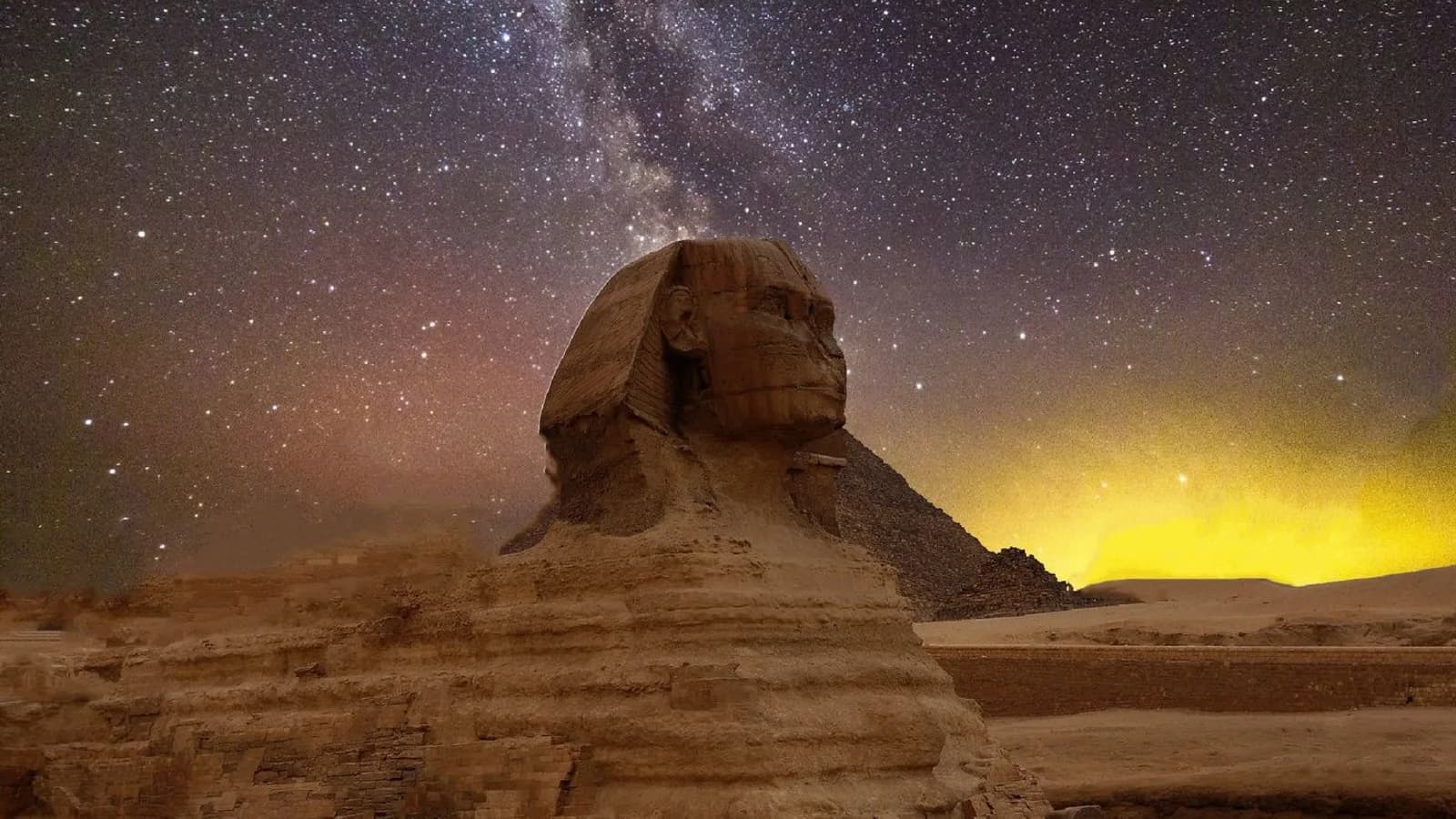
The Sphinx enclosure was cut down into bedrock, leaving walls that weather independently of the statue.
The Great Sphinx is conventionally dated to the reign of Khafre, around 2500 BC, on the basis of its position within his pyramid complex, the causeway alignment, and the quarrying sequence at Giza.
In the early 1990s the geologist Robert Schoch argued the weathering pattern on the walls of the enclosure cut around the Sphinx was produced by prolonged rainfall rather than wind and sand — which would push the carving back to a wetter period, potentially several thousand years earlier.
It is the most serious challenge to Egyptian chronology to come from outside Egyptology, and it deserves the argument rather than dismissal.
What the hypothesis says
The enclosure walls show deep vertical fissures with rounded profiles. Schoch argued this is the signature of water running down a rock face over a long period — a pattern distinct from the horizontal, undercut banding that wind-driven sand produces.
Egypt was substantially wetter before around 3000 BC. If the weathering requires heavy rain, the carving must predate the drying, and 2500 BC will not do.
The objections
They are specific, and they come from more than one direction.
The Sphinx and its enclosure are cut into layered limestone of markedly varying hardness. Softer beds erode faster whatever the agent, which can produce a fissured profile without requiring rain. Egyptologists and other geologists have argued the pattern reflects the rock rather than the climate.
The archaeology is the harder problem for the hypothesis. Giza is not an isolated statue. The Sphinx sits inside a quarry whose blocks were used in adjacent structures, and the stratigraphy ties the carving into a construction sequence.
And there is nothing else. A civilisation capable of the Sphinx in 7000 BC would leave settlements, pottery, tools, burials and a hundred other things across Egypt. None has been found, and Egypt is among the most thoroughly excavated places on earth.
The dating methods that do apply
Weathering is not the only way to date the Sphinx, and the alternatives are what give Egyptology its confidence.
The enclosure was cut from bedrock, and the removed blocks were used in the Sphinx Temple immediately in front of it and in the Valley Temple beside it. Those temples are architecturally and stratigraphically tied to Khafre's complex. Quarry and building are one operation.
The causeway from Khafre's pyramid runs to the Sphinx enclosure, and the layout is integrated rather than adapted.
Workers' settlements at Giza have been excavated, with bakeries, breweries, dormitories and cemeteries, and dated by ceramics and radiocarbon to the Fourth Dynasty. There is a labour force in the right place at the right time.
Where this leaves it
Schoch published in peer-reviewed venues and presented at the Geological Society of America. This is not fringe in the sense of being kept out; it was heard and not accepted.
The strongest honest position is that the weathering question is a live geological argument and the early date is not carried by it, because a date has to satisfy the geology, the stratigraphy and the total absence of a civilisation — and only the first is in play.
Join the discussion
Still open on this one:
- 01
Is there a rock-composition explanation that fully accounts for the fissuring?
This is the crux and it is a geological question that could in principle be settled by detailed bed-by-bed analysis of the enclosure walls.
Be the first to comment
Sources
Open them and check for yourself. Where a record is public, it is linked.
Memphis and its Necropolis — the Pyramid Fields
UNESCO World Heritage Centre
British Museum
Related
Psychic Phenomena
The Nine: who — or what — were they?
On New Year’s Eve 1952, in a laboratory in Maine, a voice announced itself as one of nine. Over the next forty years it reached a credentialled scientist, a celebrity psychic, a bestselling book and the creator of Star Trek. This is what is documented, and what is not.

Psychic Phenomena
New Year’s Eve 1952: the first session with the Nine
The founding event of the whole Nine phenomenon happened in a Maine farmhouse on 31 December 1952. Here is what the record supports about that evening, and how much of the familiar account was written down much later.
Psychic Phenomena
D. G. Vinod: the man at the beginning of the Nine
Every version of the Nine story starts with Dr D. G. Vinod in a trance in Maine. He is also the person that story then almost entirely forgets. Why the first channel is the biggest hole in the record.
Psychic Phenomena
Andrija Puharich: the doctor who kept turning up
A qualified physician, an inventor with real patents, an army medical officer — and the constant in forty years of the strangest story in American parapsychology. Puharich is the reason the Nine keep touching institutions.
0 comments