

Numbers stations: the one conspiracy theory that was proved in open court
Voices reading digits on shortwave for decades, to nobody who will admit to listening. It sounds like the purest paranoia. Then a Miami courtroom decrypted one live in 2001.
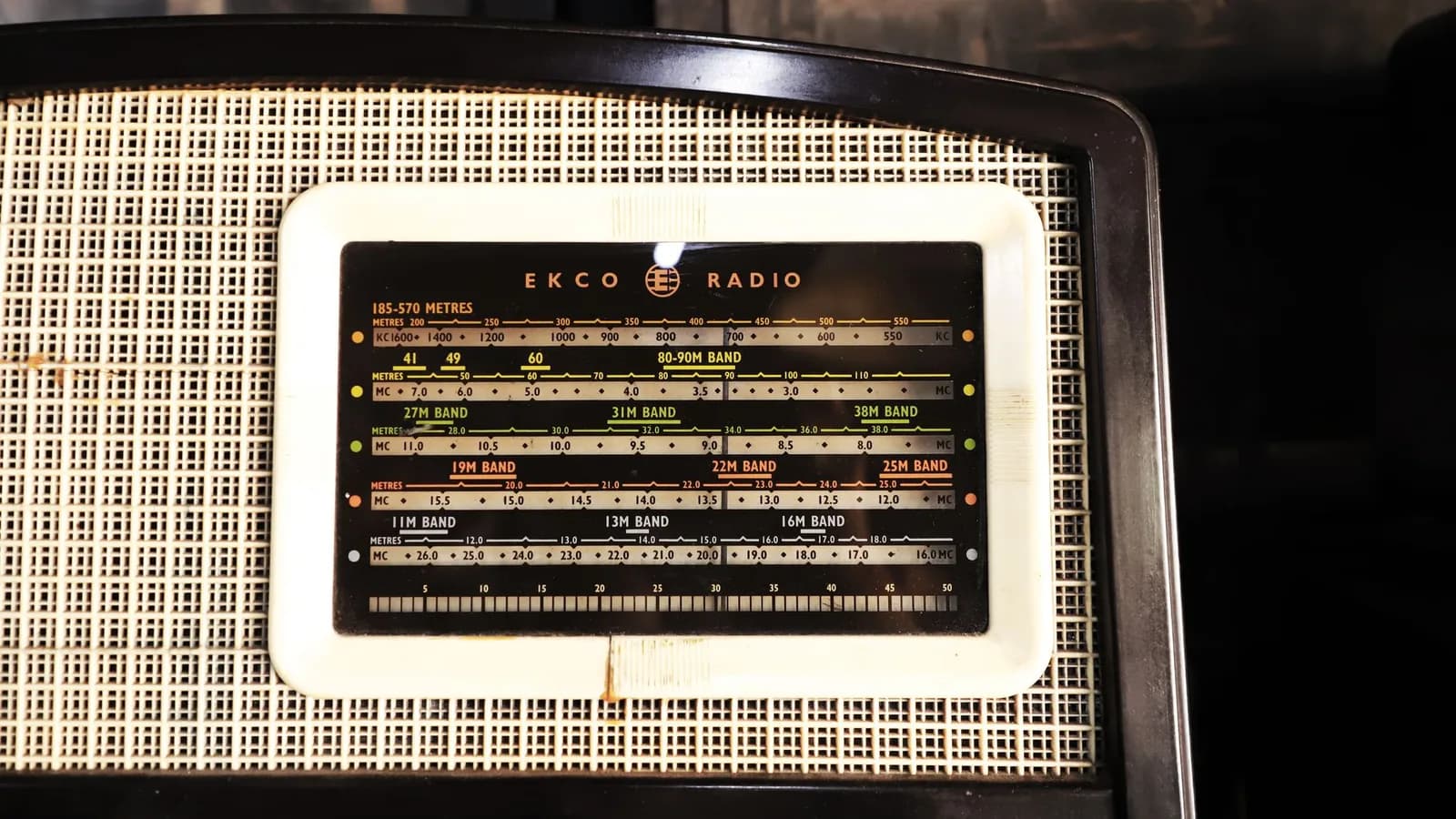
The frequency dial of a vintage radio receiver. The format survives because a radio being listened to gives off nothing that can be detected, and leaves no record of who tuned in.
Somewhere on the shortwave bands, a voice reads out groups of digits. It repeats them for half an hour and stops. There is no station identification, no explanation, and no acknowledgement from any government that the transmission exists.
This has been going on since the 1950s at least, and in some form since the First World War. Almost every element of it sounds like invention, and almost all of it is documented.
What the transmissions are
The classic format is a call-up — a repeated identifier, sometimes a snatch of music, sometimes a spoken word — followed by a count of message groups, followed by the groups themselves, usually five digits at a time, read twice.
The best-known English one was catalogued by listeners as E03 and nicknamed the Lincolnshire Poacher, after the folk tune whose opening bars preceded each transmission. A female voice read groups of five, raising the pitch on the last digit of each. Amateur direction-finding placed its transmitter at the RAF base at Akrotiri in Cyprus. It went off the air in July 2008. A companion station covering the Pacific, nicknamed Cherry Ripe, worked the same way.
The Cuban equivalent, catalogued V02 and later HM01, opens with the Spanish word for attention. It is still running.
The court case
The reason this subject is not speculation is a federal prosecution in Miami.
In 1998 the FBI arrested members of what it called the Wasp Network, a group of Cuban intelligence officers operating in Florida. The prosecution went to trial and the defendants were convicted in 2001.
The FBI had entered one of the apartments covertly in 1995 and copied the decryption software from a computer there. At trial, prosecutors played recordings of the Cuban station and produced the decrypted plaintext of the messages the defendants had received.
That put the entire mechanism into open evidence: a shortwave broadcast of digits, a handheld receiver, a laptop, a key, and operational instructions to an agent in another country. It is the only occasion on which a numbers station has been publicly decrypted, and it settled what they are for.
Why anyone still uses shortwave
Because the method has one property that nothing built since can match. A radio receiver in listening mode emits nothing. There is no connection to trace, no server to subpoena, no account to seize, no metadata at all. A person with a cheap receiver is indistinguishable from a person with a cheap receiver.
Paired with a genuine one-time pad — a key as long as the message, used once and destroyed — the traffic is not merely difficult to break. It is mathematically impossible to break, and that result has been known since 1949.
What defeated the Wasp Network was not the cipher. It was a physical entry that took the key. That is the standing weakness of the system and always has been.
It also explains why short intercepted texts stay unread. The pencilled letters found with the Somerton Man are usually called a cipher; the more likely reading is that they are too short to carry enough structure to attack at all. Length is what cryptanalysis feeds on, and numbers stations are designed to give it none.
What is claimed beyond the evidence
The attributions. Enthusiast catalogues assign stations to specific agencies with a confidence that direction-finding does not support: a bearing gives you a transmitter site, not an operator, and shared transmitter facilities are normal.
Beyond that sit the theories that these are mind-control carriers, or a nuclear dead-hand system, or messages to something other than people. Nothing in the signals supports any of it.
What is genuinely unknown
For every station except the Cuban one: who operates it, and what was said. The traffic is unbreakable by design and the operators do not comment. That is not a cover-up; it is the intended outcome of the design.
Join the discussion
Still open on this one:
- 01
Has any numbers station other than the Cuban one been decrypted publicly?
No. The Miami trial remains the only case where plaintext entered the public record.
Be the first to comment
See also
Everything this piece touches
Sources
Open them and check for yourself. Where a record is public, it is linked.
Related
Psychic Phenomena
The Nine: who — or what — were they?
On New Year’s Eve 1952, in a laboratory in Maine, a voice announced itself as one of nine. Over the next forty years it reached a credentialled scientist, a celebrity psychic, a bestselling book and the creator of Star Trek. This is what is documented, and what is not.
Psychic Phenomena
New Year’s Eve 1952: the first session with the Nine
The founding event of the whole Nine phenomenon happened in a Maine farmhouse on 31 December 1952. Here is what the record supports about that evening, and how much of the familiar account was written down much later.
Psychic Phenomena
D. G. Vinod: the man at the beginning of the Nine
Every version of the Nine story starts with Dr D. G. Vinod in a trance in Maine. He is also the person that story then almost entirely forgets. Why the first channel is the biggest hole in the record.
Psychic Phenomena
Andrija Puharich: the doctor who kept turning up
A qualified physician, an inventor with real patents, an army medical officer — and the constant in forty years of the strangest story in American parapsychology. Puharich is the reason the Nine keep touching institutions.
0 comments