

The Mary Celeste: which details come from the salvage court, and which from a short story
The warm meal on the table, the cat asleep, the phial of oil standing upright. None of it is in the record. All of it comes from a story Arthur Conan Doyle published in 1884.
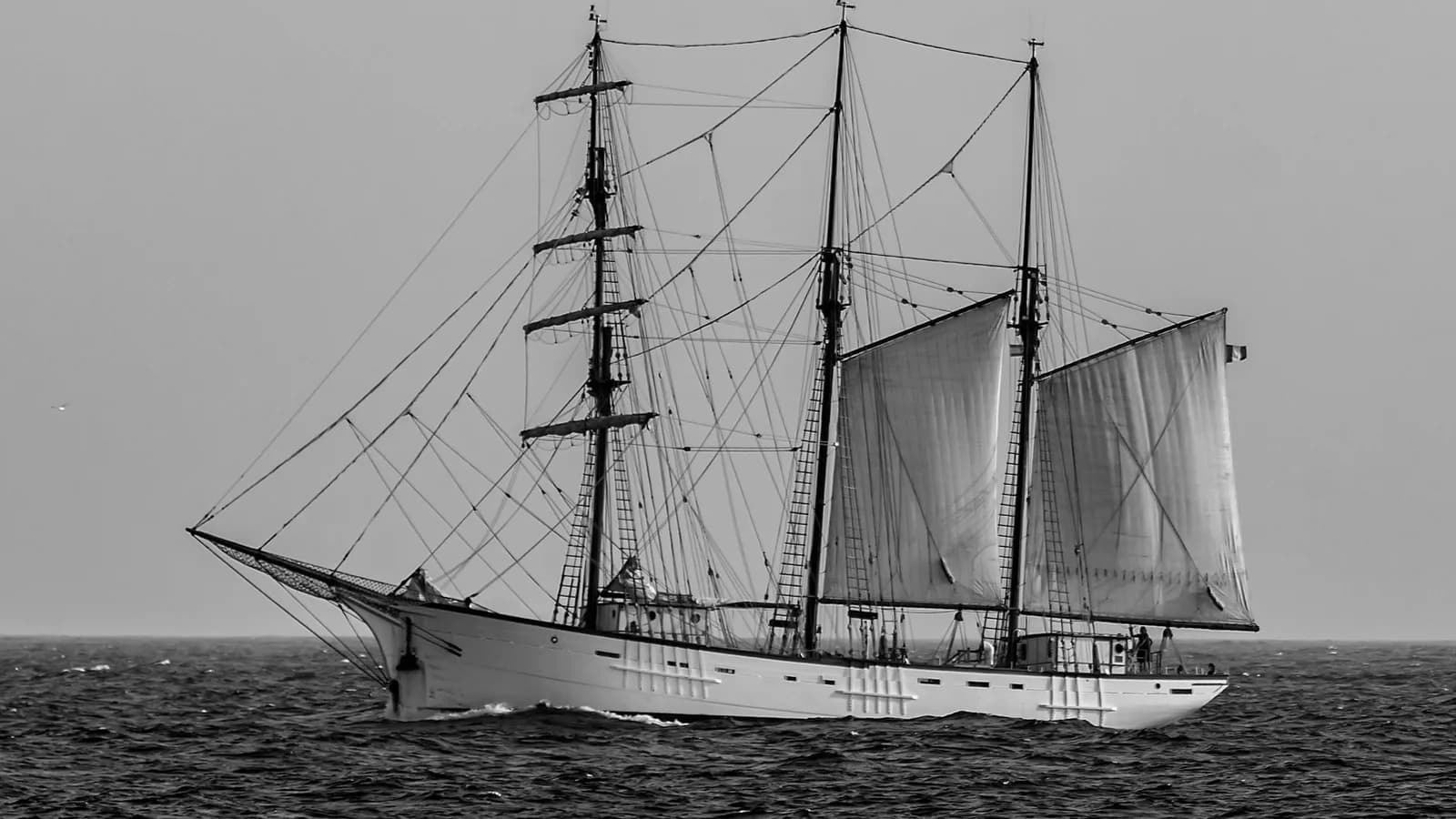
A sailing ship under canvas. The Mary Celeste was a 282-ton brigantine, and she sailed from New York on 7 November 1872 with ten people aboard.
The Mary Celeste sailed from New York on 7 November 1872, bound for Genoa. Aboard were Captain Benjamin Spooner Briggs, his wife Sarah, their two-year-old daughter Sophia, and a crew of seven. In the hold were 1,701 barrels of industrial alcohol.
A month later she was found sailing alone in the Atlantic, between the Azores and Portugal, with nobody on board. No trace of the ten people has ever been found.
Almost everything the general reader knows about that discovery is fiction, and it is possible to say precisely where the fiction was written.
What the salvage court heard
The Dei Gratia, under Captain David Morehouse, sighted her on 4 December 1872 by the ship's own reckoning. A boarding party led by the mate, Oliver Deveau, went across and gave sworn evidence at Gibraltar a few weeks later.
What Deveau described was a ship in working order and empty of people. The single lifeboat was gone. So were the chronometer, the sextant, the ship's register and the navigation book. There was around three and a half feet of water in the hold — significant, but nowhere near enough to sink her, and one of the pumps had been taken apart.
Some sails were set, some were furled, and some had blown out. A hatch cover was off. Six months of food and water remained. The crew's personal possessions were undisturbed.
The last entry on the ship's log slate was dated 25 November, putting her near the island of Santa Maria in the Azores — several hundred miles behind where she was found.
The court suspected a crime and could not find one
Frederick Solly-Flood, the Attorney General of Gibraltar, ran the salvage hearing on the assumption that the crew of the Dei Gratia had murdered the crew of the Mary Celeste, or that Briggs and Morehouse had conspired to defraud the insurers.
He had marks on the deck and a sword from the captain's cabin analysed for blood. The analysis found none. He examined the ownership and found no shared interest that would support a fraud.
The court awarded salvage in 1873, but at about a fifth of what such a salvage would normally have earned — a judgement that convicted nobody while making the bench's suspicion clear. No charge was ever brought.
Where the famous details were written
In January 1884 The Cornhill Magazine published, anonymously, a short story called "J. Habakuk Jephson's Statement". Its author was a young doctor named Arthur Conan Doyle, four years away from writing Sherlock Holmes.
The story is presented as a survivor's account. It calls the ship the Marie Celeste — Doyle changed the name, though he left the Dei Gratia's name alone — and it supplies the details that are now inseparable from the case: the meal still warm, the tea still steaming, the small domestic scene abandoned in a single instant.
It was written well enough that readers took it for reporting. Solly-Flood himself is said to have responded to it as though it were a factual claim. Within a generation the invented details had migrated into the newspapers, and from there into every retelling since.
What actually appears to have happened
The evidence supports an ordinary and frightening explanation. Alcohol leaking from porous barrels in a hot hold produces vapour. A rumble, a smell, or a hatch blown off would look to a captain like the first moment of an explosion.
The standard response is to get everyone into the boat, stand off on a tow line, and wait to see whether the ship blows up. Briggs took his wife, his daughter, his crew, his instruments and his register — which is exactly the luggage of a man expecting to come back or to have to navigate.
If the line parted in weather, an open boat in the mid-Atlantic in December has no outcome. The ship, unharmed, sails on without them.
One further correction is worth making because it is repeated constantly. The ship is routinely listed among the losses of the Bermuda Triangle. She was found between the Azores and the coast of Portugal, roughly three thousand miles from it.
What can be said with confidence is narrower and more useful. The Mary Celeste is a genuine unsolved abandonment. It is not a ghost ship with a warm dinner on the table, and it never was.
Join the discussion
Still open on this one:
- 01
Was the ship's boat ever found?
No. Every account of a recovered boat traces back to fiction or to unattributed newspaper filler. The absence is total.
- 02
Did Conan Doyle intend the story as a hoax?
He published it anonymously as fiction in a fiction magazine. The confusion came from readers and newspapers, not from a claim he made.
Be the first to comment
See also
Everything this piece touches
Sources
Open them and check for yourself. Where a record is public, it is linked.
The National Archives, Kew
The Cornhill Magazine, January 1884
Smith, Elder & Co. · no public copy located
Vice-Admiralty Court of Gibraltar, salvage proceedings, 1873
Gibraltar National Archives · no public copy located
Related
Psychic Phenomena
The Nine: who — or what — were they?
On New Year’s Eve 1952, in a laboratory in Maine, a voice announced itself as one of nine. Over the next forty years it reached a credentialled scientist, a celebrity psychic, a bestselling book and the creator of Star Trek. This is what is documented, and what is not.
Psychic Phenomena
New Year’s Eve 1952: the first session with the Nine
The founding event of the whole Nine phenomenon happened in a Maine farmhouse on 31 December 1952. Here is what the record supports about that evening, and how much of the familiar account was written down much later.
Psychic Phenomena
D. G. Vinod: the man at the beginning of the Nine
Every version of the Nine story starts with Dr D. G. Vinod in a trance in Maine. He is also the person that story then almost entirely forgets. Why the first channel is the biggest hole in the record.
Psychic Phenomena
Andrija Puharich: the doctor who kept turning up
A qualified physician, an inventor with real patents, an army medical officer — and the constant in forty years of the strangest story in American parapsychology. Puharich is the reason the Nine keep touching institutions.
0 comments