

Kenneth Arnold, 24 June 1947: the sighting that named the subject
A businessman flying his own aircraft past Mount Rainier reported nine objects moving in ways he could not account for. What he actually described, and what the newspapers turned it into, are two different things.
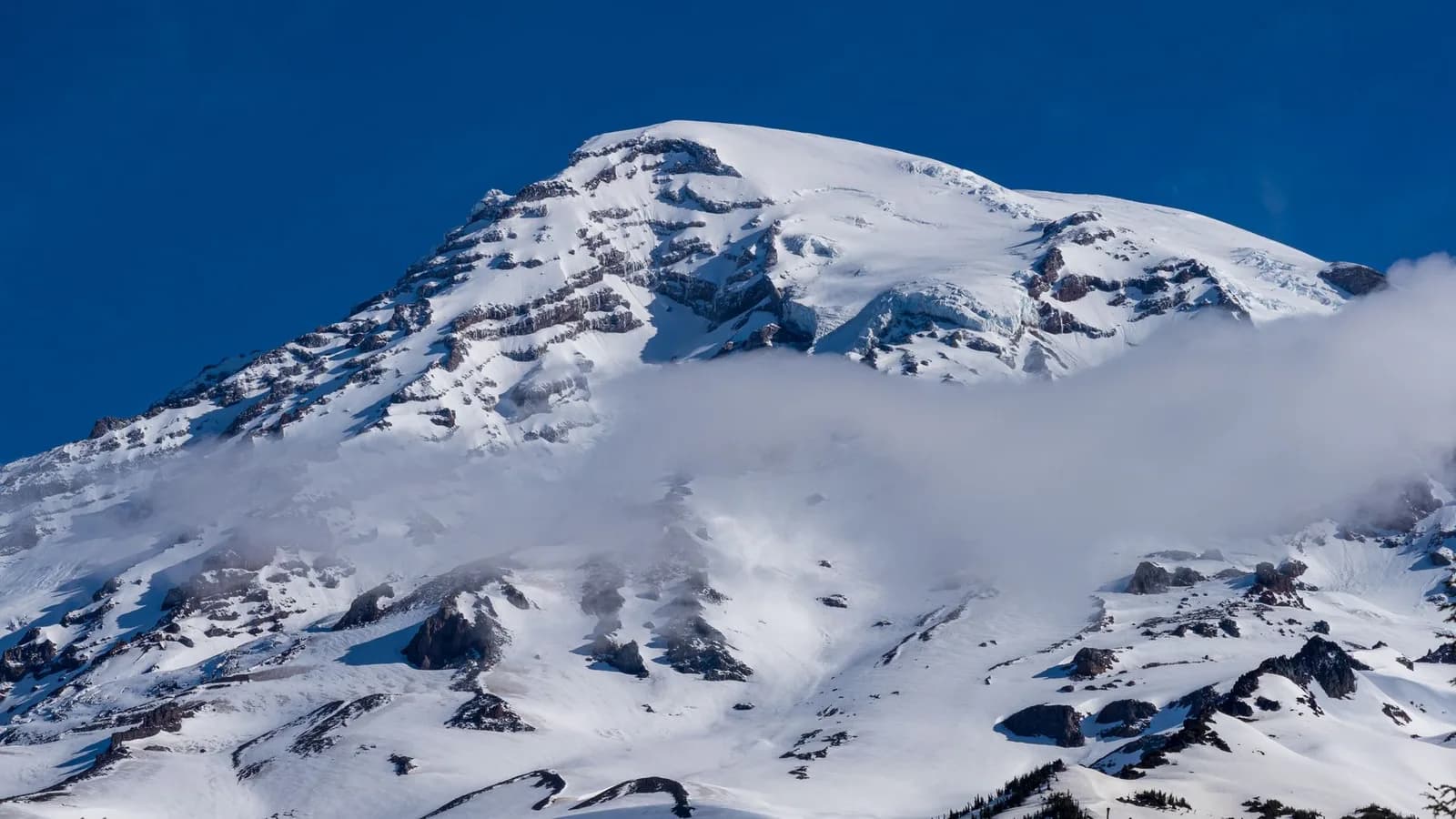
Arnold was flying near Mount Rainier in Washington State on 24 June 1947.
On the afternoon of 24 June 1947, Kenneth Arnold was flying a small aircraft near Mount Rainier in Washington State, looking for a transport plane that had gone down. He did not find it. He reported instead a formation of nine objects travelling south past the mountain at a speed he estimated in the thousands of miles per hour.
Everything in this subject dates from that afternoon — not because it was the first such report, but because it was the one the press picked up.
What is documented
Arnold was a credible witness by any ordinary standard: an experienced private pilot, a businessman selling fire-fighting equipment, a deputy sheriff, with no history of making public claims. He reported the sighting to officials at Yakima and then Pendleton, and spoke to reporters the same day.
He described the objects as flying in a chain, tilting and banking, and passing between two peaks in a time he later used to calculate their speed. He drew what he had seen, and the drawing is the key document in the case.
How the word happened
Asked how the objects moved, Arnold said they flew erratically, like a saucer would if you skipped it across water. He was describing the motion. A reporter compressed it, and within days the American press had "flying saucers".
This is worth pausing on, because it may be the single most consequential misquotation of the twentieth century. A description of movement became a description of shape, and the shape then appeared in thousands of subsequent reports.
The explanations, and how they fare
Several conventional accounts have been offered and each has a difficulty.
A mirage or atmospheric refraction could distort distant objects, but would struggle to produce nine of them in formation, tracked across a measurable distance.
A flight of pelicans has been proposed, and accounts for the undulating motion and the crescent silhouette rather well. It requires Arnold to have misjudged the distance badly — but distance is precisely what a pilot cannot judge without a known reference, and his speed calculation depends entirely on it.
Meteor fragments were suggested at the time, and do not survive the reported flight path or duration.
What Arnold did next
He did not build a career on it, which is worth knowing. He gave interviews, wrote about it, and remained consistent for the rest of his life about what he had seen — including his irritation at the word "saucer", which he corrected repeatedly and unsuccessfully.
He also grew sceptical of much of what followed. A man who watched an entire subculture form around a phrase he had not used had a clearer view than most of how these things get built.
Join the discussion
Still open on this one:
- 01
Do Arnold’s original drawings survive in their earliest form?
Several versions circulate and they differ. The earliest, made closest to the sighting, is the one that matters and its provenance is not always stated.
Be the first to comment
Sources
Open them and check for yourself. Where a record is public, it is linked.
Project Blue Book: the complete case files
US National Archives and Records Administration
Scientific Study of Unidentified Flying Objects (the Condon Report)
University of Colorado, full text at the National Capital Area Skeptics · 1 Jan 1968
The UFO Experience: A Scientific Inquiry
J. Allen Hynek, Henry Regnery · 1 Jan 1972 · no public copy located
Related

Psychic Phenomena
The Nine: who — or what — were they?
On New Year’s Eve 1952, in a laboratory in Maine, a voice announced itself as one of nine. Over the next forty years it reached a credentialled scientist, a celebrity psychic, a bestselling book and the creator of Star Trek. This is what is documented, and what is not.

Psychic Phenomena
New Year’s Eve 1952: the first session with the Nine
The founding event of the whole Nine phenomenon happened in a Maine farmhouse on 31 December 1952. Here is what the record supports about that evening, and how much of the familiar account was written down much later.

Psychic Phenomena
D. G. Vinod: the man at the beginning of the Nine
Every version of the Nine story starts with Dr D. G. Vinod in a trance in Maine. He is also the person that story then almost entirely forgets. Why the first channel is the biggest hole in the record.

Psychic Phenomena
Andrija Puharich: the doctor who kept turning up
A qualified physician, an inventor with real patents, an army medical officer — and the constant in forty years of the strangest story in American parapsychology. Puharich is the reason the Nine keep touching institutions.
0 comments