

George Adamski: the man who invented the contactee
A man who ran a hamburger stand near Mount Palomar said he met a Venusian in the desert. His photographs are almost certainly household objects. His template is still in use.
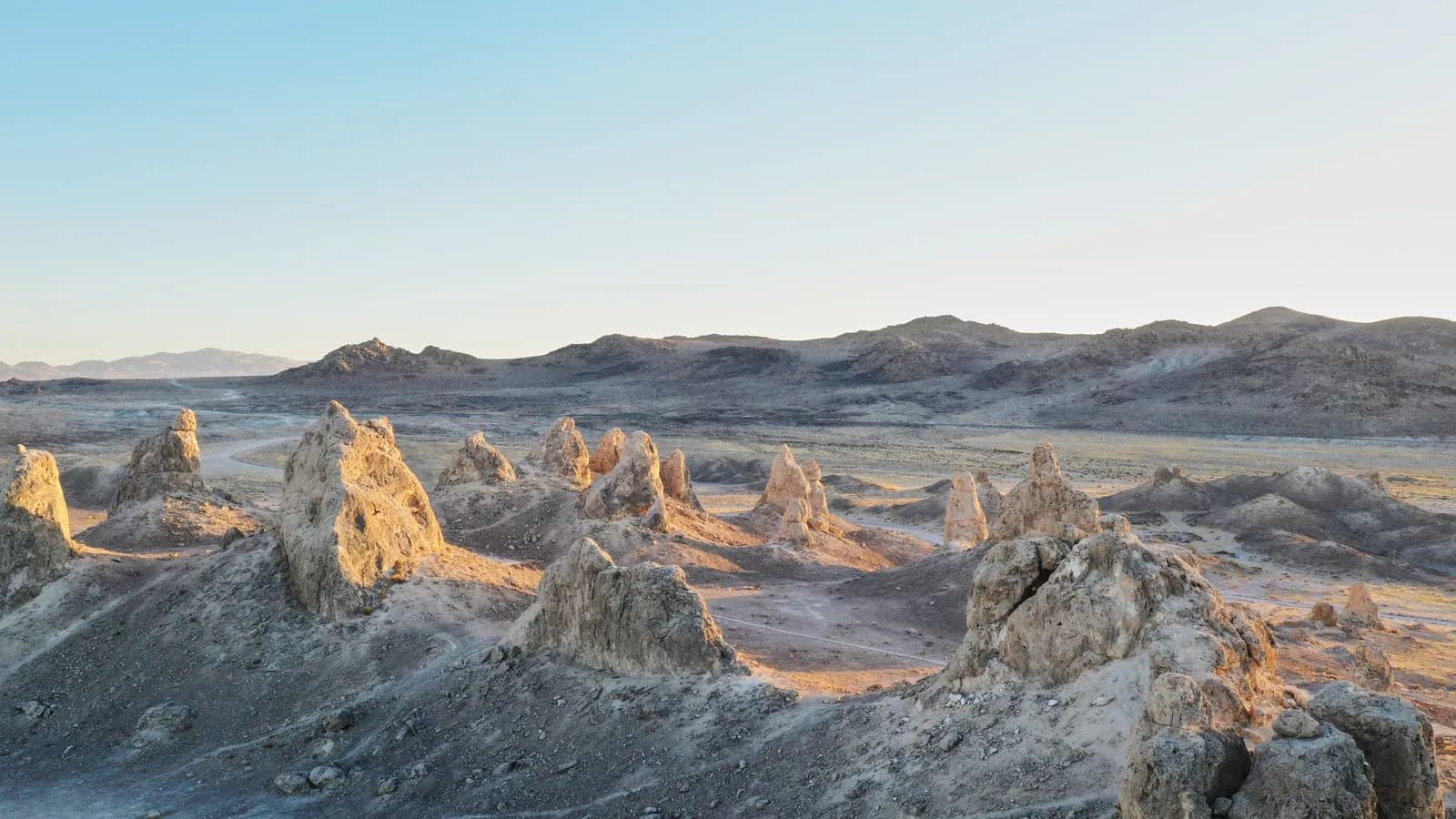
Adamski said he met a visitor in the California desert in November 1952.
George Adamski ran a small refreshment stand on the road up to Mount Palomar in California. He was an amateur astronomer with a telescope and a long prior involvement in mystical and occult teaching.
On 20 November 1952, he said, he went into the desert near Desert Center with several companions and met a being from Venus, whom he later called Orthon. They communicated by gesture and telepathy. The visitor was human in appearance, long-haired, and had come with a warning about nuclear weapons.
The 1953 book Flying Saucers Have Landed, written with Desmond Leslie, sold in very large numbers. Almost every later contactee account descends from it.
The template he created
Before Adamski, the subject was sightings — lights and objects, seen at a distance, reported to authorities.
He introduced the elements that became standard: benevolent human-looking visitors, telepathic communication, a message about the dangers of nuclear war, and a single chosen witness.
That the message matched the anxieties of 1952 America exactly is worth noticing. The visitors were concerned about precisely what his readers were concerned about.
The photographs
Adamski produced photographs of what he called scout ships: a domed disc with three spheres beneath it.
Analysts have argued from the beginning that the object is assembled from ordinary items. The most persistent identification is a chicken brooder lamp, with parts of a vacuum cleaner and light-bulb tops making up the rest. The three spheres closely resemble a specific type of lamp.
The images show no independent scale reference, and the resemblance to the household objects proposed is close.
Where the sceptical work was done
The identification of Adamski's scout ship photographs was not a modern debunking. It was contemporary.
Photographic analysts working in the 1950s compared the images with commercially available equipment and proposed specific components, including a lamp assembly with three spherical elements matching the shape and spacing beneath the craft.
The most persistent version of this analysis identifies parts of a chicken brooder — a heating lamp used in poultry rearing, and an item Adamski would have encountered readily.
What falsified him
He kept going, and the claims became testable.
Adamski described travelling to the Moon and to Venus. He reported cities, vegetation, forests, rivers and inhabited landscapes.
Within roughly a decade, Mariner and later probes established that the surface of Venus is around 465°C under a crushing carbon dioxide atmosphere, and that the far side of the Moon is cratered rock. His descriptions were not approximately wrong; they described places that do not exist.
Join the discussion
Still open on this one:
- 01
Who were the desert witnesses?
Adamski named companions present at the 1952 meeting who signed statements. Their accounts have been examined and disputed. It is the only part of the case with any independent testimony.
Be the first to comment
Sources
Open them and check for yourself. Where a record is public, it is linked.
US National Archives
The National Archives
Related
Psychic Phenomena
The Nine: who — or what — were they?
On New Year’s Eve 1952, in a laboratory in Maine, a voice announced itself as one of nine. Over the next forty years it reached a credentialled scientist, a celebrity psychic, a bestselling book and the creator of Star Trek. This is what is documented, and what is not.
Psychic Phenomena
New Year’s Eve 1952: the first session with the Nine
The founding event of the whole Nine phenomenon happened in a Maine farmhouse on 31 December 1952. Here is what the record supports about that evening, and how much of the familiar account was written down much later.
Psychic Phenomena
D. G. Vinod: the man at the beginning of the Nine
Every version of the Nine story starts with Dr D. G. Vinod in a trance in Maine. He is also the person that story then almost entirely forgets. Why the first channel is the biggest hole in the record.
Psychic Phenomena
Andrija Puharich: the doctor who kept turning up
A qualified physician, an inventor with real patents, an army medical officer — and the constant in forty years of the strangest story in American parapsychology. Puharich is the reason the Nine keep touching institutions.
0 comments