

Tabby’s Star: the dimming that was supposed to be a megastructure
A star in Cygnus dipped in brightness by amounts and in patterns nothing in the catalogue could match. For two years it was the best candidate for alien engineering anyone had. Then the colour of the dimming gave it away.
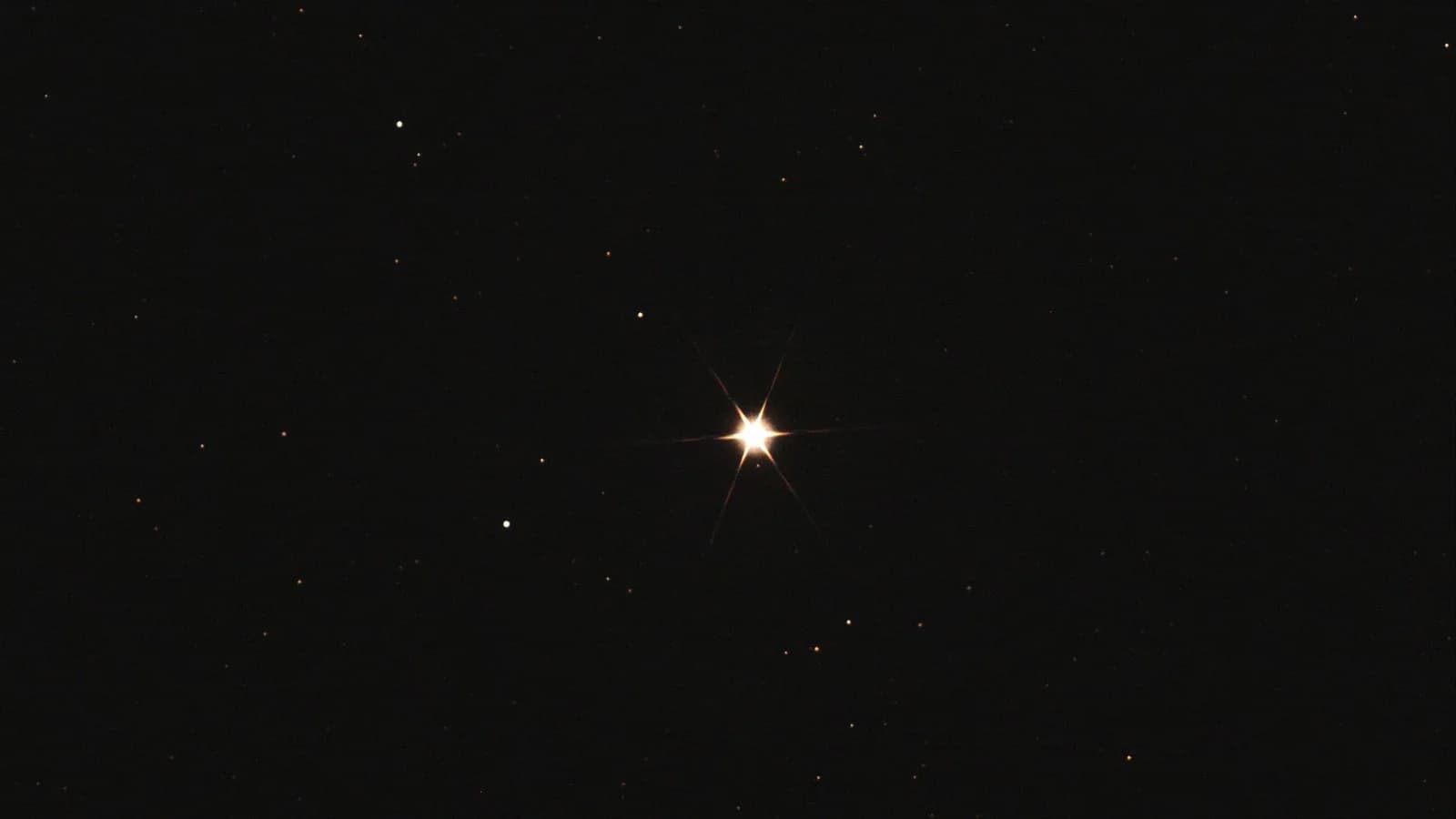
KIC 8462852 lies about 1,470 light years away in Cygnus and is otherwise unremarkable.
KIC 8462852 is an otherwise unremarkable star about 1,470 light years away in Cygnus. The Kepler space telescope watched it for four years as part of a survey looking for planets, and what it recorded did not look like a planet.
It became known as Tabby’s Star, after Tabetha Boyajian, the astronomer who led the analysis.
What was observed
Irregular dips in brightness, some as deep as twenty-two per cent, lasting days to weeks, with no periodicity.
That combination is genuinely strange. A transiting planet blocks a fraction of a per cent, briefly, on a strict schedule. Twenty-two per cent requires something enormous. The lack of any period rules out a single orbiting body on a regular path.
The megastructure hypothesis
It was raised seriously and in the literature — that irregular, deep, aperiodic dimming is what a partially built structure around a star might look like, and that Tabby’s Star deserved targeted SETI observation.
It duly got it. Radio and optical searches were pointed at the star and found nothing.
What settled it
Colour. A dedicated observing campaign, funded partly by public subscription, caught the star mid-dip and measured the dimming across multiple wavelengths simultaneously.
An opaque solid object blocks all wavelengths equally — a structure would produce a grey dip. What was measured was wavelength-dependent: blue light dimmed more than red.
That is the signature of dust. Fine particles scatter short wavelengths more efficiently, which is why sunsets are red. The dips are caused by clouds of fine material passing in front of the star.
Why this is the best story in the section
Because it is what the process looks like when it works. An anomaly was found, an exotic hypothesis was raised openly by professionals, a specific observational test was designed that could distinguish it from the mundane alternative, the observation was made, and the exotic hypothesis lost.
Nobody was embarrassed and nobody had to retract a claim, because the claim was framed from the start as something that could be tested. That is the standard the rest of this site’s subject matter almost never reaches, and it is worth pointing at when it happens.
Join the discussion
Still open on this one:
- 01
What is producing the dust?
The megastructure is excluded but the source of the material is not established. It remains a live astrophysical question rather than a closed case.
Be the first to comment
Sources
Open them and check for yourself. Where a record is public, it is linked.
NASA
SETI Institute
Related
Psychic Phenomena
The Nine: who — or what — were they?
On New Year’s Eve 1952, in a laboratory in Maine, a voice announced itself as one of nine. Over the next forty years it reached a credentialled scientist, a celebrity psychic, a bestselling book and the creator of Star Trek. This is what is documented, and what is not.
Psychic Phenomena
New Year’s Eve 1952: the first session with the Nine
The founding event of the whole Nine phenomenon happened in a Maine farmhouse on 31 December 1952. Here is what the record supports about that evening, and how much of the familiar account was written down much later.
Psychic Phenomena
D. G. Vinod: the man at the beginning of the Nine
Every version of the Nine story starts with Dr D. G. Vinod in a trance in Maine. He is also the person that story then almost entirely forgets. Why the first channel is the biggest hole in the record.
Psychic Phenomena
Andrija Puharich: the doctor who kept turning up
A qualified physician, an inventor with real patents, an army medical officer — and the constant in forty years of the strangest story in American parapsychology. Puharich is the reason the Nine keep touching institutions.
0 comments