

SETI: sixty-five years of listening, and what the silence means
The search for radio signals from other civilisations began in 1960 with one astronomer and one telescope. It has found nothing — and understanding how little of the search space that covers is the whole subject.
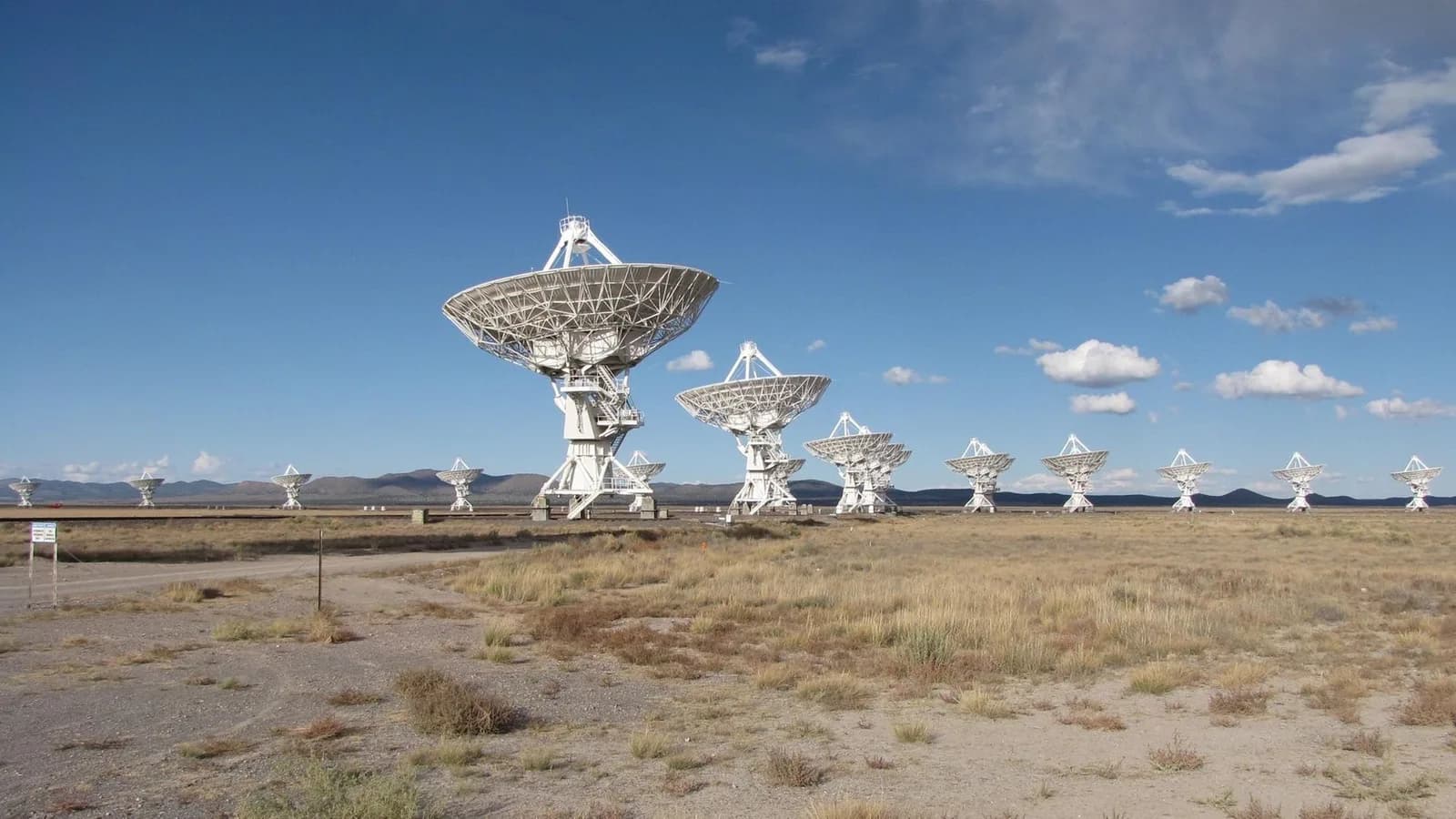
Modern searches use arrays rather than single dishes, covering more sky at once.
In April 1960 the astronomer Frank Drake pointed a telescope at Green Bank, West Virginia, at two nearby Sun-like stars and listened for narrowband radio signals. Project Ozma ran for a few months and found nothing.
Everything since has been a larger version of the same experiment, and the result has been the same. What that means is the most misunderstood thing in the field.
What has actually been searched
Far less than people assume. A search covers a specific patch of sky, over a specific frequency range, for a specific length of time, above a specific signal strength. Miss any dimension and you miss the signal.
Comparisons have been made between the total volume searched to date and a bathtub of water drawn from the Earth’s oceans. The exact figure depends on assumptions, but the order of magnitude is not seriously contested — the fraction covered is very small.
The milestones
The Arecibo message of 1974 sent a short broadcast towards a globular cluster 25,000 light years away. It was a demonstration of capability rather than an attempt at contact — the target will have moved by the time it arrives.
NASA ran a SETI programme until Congress cancelled its funding in 1993, after which the work moved to privately funded institutions. That cancellation shaped the field: it has been philanthropically funded ever since, which affects what gets searched.
Breakthrough Listen, announced in 2015 with a hundred million dollars behind it, is the largest search ever mounted, using major telescopes and publishing its data openly.
What changed the assumptions
Exoplanets. When Drake began, no planet outside the solar system had been confirmed and it was genuinely unknown whether they were common.
They are. Thousands are now confirmed and the statistics suggest planets are the rule rather than the exception, with a substantial fraction of stars hosting a roughly Earth-sized planet in the temperate zone.
That removes one of the largest uncertainties in the problem and makes the silence harder rather than easier to account for — which is the modern form of the Fermi paradox.
Where it is going
Away from radio alone. Optical SETI looks for laser pulses. Technosignature research looks for industrial byproducts in exoplanet atmospheres, waste heat, or structures — things a civilisation would produce whether or not it wanted to be found.
That shift matters, because it stops assuming the target is trying to talk to us.
Join the discussion
Still open on this one:
- 01
How long does a civilisation stay detectable by radio?
Our own leakage peaked and is declining. If that is typical, the detectable window is measured in decades and the whole search strategy needs rethinking.
Be the first to comment
Sources
Open them and check for yourself. Where a record is public, it is linked.
SETI Institute
NASA
Related

Psychic Phenomena
The Nine: who — or what — were they?
On New Year’s Eve 1952, in a laboratory in Maine, a voice announced itself as one of nine. Over the next forty years it reached a credentialled scientist, a celebrity psychic, a bestselling book and the creator of Star Trek. This is what is documented, and what is not.
Psychic Phenomena
New Year’s Eve 1952: the first session with the Nine
The founding event of the whole Nine phenomenon happened in a Maine farmhouse on 31 December 1952. Here is what the record supports about that evening, and how much of the familiar account was written down much later.

Psychic Phenomena
D. G. Vinod: the man at the beginning of the Nine
Every version of the Nine story starts with Dr D. G. Vinod in a trance in Maine. He is also the person that story then almost entirely forgets. Why the first channel is the biggest hole in the record.

Psychic Phenomena
Andrija Puharich: the doctor who kept turning up
A qualified physician, an inventor with real patents, an army medical officer — and the constant in forty years of the strangest story in American parapsychology. Puharich is the reason the Nine keep touching institutions.
0 comments