

Quantum consciousness: the objection, and the experiment that revived it
Penrose and Hameroff proposed that consciousness arises from quantum processes in neurons. A calculation in 2000 appeared to kill it outright. Recent anaesthetic work has made it interesting again.
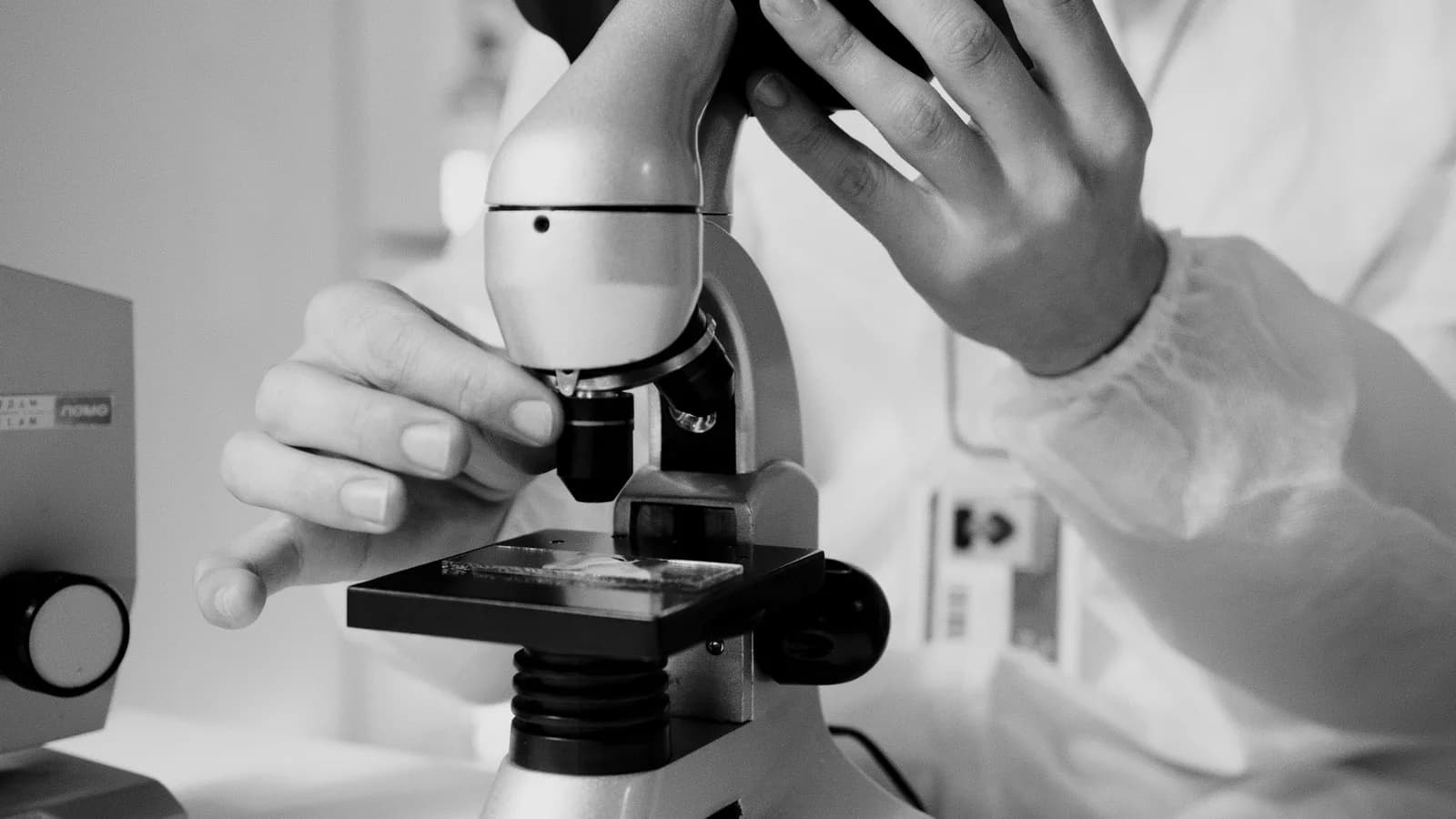
The proposal locates quantum processes in microtubules within neurons.
Quantum consciousness is invoked constantly in popular writing to explain telepathy, healing and the power of thought. Almost all of that is unrelated to the actual scientific proposal, which is specific, published, and has a genuine argument attached.
What Orch-OR proposes
Roger Penrose, a mathematical physicist, argued in the late 1980s that human mathematical insight involves something not reducible to computation, and that this points to a physical process beyond classical neuroscience.
Stuart Hameroff, an anaesthesiologist, proposed a site: microtubules, protein structures within cells including neurons.
Together they developed orchestrated objective reduction — Orch-OR — in which quantum states in microtubules are sustained, orchestrated by neural activity, and collapse in a way tied to spacetime geometry, producing moments of conscious experience.
The decoherence objection
In 2000 Max Tegmark published a calculation of how long a quantum state could survive in the brain's environment.
The brain is warm, wet and noisy. Quantum superpositions in such an environment decohere — lose their quantum character through interaction with surroundings — extremely fast. Tegmark estimated decoherence times in the region of ten to the minus thirteen seconds.
Neural processes operate on timescales of milliseconds. That is a gap of roughly ten orders of magnitude, and it appeared decisive.
Hameroff, Hagan and Tuszynski responded that Tegmark had modelled the wrong system and that shielding within microtubules could extend coherence substantially. The dispute over the correct model has never been fully resolved.
The measurement problem it invokes
Orch-OR is tied to a specific position on one of the oldest open questions in physics, and that is either its strength or its weakness depending on how that question resolves.
Quantum mechanics describes systems evolving as superpositions until measurement produces a definite outcome. What constitutes measurement, and whether collapse is a physical process, is unresolved.
Penrose proposes that collapse is objective and gravitational — that a superposition of different mass distributions becomes unstable and reduces spontaneously, at a rate set by the gravitational difference.
What has happened recently
Experimental work rather than argument, which is the change worth reporting.
Research published in 2024 from Wellesley College examined rats given a drug that binds to microtubules before administering anaesthetic. The treated animals took measurably longer to lose consciousness.
That is a specific, testable prediction of the microtubule account, and it came out in the predicted direction. It is animal work, it is one finding, and it establishes a role for microtubules in anaesthetic action rather than confirming any quantum claim.
Join the discussion
Still open on this one:
- 01
Can quantum coherence be measured in a living neuron?
This is the decisive experiment and nobody has performed it. Until it is done, the argument remains a dispute between two calculations.
Be the first to comment
Sources
Open them and check for yourself. Where a record is public, it is linked.
NASA
Related

Psychic Phenomena
The Nine: who — or what — were they?
On New Year’s Eve 1952, in a laboratory in Maine, a voice announced itself as one of nine. Over the next forty years it reached a credentialled scientist, a celebrity psychic, a bestselling book and the creator of Star Trek. This is what is documented, and what is not.
Psychic Phenomena
New Year’s Eve 1952: the first session with the Nine
The founding event of the whole Nine phenomenon happened in a Maine farmhouse on 31 December 1952. Here is what the record supports about that evening, and how much of the familiar account was written down much later.

Psychic Phenomena
D. G. Vinod: the man at the beginning of the Nine
Every version of the Nine story starts with Dr D. G. Vinod in a trance in Maine. He is also the person that story then almost entirely forgets. Why the first channel is the biggest hole in the record.

Psychic Phenomena
Andrija Puharich: the doctor who kept turning up
A qualified physician, an inventor with real patents, an army medical officer — and the constant in forty years of the strangest story in American parapsychology. Puharich is the reason the Nine keep touching institutions.
0 comments