

The Pioneer anomaly: an unexplained force, and how it was explained
Two spacecraft leaving the solar system were being pulled back by something nobody could account for. It lasted thirty years, attracted serious new-physics proposals, and turned out to be heat.
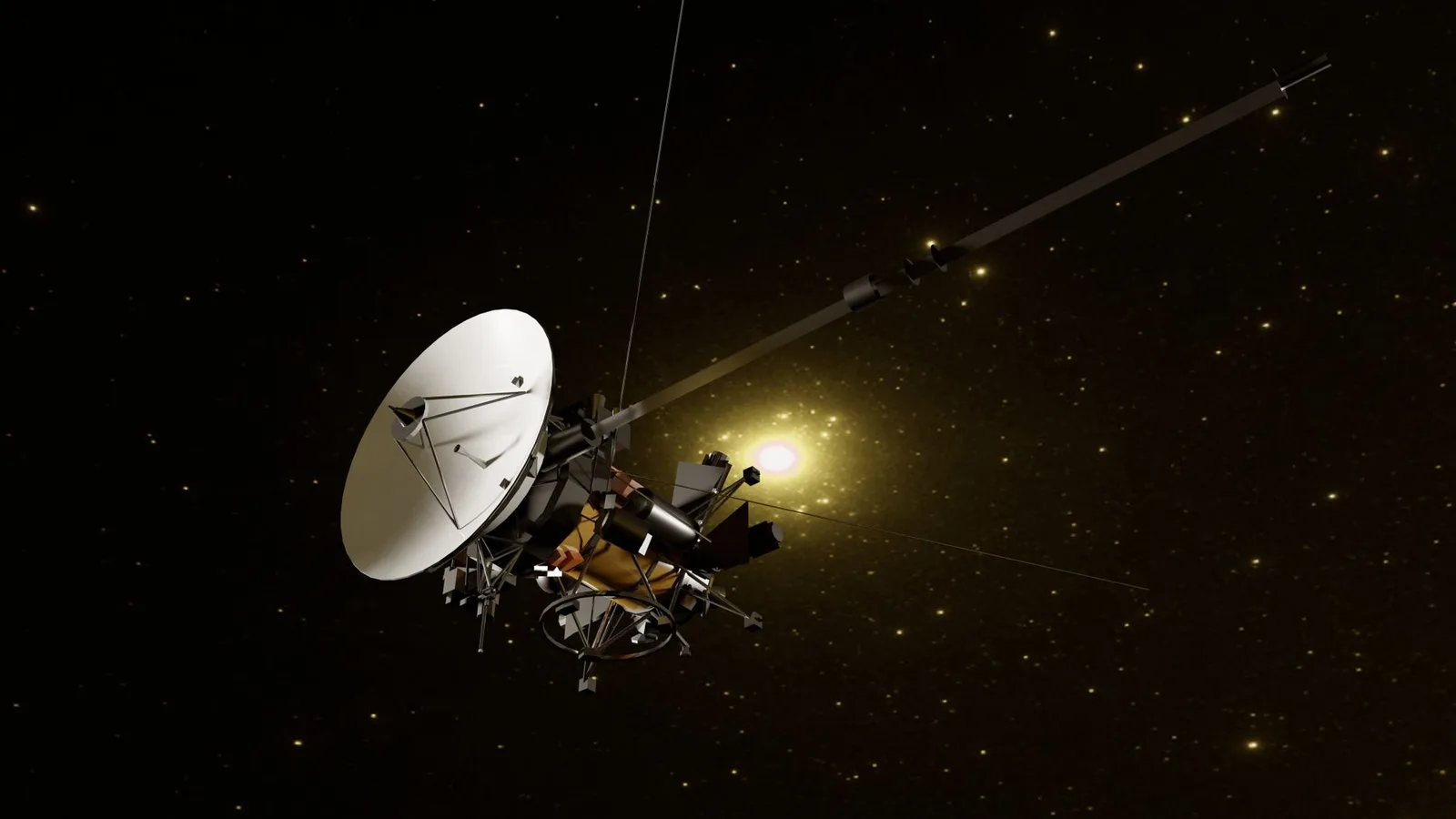
Pioneer 10 and 11 were launched in 1972 and 1973 and are still receding from the solar system.
Pioneer 10 and Pioneer 11 left Earth in 1972 and 1973, crossed the asteroid belt, passed Jupiter and Saturn, and headed out of the solar system. Their trajectories were tracked by radio for decades with extraordinary precision.
By the 1980s the tracking showed something wrong. Both were decelerating slightly more than gravity accounted for — a tiny extra pull towards the Sun, around eight ten-billionths of a metre per second squared.
Why it was taken seriously
Because it was small, consistent and measured on two independent spacecraft.
An error in one probe’s tracking would be a fault. The same anomaly, of the same magnitude, in the same direction, on two vehicles launched a year apart and heading in different directions, is a signal.
And it persisted through every recalculation. Gravitational effects of known bodies, relativistic corrections, solar wind, drag from interplanetary dust, errors in the ephemeris, clock effects — checked, and none accounted for it.
The exotic proposals
It attracted them, as such things do. Modified Newtonian dynamics, which alters gravity at very low accelerations and was devised for galaxy rotation curves, predicted deviations in roughly the right regime. Extra dimensions were proposed. Dark matter distributions were suggested. So was a variation in the gravitational constant.
These were serious papers by serious people. If the anomaly had held, it would have been the most important result in gravitational physics in a century.
What it turned out to be
Heat, radiated unevenly.
The spacecraft carry radioisotope thermoelectric generators and electronics that produce heat, which is radiated away as infrared. Photons carry momentum, so radiating more heat in one direction than another produces a small thrust.
Establishing this required recovering the original telemetry — much of it on decades-old media — and building a detailed thermal model of the spacecraft, tracking how heat flowed and where it left. The work took years. The answer accounted for the anomaly.
Why this is the most useful piece in the section
Because it is a complete cycle. A real anomaly, taken seriously, attracting exotic explanations from credentialled people, resolved by recovering the primary data and doing the difficult unglamorous modelling — and the answer was ordinary physics that nobody had bothered to calculate.
Every unexplained case on this site could end this way, and the ones that do will end like this: not with a revelation, but with somebody finding the tapes.
Join the discussion
Still open on this one:
- 01
How many other standing anomalies are waiting on archived data?
Pioneer was solved by recovering telemetry nobody had looked at in decades. That is a category of work, not a one-off, and very little of it is funded.
Be the first to comment
Sources
Open them and check for yourself. Where a record is public, it is linked.
NASA
Support for the thermal origin of the Pioneer anomaly
Turyshev et al., Physical Review Letters · 1 Jul 2012 · no public copy located
Related

Psychic Phenomena
The Nine: who — or what — were they?
On New Year’s Eve 1952, in a laboratory in Maine, a voice announced itself as one of nine. Over the next forty years it reached a credentialled scientist, a celebrity psychic, a bestselling book and the creator of Star Trek. This is what is documented, and what is not.

Psychic Phenomena
New Year’s Eve 1952: the first session with the Nine
The founding event of the whole Nine phenomenon happened in a Maine farmhouse on 31 December 1952. Here is what the record supports about that evening, and how much of the familiar account was written down much later.

Psychic Phenomena
D. G. Vinod: the man at the beginning of the Nine
Every version of the Nine story starts with Dr D. G. Vinod in a trance in Maine. He is also the person that story then almost entirely forgets. Why the first channel is the biggest hole in the record.

Psychic Phenomena
Andrija Puharich: the doctor who kept turning up
A qualified physician, an inventor with real patents, an army medical officer — and the constant in forty years of the strangest story in American parapsychology. Puharich is the reason the Nine keep touching institutions.
0 comments