

The Face on Mars: what a better camera did to it
A Viking orbiter photographed a mesa in 1976 that looked like a face. For twenty-two years it was the most famous image in the subject. Then something went back and looked properly.
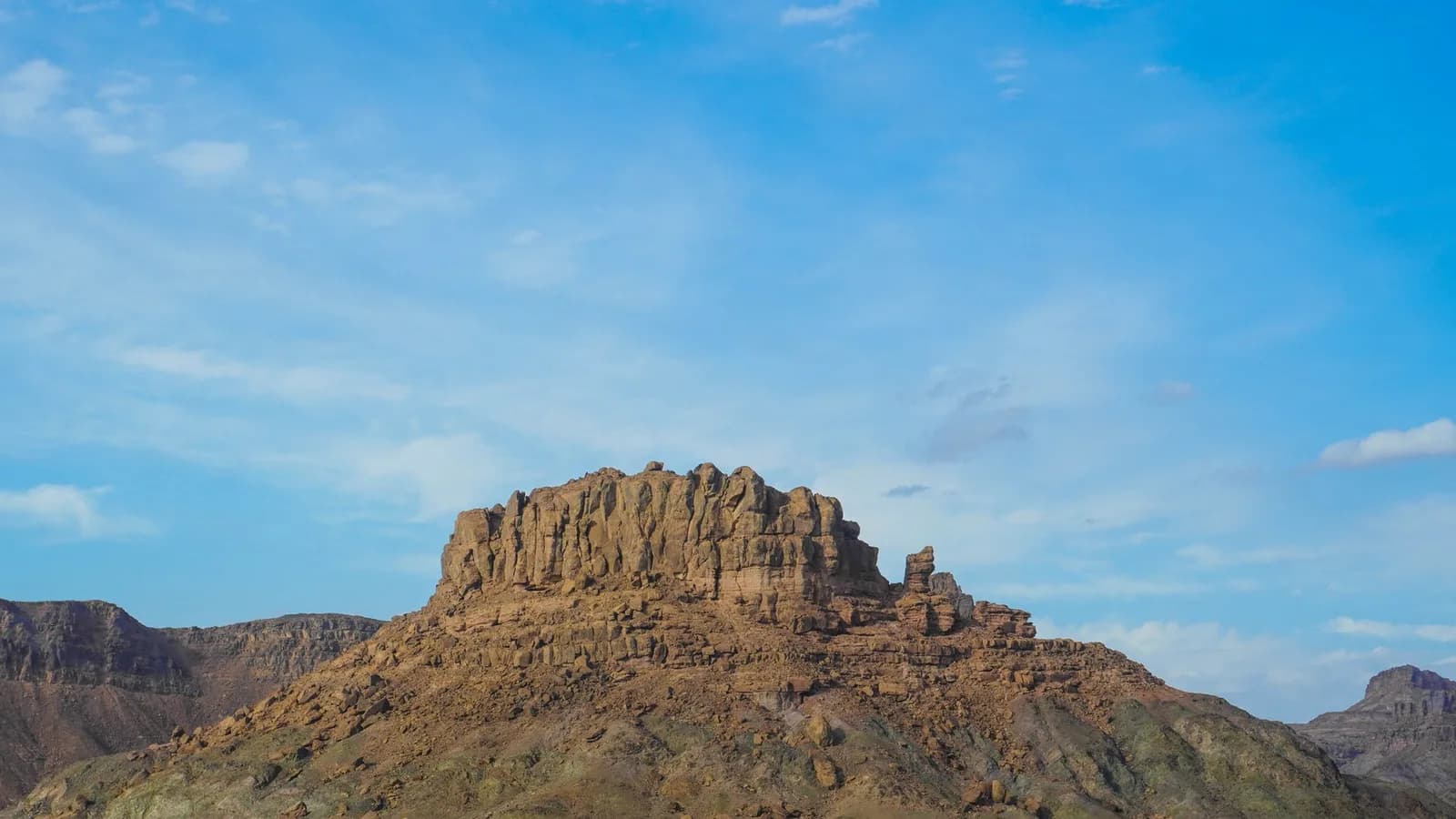
A terrestrial mesa. Cydonia is a region of Martian mesas and buttes; no photograph here is of Mars.
On 25 July 1976 the Viking 1 orbiter photographed a region of Mars called Cydonia. One frame showed a mesa about two kilometres across which, in that lighting and at that resolution, looked strikingly like a human face.
NASA released the image with a caption noting the resemblance, expecting it to be a curiosity. It became the most reproduced photograph in the history of this subject.
Why the original image looked like that
Three things combined.
Resolution. The Viking image had a pixel size of roughly fifty metres. Every detail smaller than that is absent, and the brain fills absences with pattern.
Lighting. The Sun was low, throwing long shadows that produced apparent eye sockets and a nose ridge from ordinary topography.
And pareidolia — the strong, involuntary human tendency to see faces, which operates on far less information than this. It is not a failure of intelligence; it is a perceptual system tuned to find faces at almost any cost.
What the better cameras showed
Mars Global Surveyor imaged Cydonia in 1998 and again in 2001 at resolutions approaching a metre and a half per pixel, under different illumination.
It is a mesa. Eroded, irregular, unremarkable, and one of many in the region. The apparent facial features are not present at higher resolution because they were never on the ground — they were in the shadows and the missing pixels.
Later stereo imaging produced elevation models allowing the landform to be viewed from any angle. From every angle but the original one, it does not resemble a face at all.
Why it is worth keeping on the site
Because it is the cleanest example of the whole problem. A real photograph, honestly released, of a real object — and an interpretation that came entirely from the limits of the instrument.
It also has the rare property of having been settled by going back and looking. Almost nothing in this field can be re-observed. When it can be, the ambiguity usually resolves in one direction.
Join the discussion
Still open on this one:
- 01
Why does the resemblance disappear from other angles?
Because it was produced by shadow at one Sun angle and one viewing geometry. The elevation models make this checkable by anyone, which is the useful part.
Be the first to comment
Sources
Open them and check for yourself. Where a record is public, it is linked.
NASA
Mars Express imagery of Cydonia
European Space Agency
Related

Psychic Phenomena
The Nine: who — or what — were they?
On New Year’s Eve 1952, in a laboratory in Maine, a voice announced itself as one of nine. Over the next forty years it reached a credentialled scientist, a celebrity psychic, a bestselling book and the creator of Star Trek. This is what is documented, and what is not.
Psychic Phenomena
New Year’s Eve 1952: the first session with the Nine
The founding event of the whole Nine phenomenon happened in a Maine farmhouse on 31 December 1952. Here is what the record supports about that evening, and how much of the familiar account was written down much later.

Psychic Phenomena
D. G. Vinod: the man at the beginning of the Nine
Every version of the Nine story starts with Dr D. G. Vinod in a trance in Maine. He is also the person that story then almost entirely forgets. Why the first channel is the biggest hole in the record.

Psychic Phenomena
Andrija Puharich: the doctor who kept turning up
A qualified physician, an inventor with real patents, an army medical officer — and the constant in forty years of the strangest story in American parapsychology. Puharich is the reason the Nine keep touching institutions.
0 comments