

ALH84001: the day a president announced life on Mars
A meteorite from Antarctica produced structures a NASA team argued were fossil bacteria. It was announced from the White House lawn in 1996. Almost every feature has since been explained without biology.
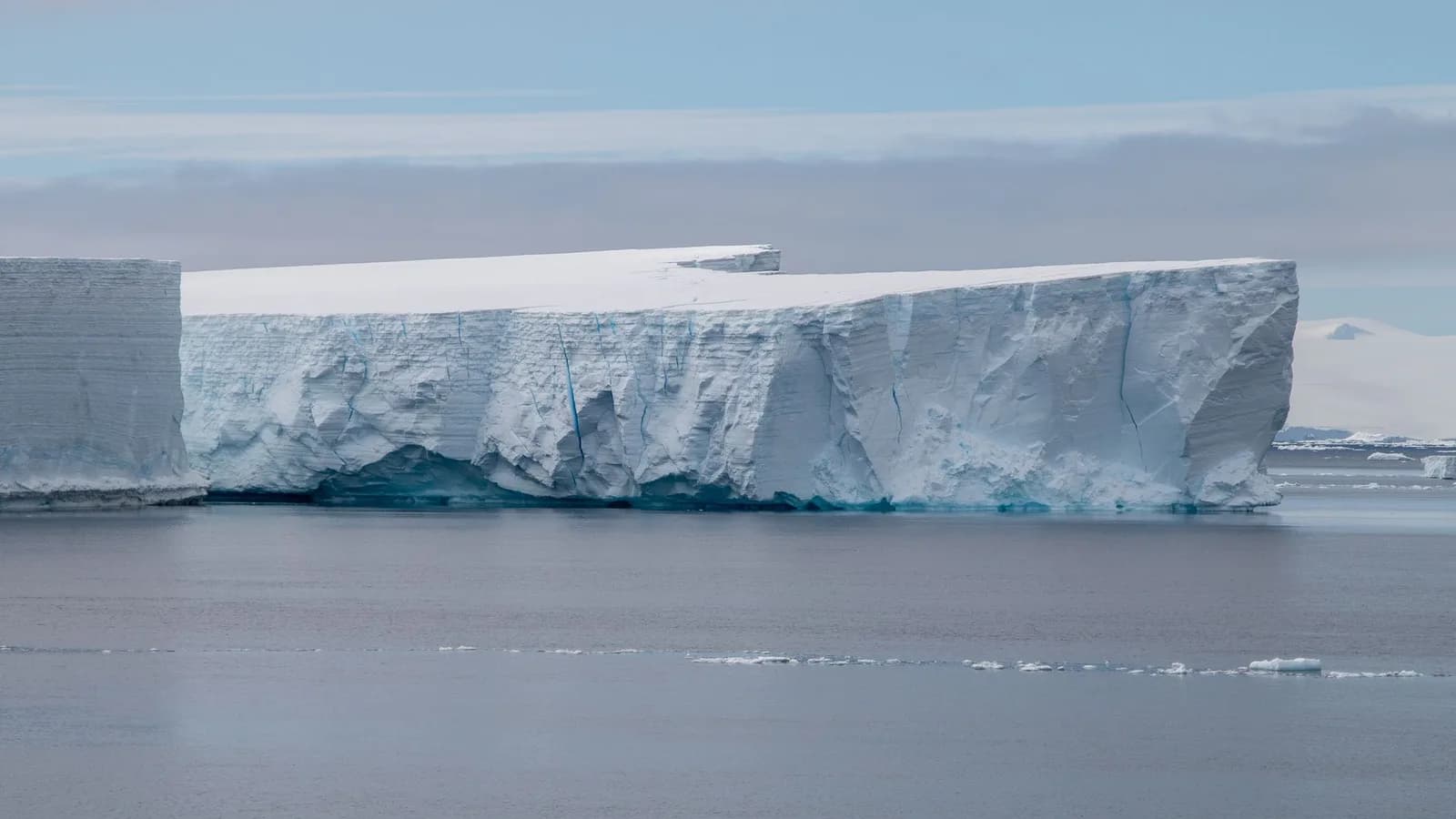
ALH84001 was recovered from the Allan Hills ice field in Antarctica in 1984.
In 1984 a meteorite was collected from the Allan Hills region of Antarctica. Analysis established that it had come from Mars — blasted off the surface by an impact, and eventually falling to Earth. In 1996 a NASA-led team published a paper in Science arguing it contained evidence of past microbial life.
President Clinton announced it from the White House lawn. It remains the most prominent claim of extraterrestrial life ever made by a mainstream scientific team.
The evidence offered
Four strands, presented as more persuasive together than separately — which was the paper’s explicit argument and also its weakness.
Carbonate globules, of a kind that can form in water.
Polycyclic aromatic hydrocarbons, organic molecules that can be produced by the decay of living matter.
Grains of magnetite in shapes and purities resembling those made by certain terrestrial bacteria.
And structures, visible under electron microscopy, resembling fossilised bacteria — the famous image.
What happened next
Which is exactly what the field did, over the following decade.
The structures were shown to be far smaller than any known free-living organism — at that size there is not room for the machinery a cell needs. Similar shapes were also produced abiotically in the laboratory, and some are artefacts of the coating applied for electron microscopy.
The hydrocarbons occur in meteorites generally and can form without life. Antarctic contamination could not be excluded.
The magnetite grains, the most durable strand, were shown to be producible by thermal decomposition of carbonate under conditions the rock plausibly experienced.
What it actually achieved
More than the claim itself. NASA’s astrobiology programme was substantially expanded in its wake, and the modern discipline of searching for biosignatures — including the standards used to assess K2-18b today — was shaped by the argument this rock started.
It also produced a lasting caution. The lesson every practitioner drew was that morphology is not evidence of biology: something that looks like a cell is not a cell, because shape is cheap and chemistry makes shapes constantly.
Join the discussion
Still open on this one:
- 01
Will Mars sample return actually happen?
Every serious answer about Martian biology depends on it. The mission has been repeatedly rescoped and its future is a budget question rather than a scientific one.
Be the first to comment
Sources
Open them and check for yourself. Where a record is public, it is linked.
NASA
Search for Past Life on Mars
McKay et al., Science · 16 Aug 1996 · no public copy located
Related
Psychic Phenomena
The Nine: who — or what — were they?
On New Year’s Eve 1952, in a laboratory in Maine, a voice announced itself as one of nine. Over the next forty years it reached a credentialled scientist, a celebrity psychic, a bestselling book and the creator of Star Trek. This is what is documented, and what is not.
Psychic Phenomena
New Year’s Eve 1952: the first session with the Nine
The founding event of the whole Nine phenomenon happened in a Maine farmhouse on 31 December 1952. Here is what the record supports about that evening, and how much of the familiar account was written down much later.
Psychic Phenomena
D. G. Vinod: the man at the beginning of the Nine
Every version of the Nine story starts with Dr D. G. Vinod in a trance in Maine. He is also the person that story then almost entirely forgets. Why the first channel is the biggest hole in the record.
Psychic Phenomena
Andrija Puharich: the doctor who kept turning up
A qualified physician, an inventor with real patents, an army medical officer — and the constant in forty years of the strangest story in American parapsychology. Puharich is the reason the Nine keep touching institutions.
0 comments