

The Voynich manuscript: undeciphered, and definitely medieval
Two hundred and forty pages of unknown script and impossible plants, in a book nobody can read. The carbon dating settled when it was made, which narrowed the question considerably.
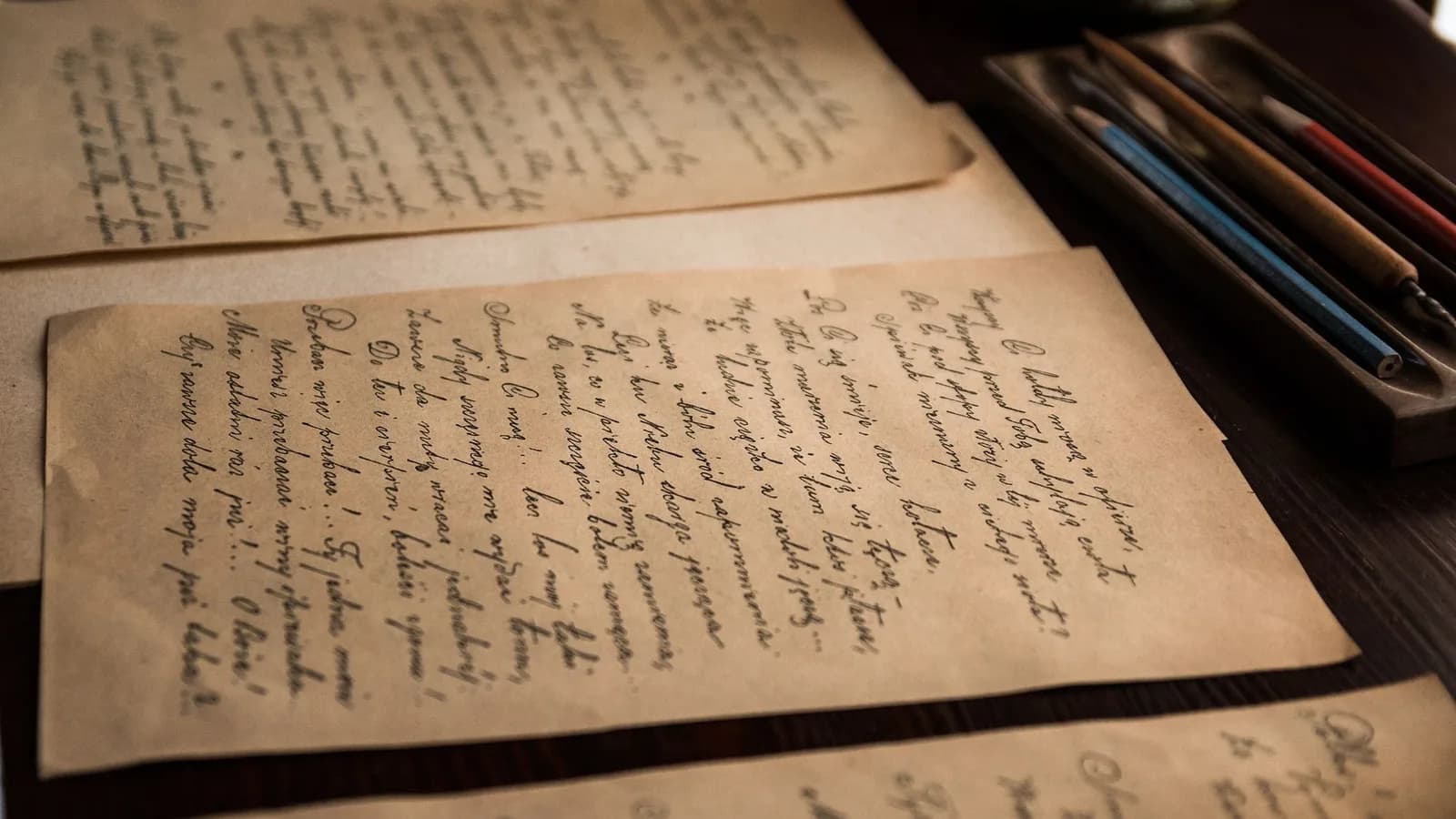
The Voynich manuscript is held at Yale’s Beinecke Library and has been fully digitised.
The Voynich manuscript is a codex of about 240 surviving vellum pages, written in an unknown script, illustrated with plants that do not exist, astronomical diagrams, and pages of naked figures in what appear to be systems of pipes and pools.
Nobody has read it. Not because it is difficult, but because a century of professional and amateur effort — including by cryptanalysts who broke real ciphers in wartime — has produced no accepted decipherment.
What is documented
It is named after Wilfrid Voynich, a book dealer who acquired it in 1912. Its earlier history is partial: a letter of 1665 accompanies it, and it can be traced with reasonable confidence to seventeenth-century Prague and the court of Rudolf II.
In 2009 the vellum was radiocarbon dated to roughly 1404 to 1438. Analysis of the inks and pigments is consistent with that period.
What the text is like
This is where it gets genuinely strange, and it is the reason the manuscript resists both decipherment and dismissal.
Statistically, the text behaves like language. Word lengths follow a natural distribution. Certain words recur in ways that track the subject matter of the surrounding illustrations — one set of words dominates the botanical pages, another the astronomical.
But it also has features no known language has. Words repeat consecutively far more often than natural language allows. There is very little of the variation in word structure that inflection produces.
The candidate explanations
A cipher. Attractive, and the difficulty is that no cipher of the period produces text with these statistical properties, and modern cryptanalysis has not broken it.
An unrecorded natural language, or a known one in an invented script. Various have been proposed and none has produced a consistent reading that other scholars can reproduce.
A constructed language, of the kind several European scholars attempted in this era.
Or elaborate nonsense — produced by a technique that generates language-like text without meaning, to be sold to a wealthy collector. This accounts for the statistics reasonably well and is currently the explanation with fewest difficulties.
Why it is worth keeping open
Because the nonsense hypothesis has a weakness that is not often stated: it requires somebody to have produced 240 pages of consistent, structured, illustrated gibberish, with internally coherent statistical properties, on expensive vellum, in the fifteenth century.
That is a great deal of disciplined work for a fraud, and the discipline is the part that resists explanation.
Join the discussion
Still open on this one:
- 01
Does the text encode meaning at all?
The most important question and possibly answerable statistically without decipherment. Work in this direction has been done and has not converged.
Be the first to comment
Sources
Open them and check for yourself. Where a record is public, it is linked.
Beinecke Rare Book and Manuscript Library
Yale University
British Library
Related

Psychic Phenomena
The Nine: who — or what — were they?
On New Year’s Eve 1952, in a laboratory in Maine, a voice announced itself as one of nine. Over the next forty years it reached a credentialled scientist, a celebrity psychic, a bestselling book and the creator of Star Trek. This is what is documented, and what is not.
Psychic Phenomena
New Year’s Eve 1952: the first session with the Nine
The founding event of the whole Nine phenomenon happened in a Maine farmhouse on 31 December 1952. Here is what the record supports about that evening, and how much of the familiar account was written down much later.
Psychic Phenomena
D. G. Vinod: the man at the beginning of the Nine
Every version of the Nine story starts with Dr D. G. Vinod in a trance in Maine. He is also the person that story then almost entirely forgets. Why the first channel is the biggest hole in the record.

Psychic Phenomena
Andrija Puharich: the doctor who kept turning up
A qualified physician, an inventor with real patents, an army medical officer — and the constant in forty years of the strangest story in American parapsychology. Puharich is the reason the Nine keep touching institutions.
0 comments