

The Phaistos Disc: printed, and unreadable
A clay disc from Bronze Age Crete carrying 241 stamped signs in a spiral. It was made with punches, which makes it the earliest known printing. Nobody can read a word of it.
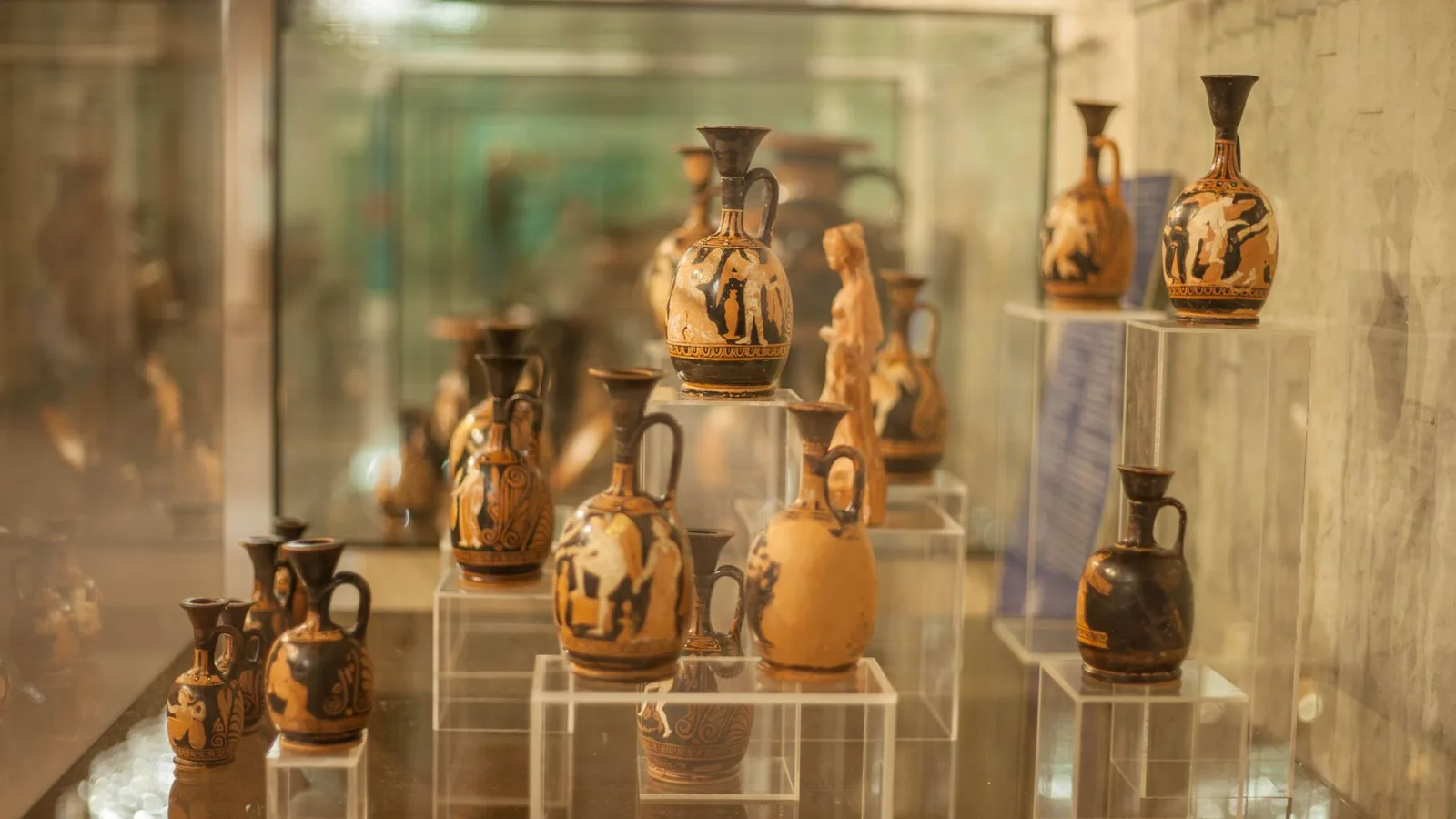
Minoan material from Crete. The disc itself is fired clay, about fifteen centimetres across.
The Phaistos Disc was found in 1908 by the Italian archaeologist Luigi Pernier at the Minoan palace site of Phaistos in southern Crete. It is fired clay, roughly fifteen centimetres across, and carries 241 signs arranged in a spiral on both faces.
It is conventionally dated to the Middle Minoan period, around 1700 BC.
The remarkable thing about it
The signs were not incised by hand. They were stamped, using individual punches — one punch per sign, pressed into wet clay.
There are forty-five distinct signs. That means someone made forty-five reusable stamps and used them to compose a text.
It is, in a limited but real sense, the earliest known example of printing with movable type, by something over three thousand years.
Why it cannot be read
There is one of it.
Decipherment requires a corpus. Linear B was read by Michael Ventris in 1952 because thousands of tablets existed, allowing patterns, repetitions and administrative structures to be identified — and because Ventris could test a proposed value against enormous quantities of text.
The disc has 241 signs total. Even if the language were known and the system were straightforward, that is not enough material to work with. Decipherments of it are published regularly and none can be tested.
The signs themselves are legible and have been catalogued: a plumed head, a shield, a walking figure, a fish, a boat, a flower. What they represent phonetically, or whether they are phonetic at all, is unknown.
How Linear B was actually broken
The contrast makes the disc's problem concrete.
Michael Ventris had thousands of tablets from Knossos and Pylos. Alice Kober had already established, by patient analysis, that certain sign groups varied their endings in regular ways — evidence of an inflected language, and a set of relationships between signs before any sound value was assigned.
Ventris then guessed that certain frequent words were place names, tested the resulting sound values across the whole corpus, and found they generated readable Greek in contexts he had not used to derive them.
The authenticity question
A minority position, argued most prominently by the antiquities scholar Jerome Eisenberg in 2008, holds that the disc is a modern forgery — that its uniqueness, its unusually clean edges and the circumstances of its discovery are suspicious.
The mainstream position is that it is genuine. It was found in a stratified archaeological context alongside a Linear A tablet, and the case for forgery rests largely on the fact that it is unlike anything else.
Join the discussion
Still open on this one:
- 01
Will a second stamped object ever be found?
It is the only thing that would move the problem. Minoan Crete continues to be excavated, and one more disc would transform the case entirely.
Be the first to comment
Sources
Open them and check for yourself. Where a record is public, it is linked.
British Museum
The British Library
Related

Psychic Phenomena
The Nine: who — or what — were they?
On New Year’s Eve 1952, in a laboratory in Maine, a voice announced itself as one of nine. Over the next forty years it reached a credentialled scientist, a celebrity psychic, a bestselling book and the creator of Star Trek. This is what is documented, and what is not.
Psychic Phenomena
New Year’s Eve 1952: the first session with the Nine
The founding event of the whole Nine phenomenon happened in a Maine farmhouse on 31 December 1952. Here is what the record supports about that evening, and how much of the familiar account was written down much later.
Psychic Phenomena
D. G. Vinod: the man at the beginning of the Nine
Every version of the Nine story starts with Dr D. G. Vinod in a trance in Maine. He is also the person that story then almost entirely forgets. Why the first channel is the biggest hole in the record.

Psychic Phenomena
Andrija Puharich: the doctor who kept turning up
A qualified physician, an inventor with real patents, an army medical officer — and the constant in forty years of the strangest story in American parapsychology. Puharich is the reason the Nine keep touching institutions.
0 comments