

The Max Headroom intrusion: unsolved because it was difficult, not because it was sinister
On one November evening in 1987, somebody took over two Chicago television stations. Nobody has ever been identified — and the interesting part is what the equipment tells you about who could have done it.
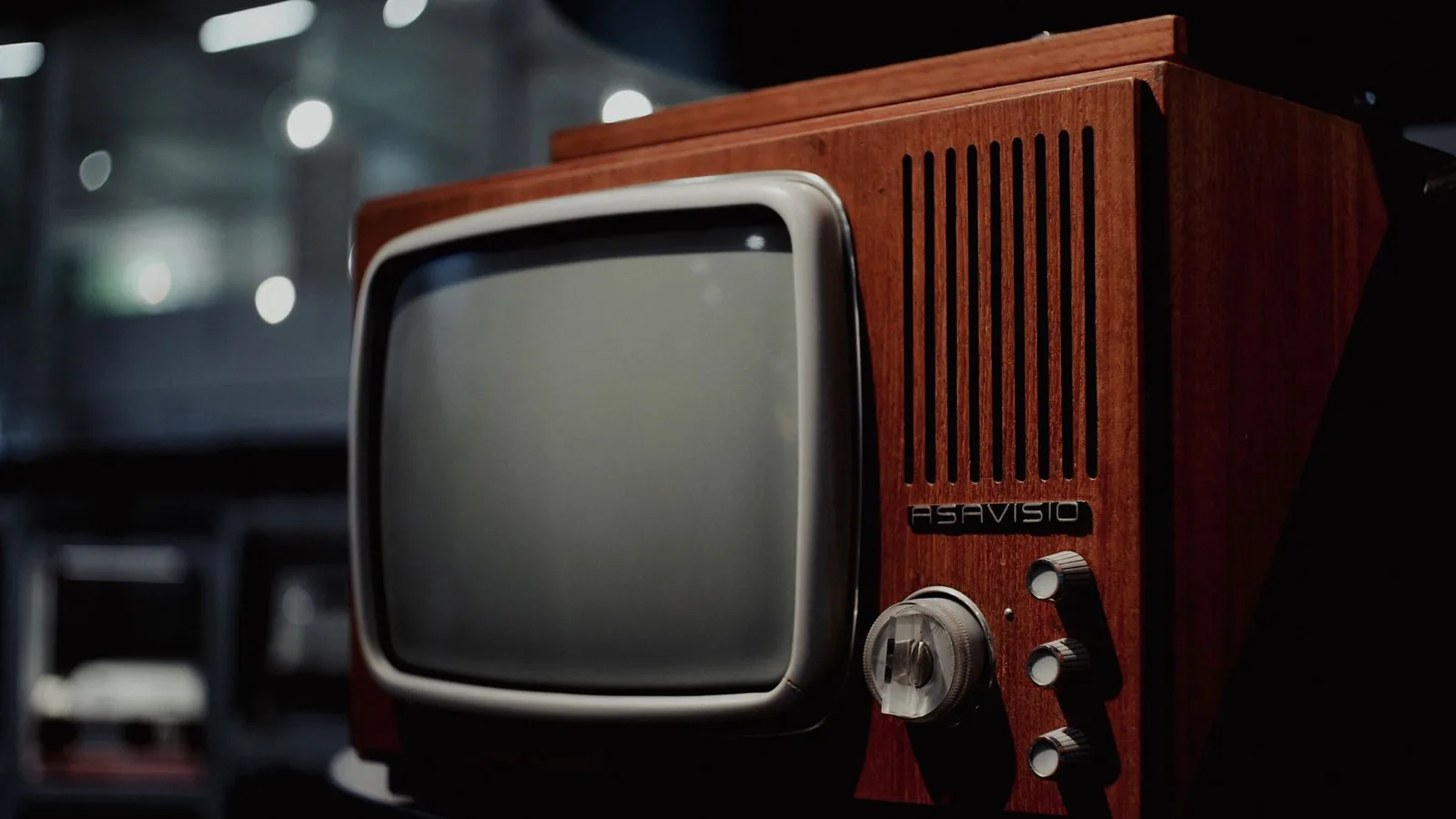
A vintage CRT television. Both 1987 intrusions were achieved by overpowering a studio-to-transmitter microwave link, not by entering a studio.
On the evening of 22 November 1987, two television stations in Chicago lost control of their own broadcasts to a person in a rubber mask.
The Federal Communications Commission investigated. Nearly forty years later, nobody has been identified, charged or credibly named. It is the most successful unsolved broadcast intrusion in American history, and the reason it stayed unsolved is technical rather than mysterious.
What happened
The first intrusion came at around 9.14pm, during the sports segment of WGN-TV's Nine O'Clock News. For roughly twenty-five seconds the picture was replaced by a figure in a Max Headroom mask, rocking in front of a sheet of corrugated metal turning behind them.
There was no sound. The intruder's audio was on the wrong subcarrier, so WGN's viewers got the image in silence while the sportscaster tried to carry on. Engineers switched the studio-to-transmitter link to a different frequency and it stopped.
About two hours later it happened again, on the PBS station WTTW, in the middle of the Doctor Who serial "Horror of Fang Rock". This time it ran for roughly ninety seconds and the audio worked, badly.
The content was juvenile. The figure referenced a WGN sportscaster by name, hummed a cartoon theme, held up a Pepsi can — a joke about the Max Headroom character's cola advertising — and the sequence ended with an accomplice striking the figure's bared buttocks with a flyswatter.
Why this was hard
This was not a hack in any modern sense. Nobody got into a studio and nobody got into a computer.
A television station in 1987 sent its programme from the studio to the transmitter over a microwave link. To hijack the broadcast you had to transmit on that link's frequency, at the receiving antenna, with more power than the station's own signal.
That requires a directional dish, a transmitter of adequate output, line of sight to the receiving point, and knowledge of which frequency and polarisation the station was using. In 1987 that meant broadcast-grade equipment and broadcast-industry knowledge.
It also meant a fixed position and a strong signal, which is normally how such things are found. It was not found.
What was added afterwards
The footage has been absorbed into internet horror culture, and a good deal of the atmosphere now attached to it was applied later. Watched cold, it is a crude prank by people who thought the Max Headroom character was funny and had access to a transmitter.
Names circulate. A widely shared account posted in 2020 identified two brothers as the culprits, on the testimony of an acquaintance. Nobody has been charged, no technical detail has been confirmed, and the claim rests on recollection.
What would settle it
Not a confession. Confessions are cheap and this case has attracted several.
What would settle it is a confession containing checkable technical particulars: the link frequency used against each station, the transmitting position, the equipment. Those details were never made public in full, so anyone who supplied them correctly would be demonstrating knowledge rather than asserting it.
It also stands as a reminder of something worth keeping in view: a broadcast reaching hundreds of thousands of homes was, in 1987, protected by nothing but the cost of a microwave transmitter.
Join the discussion
Still open on this one:
- 01
Was anyone ever charged?
No. The FCC investigation closed without identifying anyone, and no prosecution followed.
Be the first to comment
Sources
Open them and check for yourself. Where a record is public, it is linked.
Enforcement records and broadcast regulation
Federal Communications Commission · no public copy located
Internet Archive
WTTW station statements on the 1987 intrusion
WTTW, Chicago · no public copy located
Related

Psychic Phenomena
The Nine: who — or what — were they?
On New Year’s Eve 1952, in a laboratory in Maine, a voice announced itself as one of nine. Over the next forty years it reached a credentialled scientist, a celebrity psychic, a bestselling book and the creator of Star Trek. This is what is documented, and what is not.
Psychic Phenomena
New Year’s Eve 1952: the first session with the Nine
The founding event of the whole Nine phenomenon happened in a Maine farmhouse on 31 December 1952. Here is what the record supports about that evening, and how much of the familiar account was written down much later.
Psychic Phenomena
D. G. Vinod: the man at the beginning of the Nine
Every version of the Nine story starts with Dr D. G. Vinod in a trance in Maine. He is also the person that story then almost entirely forgets. Why the first channel is the biggest hole in the record.
Psychic Phenomena
Andrija Puharich: the doctor who kept turning up
A qualified physician, an inventor with real patents, an army medical officer — and the constant in forty years of the strangest story in American parapsychology. Puharich is the reason the Nine keep touching institutions.
0 comments