

The Green Children of Woolpit: what the two chroniclers actually wrote
Two children with green skin found by the wolf pits in Suffolk. The story survives in two twelfth-century manuscripts, and neither of them mentions anything from the sky.
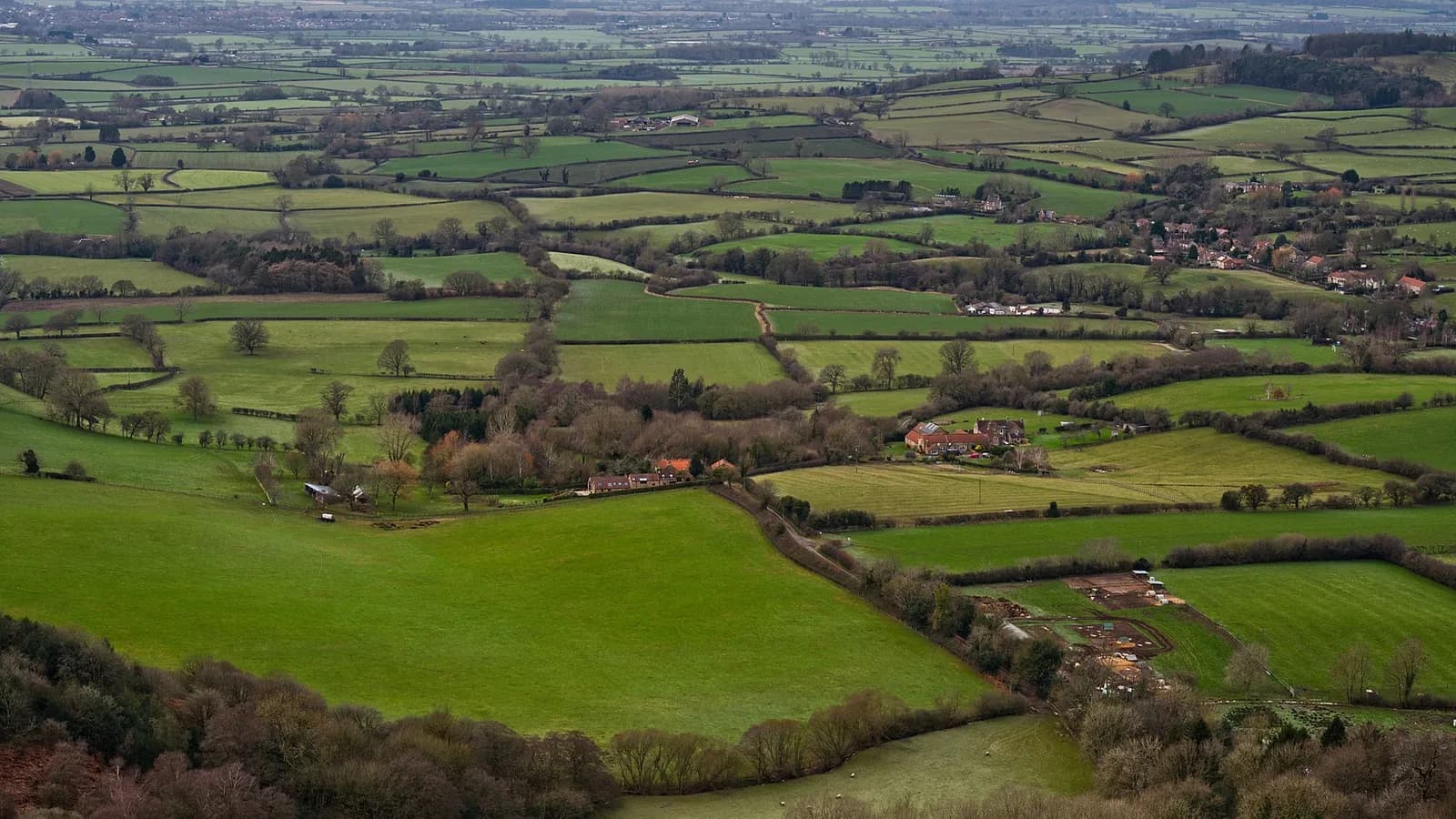
Green fields and farmland from the air. Woolpit in Suffolk takes its name from the wolf pits — trenches dug to trap wolves — beside which the children were said to have been found.
Two children were found near the wolf pits at Woolpit in Suffolk. Their skin was green. Their clothing was of an unfamiliar material. They spoke a language nobody present understood, and they would eat nothing but raw beans.
This is one of the oldest stories in English folklore that is not obviously a folk tale, and it survives in two independent medieval manuscripts. Reading them is more interesting than reading anything written about them since.
The two sources
Ralph of Coggeshall was abbot of the Cistercian house at Coggeshall in Essex. His Chronicon Anglicanum contains the fuller version, written around 1220.
William of Newburgh was an Augustinian canon in Yorkshire. His Historia rerum Anglicarum, written around 1189, contains the shorter one.
They disagree about when it happened. Newburgh places it in the reign of King Stephen, which ended in 1154. Ralph places it under Henry II, who reigned from 1154 to 1189. Neither writer was present, and both are writing decades after the fact.
What the accounts say
The children were taken to de Calne's house. They refused all food until beans were brought in — and they first tried to open the stalks rather than the pods, which reads like a real observed detail rather than an invented one.
The boy sickened and died soon after baptism. The girl lived. Her skin gradually lost its colour, she learned English, and she was described as remaining in service and later marrying.
Once she could be questioned, she said they came from a country where the sun did not rise properly and everything stood in a long twilight. Its people were Christian and it had churches. She called it St Martin's Land. She said they had been minding animals, heard a great sound, and found themselves at the pits, dazzled by the light.
That is the whole of it. There is nothing in either chronicle about a craft, a light in the sky, or a descent from above.
What was added later
The reading of the children as extraterrestrials is a twentieth-century construction. So is the parallel-world reading. Both take the girl's description of a dim country and treat it as cosmology, which is not how either chronicler treated it — both understood her to be describing somewhere on earth that she could not name in English.
The explanation that fits the period
Suffolk in the twelfth century had a substantial Flemish population — weavers and settlers, and at times mercenaries. Flemish communities in the region were the target of violence, and a Flemish force was destroyed at Fornham St Genevieve near Bury St Edmunds in 1173.
Fornham St Martin lies immediately beside it, separated from Woolpit by the River Lark and by a few hours of walking. The suggestion that "St Martin's Land" is that village, garbled by a child who could not yet make herself understood, was set out by Paul Harris in Fortean Studies in 1998 and remains the most economical reading available.
The green colour has a medical candidate too. Severe iron-deficiency anaemia was known for centuries as green sickness, and it produces a greenish pallor that resolves with adequate food. A child starving in woodland, then fed properly in a knight's household, would lose the colour exactly as the account describes.
The refusal of all food but raw beans fits children who had been surviving on what they could find in fields.
What the record cannot settle
Whether any of it happened. Two chroniclers, thirty years apart, recording a story from a household's memory of an event decades earlier, is evidence that the story was told in Suffolk in the twelfth century. It is not evidence that two green children were found.
No charter, court roll or manorial record naming the children has been identified, and it is unlikely one exists.
Join the discussion
Still open on this one:
- 01
Do the chronicles mention the sky at all?
No. The girl describes a dim country reached through a noise and a passage. Both chroniclers treat it as a place on earth.
Be the first to comment
Sources
Open them and check for yourself. Where a record is public, it is linked.
British Library
Suffolk County Council
Chronicon Anglicanum
Ralph of Coggeshall, c. 1220 · no public copy located
Historia rerum Anglicarum
William of Newburgh, c. 1189 · no public copy located
Related
Psychic Phenomena
The Nine: who — or what — were they?
On New Year’s Eve 1952, in a laboratory in Maine, a voice announced itself as one of nine. Over the next forty years it reached a credentialled scientist, a celebrity psychic, a bestselling book and the creator of Star Trek. This is what is documented, and what is not.
Psychic Phenomena
New Year’s Eve 1952: the first session with the Nine
The founding event of the whole Nine phenomenon happened in a Maine farmhouse on 31 December 1952. Here is what the record supports about that evening, and how much of the familiar account was written down much later.
Psychic Phenomena
D. G. Vinod: the man at the beginning of the Nine
Every version of the Nine story starts with Dr D. G. Vinod in a trance in Maine. He is also the person that story then almost entirely forgets. Why the first channel is the biggest hole in the record.

Psychic Phenomena
Andrija Puharich: the doctor who kept turning up
A qualified physician, an inventor with real patents, an army medical officer — and the constant in forty years of the strangest story in American parapsychology. Puharich is the reason the Nine keep touching institutions.
0 comments