

Flannan Isles: the log entries everyone quotes were written in 1929
Three lighthouse keepers vanished from Eilean Mòr in December 1900. The chilling final log — the storm, the weeping, "God is over all" — was invented for a magazine twenty-nine years later.
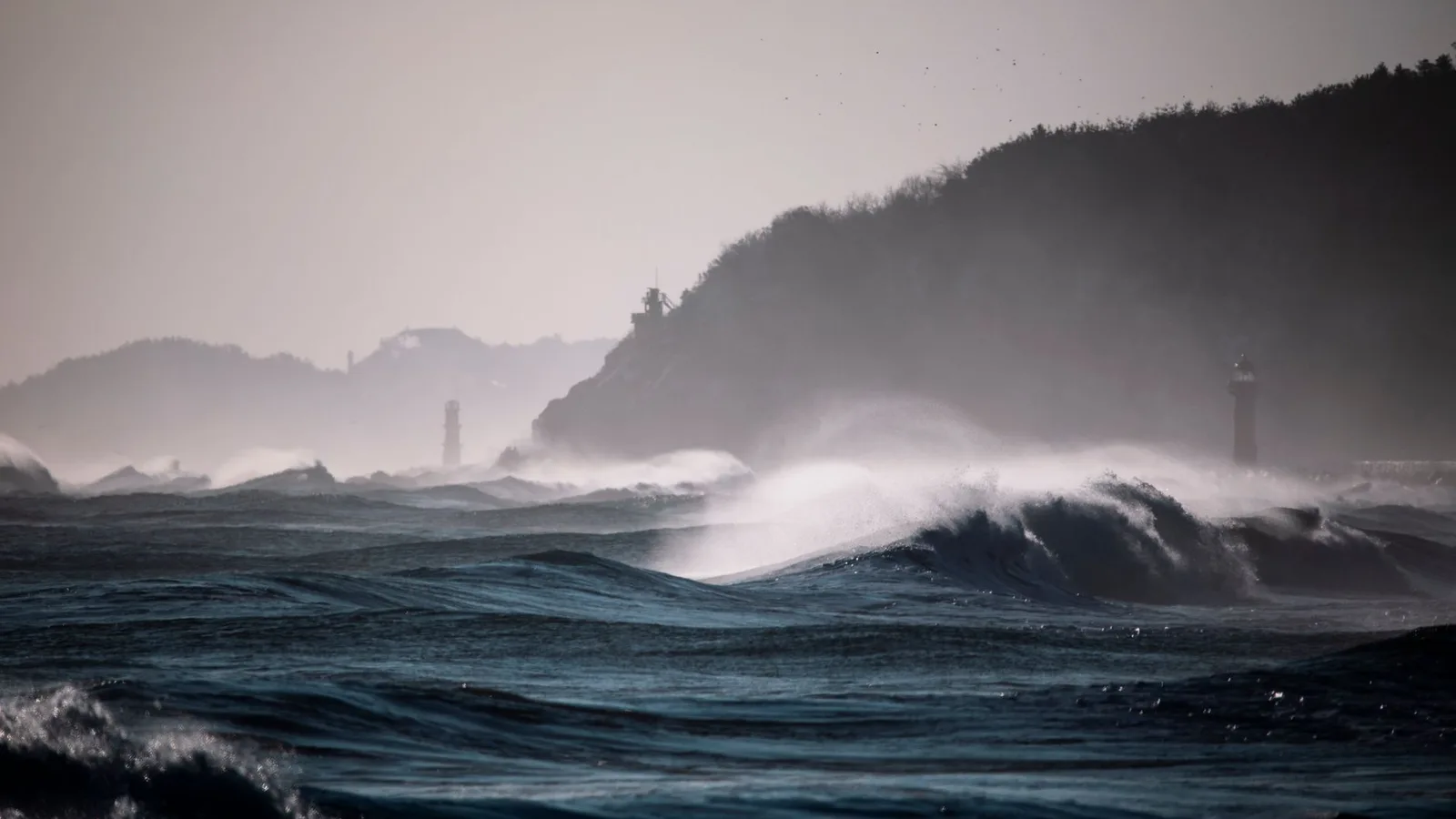
Heavy sea breaking against a coast below a lighthouse. Eilean Mòr lies about twenty miles west of Lewis, and the west landing there is over a hundred feet above the water.
On 26 December 1900 the relief vessel Hesperus reached Eilean Mòr in the Flannan Isles, twenty miles into the Atlantic west of Lewis. No flag was flying. No provision boxes were waiting on the landing. Nobody answered.
The three keepers — James Ducat, Thomas Marshall and Donald McArthur — were gone, and have never been accounted for.
The version of this story that circulates is a good deal more dramatic than the record, and the difference between the two can be dated exactly.
What is documented
The light had been established a year earlier, in December 1899. Ducat was the principal keeper. Marshall was the second assistant. McArthur was an occasional keeper, standing in for a man on sick leave — a detail that matters later.
A passing steamer, the Archtor, noted on 15 December that the light was not burning. The report did not reach the Northern Lighthouse Board promptly, and weather delayed the relief for eleven days.
When Joseph Moore went up to the station he found the entrance gate and the doors closed, the beds unmade, the kitchen clock stopped and the ashes in the grate long cold. Two of the three sets of oilskins were missing. McArthur's were still hanging on their peg.
At the west landing there was damage on a scale that is difficult to picture. Iron railings were bent. A block of stone estimated at a ton had been shifted. A wooden box fixed in a crevice one hundred and ten feet above the sea had been torn out and its ropes and life-buoy strewn about. Turf was stripped from the cliff top at around two hundred feet.
What was added later, and by whom
The entries that appear in nearly every popular account describe a storm of unprecedented severity, Ducat becoming quiet and irritable, Marshall reduced to tears, and a final line reading that God is over all.
They are not in Muirhead's report. They are not in the Northern Lighthouse Board's records. They are not in any contemporary newspaper. There is no surviving document in which they appear before 1929.
In that year a story built around them was published in the American magazine True Strange Stories under the name Ernest Fallon — a pseudonym of the journalist John L. Spivak. The entries were written for the piece. They then detached themselves from it and were repeated as fact for the next century.
A second layer came earlier and more honestly. Wilfrid Wilson Gibson published a poem called "Flannan Isle" in 1912, which is openly a poem and does not pretend otherwise. It supplied the image of an untouched meal and an overturned chair. Those, too, are now quoted as though they were in the report.
The explanation the investigator reached
Muirhead concluded that the men had gone down to the west landing to secure gear against heavy weather, and that an exceptional sea had taken them.
The physical damage supports it directly. Water reaching a hundred and ten feet does not require anything unusual to have been present; it requires an unusually large wave, and that coast produces them. Storm systems in that week are on record.
The Draupner wave measurement in 1995 confirmed that individual waves far larger than the surrounding sea state occur in nature, which retrospectively made Muirhead's reading less remarkable than it once sounded.
The one thing that is genuinely odd
Standing orders required a keeper to remain at the station. McArthur left without his oilskins.
This is the detail that keeps the case alive, and it is also the detail with the most human explanation. A man who looks out and sees his two colleagues about to be caught by a sea does not stop to put on a coat.
Join the discussion
Still open on this one:
- 01
Do the dramatic log entries exist anywhere in an archive?
No copy predating the 1929 magazine publication has ever been produced, and the Northern Lighthouse Board holds no such entries.
Be the first to comment
Sources
Open them and check for yourself. Where a record is public, it is linked.
Flannan Isles — station history
Northern Lighthouse Board
NRS
Report of Superintendent Robert Muirhead, 8 January 1901
Northern Lighthouse Board · no public copy located
Related

Psychic Phenomena
The Nine: who — or what — were they?
On New Year’s Eve 1952, in a laboratory in Maine, a voice announced itself as one of nine. Over the next forty years it reached a credentialled scientist, a celebrity psychic, a bestselling book and the creator of Star Trek. This is what is documented, and what is not.

Psychic Phenomena
New Year’s Eve 1952: the first session with the Nine
The founding event of the whole Nine phenomenon happened in a Maine farmhouse on 31 December 1952. Here is what the record supports about that evening, and how much of the familiar account was written down much later.

Psychic Phenomena
D. G. Vinod: the man at the beginning of the Nine
Every version of the Nine story starts with Dr D. G. Vinod in a trance in Maine. He is also the person that story then almost entirely forgets. Why the first channel is the biggest hole in the record.

Psychic Phenomena
Andrija Puharich: the doctor who kept turning up
A qualified physician, an inventor with real patents, an army medical officer — and the constant in forty years of the strangest story in American parapsychology. Puharich is the reason the Nine keep touching institutions.
0 comments