

Case File 063 · Open — under excavation
Göbekli Tepe
c. 9500 BC · Germuş range, Şanlıurfa Province, Türkiye · 37.22°N 38.92°E
- Documents
- 10
- Images
- 0
- Videos
- 2
- Witnesses
- 6
Overview
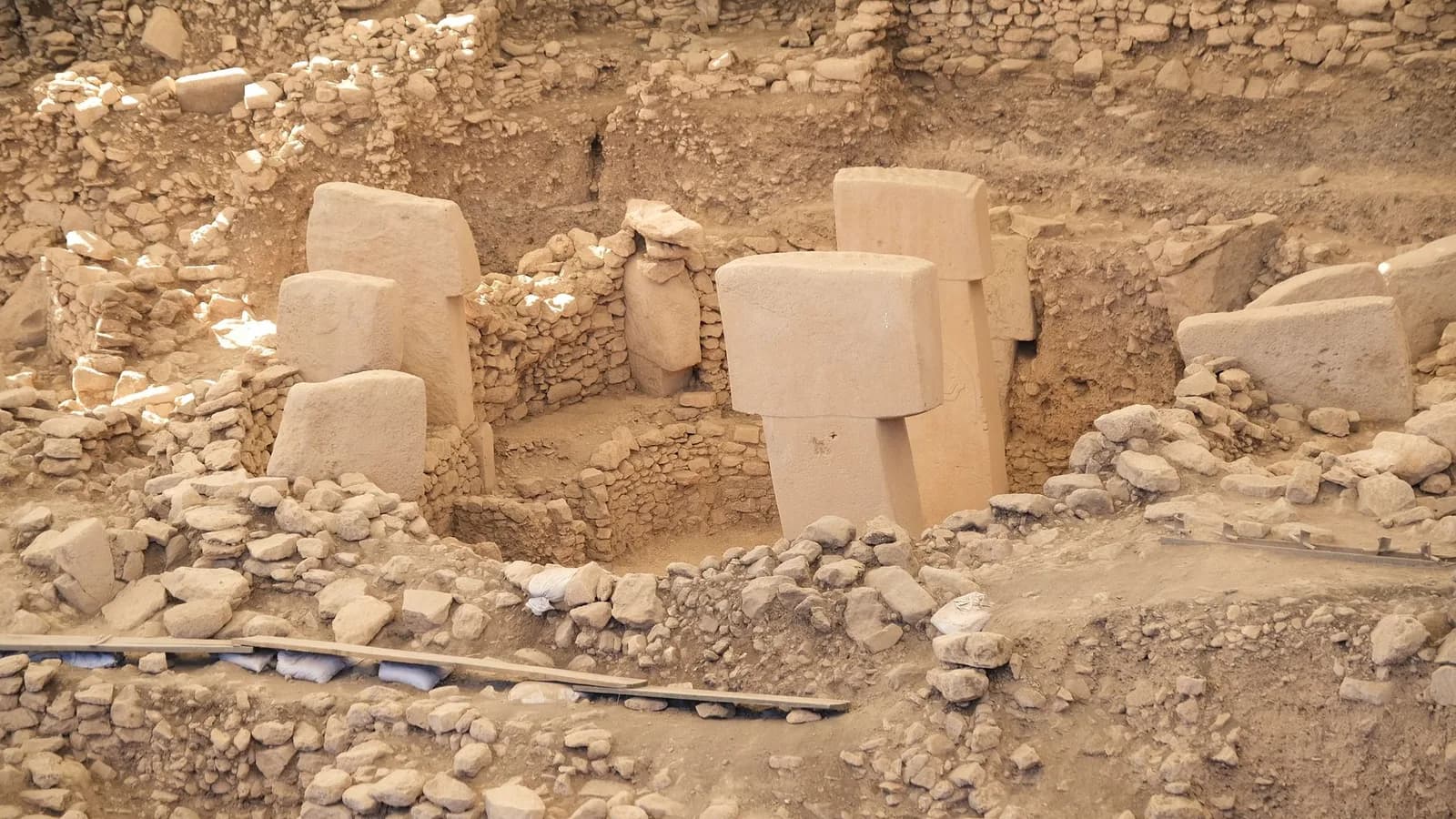
Göbekli Tepe is a man-made mound roughly 300 metres across and up to 15 metres high, on the highest point of the Germuş range about 15 kilometres north-east of Şanlıurfa. Under it are circular and oval enclosures walled in stone, each built around pairs of T-shaped limestone pillars up to 5.5 metres tall and weighing as much as ten tonnes, many of them carved in relief with foxes, boars, snakes, scorpions, cranes and vultures. Radiocarbon places the oldest of them in the tenth millennium BC — before pottery, before metal, before writing, before the wheel, and before any domesticated crop or animal in the region.
That combination is what makes the site matter, and it is not seriously disputed by anyone. The standard account of the Neolithic ran: farming produces surplus, surplus produces settlement, settlement produces monuments. Göbekli Tepe has the monuments arriving first, built by people whose rubbish heaps contain nothing but wild animals. Whatever else is argued about the site, that inversion is the finding, and it came out of an ordinary excavation trench.
This file is unusual among the dossiers here in that the primary evidence is abundant, published, peer-reviewed and still accumulating — and in that the excavators have publicly abandoned several of their own earlier conclusions. Klaus Schmidt’s reading of the site as a sanctuary visited by people who did not live there has been substantially revised by the team that succeeded him. The "deliberate burial" that made the site famous is now thought to be mostly erosion. What follows separates the excavated record from the interpretations layered on it, in both directions: the archaeology is stranger than the sceptical summary allows, and very much thinner than the popular one requires.
Timeline
c. 9500–8800 BC
Layer III: the monumental enclosures are built
The oval enclosures now labelled A to H, walled in stone with benches and built around two free-standing central T-pillars. Wall plaster from Enclosure D has been radiocarbon dated to 9984 ± 42 BP, calibrating to 9745–9314 BC at 95.4% confidence. The pillars were quarried from the same limestone the mound sits on; unfinished examples remain in the bedrock quarries a few hundred metres away.
c. 8800–8000 BC
Layer II: smaller rectangular buildings
The monumental enclosures give way to rectangular rooms with benches along the walls, grinding installations set into the floors, and much smaller pillars. This is the phase from which most of the domestic evidence comes.
c. 8000 BC
The site goes out of use
Occupation ends and the mound accumulates its covering of sediment. Whether that covering was placed there or washed there is one of the live disputes in the file.
1963
Recorded, catalogued, and passed over
The site was recorded during the joint Istanbul–Chicago survey of the Urfa province. Peter Benedict described it as a cluster of mounds of reddish soil separated by depressions and identified it as prehistoric. Attention went instead to Çayönü, found on the same survey, and Göbekli Tepe was left alone for thirty years. The projecting tops of the buried pillars had long been taken locally for gravestones.
1983–1991
Nevalı Çori is excavated, then flooded
Harald Hauptmann directed rescue excavations at Nevalı Çori ahead of the Atatürk dam. They produced a rectangular building with T- and gamma-shaped pillars along its walls, a bench connecting them, and a pair of T-pillars at the centre. The site was lost under the reservoir in 1991. It is the reason the next event happened.
October 1994
Klaus Schmidt visits the mound
Schmidt, who had worked at Nevalı Çori, went looking in the Şanlıurfa region for another site of the same character and was directed to Göbekli Tepe by the Yıldız family, who farmed the land. Having seen Nevalı Çori’s pillars, he recognised the "gravestones" as broken T-pillars of the same tradition.
1995
Excavation begins
A cooperative project between the Museum of Şanlıurfa, under Adnan Mısır, and the Istanbul department of the German Archaeological Institute, under Harald Hauptmann, with Schmidt leading the research. The first test trench cut Layer II rectangular buildings and pillar fragments.
1996
Enclosure A is found
Work moved to an area where a landowner had begun breaking up T-pillars, and uncovered the first monumental Layer III structure with elaborately carved central pillars. The site’s reputation dates from this trench.
2003
The mound is surveyed without digging it
Magnetic prospection, ground-penetrating radar and geoelectric tomography were carried out by GGH – Solutions in Geoscience, with follow-up surveys in 2006, 2007 and 2012. Schmidt’s field report recorded more than ten further large enclosures in the geomagnetic map and calculated a total of more than 200 pillars across a minimum of twenty enclosures. Almost all of it remains in the ground by deliberate policy.
20 July 2014
Schmidt dies
Klaus Schmidt (b. 1953) died of a heart attack while on holiday in Germany, having directed the excavation for nineteen years. Work continued under Müslüm Ercan of the Şanlıurfa museum and Lee Clare of the German Archaeological Institute; the directorship passed to Necmi Karul of Istanbul University in 2020.
28 June 2017
The modified skulls are published
Julia Gresky, Juliane Haelm and Lee Clare published three partially preserved human crania carrying deep intentional incisions along the sagittal axis, one with a drilled perforation in the left parietal and traces of red ochre. No parallel was known from any contemporaneous site or from the ethnographic record.
2017
The archaeoastronomy dispute
Martin Sweatman and Dimitrios Tsikritsis argued in Mediterranean Archaeology and Archaeometry that the carvings on Pillar 43 encode a date of 10,950 BC. The excavation team replied in the same journal, in the same year, setting out why they did not accept it.
1 July 2018
World Heritage inscription
Inscribed by the World Heritage Committee at its 42nd session in Manama under criteria (i), (ii) and (iv). A protective canopy over the main excavation area was completed the same year.
1 May 2019
The grinding stones are counted
Laura Dietrich and colleagues published a study of more than 7,000 ground-stone artefacts from the site, including use-wear analysis of 1,166 handstones and phytolith analysis of surfaces and sediments. The conclusion was large-scale cereal processing, at a volume the authors judged too high for daily household use.
2021
Taş Tepeler
The Turkish Ministry of Culture and Tourism launched a regional programme treating Göbekli Tepe as one site among a group — initially seven, later a dozen — including Karahan Tepe, Sayburç, Sefertepe and Çakmaktepe. The programme is the single most consequential development for how the site is interpreted, because it removes the site’s uniqueness.
August 2024
The calendar claim
Sweatman published a reading of the V-shaped marks on Pillar 43 as a 365-day lunisolar calendar with eleven epagomenal days, in the journal Time and Mind. It was reported worldwide within days as the world’s oldest calendar.
7 October 2025
The 2025 season closes
The dig team, led by Necmi Karul, reported a human statue with defined head and torso recovered from a wall between Enclosures B and D, and described the season’s main effort as restoration in Enclosure C, including reinforcing walls and re-erecting pillars.
Key people
Peter Benedict
Surveyor, joint Istanbul–Chicago prehistoric survey of south-eastern Anatolia
Recorded the site in 1963 and correctly identified it as prehistoric. His published description of mounds of reddish soil separated by depressions is the earliest scientific account of the place, and it went nowhere for thirty years.
Klaus Schmidt
German Archaeological Institute; excavation director 1995–2014
Recognised the site in 1994 and dug it for nineteen years. He argued it was a sanctuary — a place hunter-gatherers gathered at and did not live in — and popularised the phrase that has followed it ever since. Most of the primary publication of the site is his. Much of his interpretation has since been revised by his own team.
Lee Clare
German Archaeological Institute; research coordinator of the Göbekli Tepe project from 2015
Has led the reassessment of the site as a place of long-term occupation rather than pure pilgrimage, on the strength of water management installations and domestic material, and co-authored the skull study. He is also the most consistent public critic of astronomical readings of the pillars.
Necmi Karul
Istanbul University; director of excavations from 2020 and head of the Taş Tepeler programme
Runs both Göbekli Tepe and the wider regional programme, which is why the two are now reported together. Under his direction the emphasis has shifted towards conservation of what is already exposed.
E. B. Banning
Archaeologist, University of Toronto
Published the most substantial academic objection to the sanctuary reading, arguing in 2011 that the enclosures are better understood as houses and that the temple framing imports a distinction between sacred and domestic space that may not have existed. The excavators replied in print; the argument is unresolved and is the strongest internal challenge in the file.
Martin Sweatman
Chemical engineer, University of Edinburgh
Author of the archaeoastronomical readings of Pillar 43 — a date stamp for a comet impact in 2017, a solar calendar in 2024. Both were widely reported and both were rejected by the excavation team. He is not an archaeologist and does not claim to be; his papers are the clearest test case in this file of how a checkable claim about a real object fares against the site record.
Evidence
Each item carries a status. Where something is contested or has been debunked, it says so.
The radiocarbon sequence
VerifiedScientific analysis
Dated samples include wall plaster, charcoal from deep soundings, and animal bone from enclosure fills. Wall plaster from Enclosure D gave 9984 ± 42 BP, or 9745–9314 cal BC; charcoal from soundings beside it gave 9664–9311 cal BC. The excavators state the limitation themselves: because the enclosures were refilled, organic material in the fill may be older or younger than the structure around it, so most of the dates bracket the enclosures rather than date their construction directly. The plaster date is the exception, and it is why the tenth-millennium placement holds.
The Layer III enclosures and their pillars
VerifiedStructure
Enclosures A to H, excavated and standing. Central pillars up to 5.5 metres and ten tonnes, cut from the same hilltop bedrock, several carved with arms folded across the front, hands meeting above a belt, and what has been read as a fox-pelt loincloth — that is, they are stylised human figures, not abstract slabs. Unfinished pillars remain in the adjacent quarries, which establishes local manufacture beyond argument.
The faunal assemblage
VerifiedPhysical
Tens of thousands of animal bones, and every identified species is wild — gazelle dominant, then aurochs, with wild boar, red deer, fox, Asiatic wild ass and birds. There are no domesticated animals. This is the single most decisive piece of evidence in the file: it is what fixes the builders as hunters, and it is what any claim of a technologically advanced predecessor culture has to explain away.
Grinding equipment and phytoliths
VerifiedPhysical
More than 7,000 ground-stone artefacts, with use-wear analysis of 1,166 handstones and phytolith analysis of surfaces and sediments, published in 2019. The wear patterns and plant silica indicate processing of wild einkorn and barley on a scale the authors considered beyond household needs, and consistent with feasting. The morphometric data leave open whether some barley was already domesticated.
Three modified human crania
VerifiedPhysical
Skull fragments carrying deep incisions cut with flint along the sagittal axis; one has a drilled hole in the left parietal and traces of red ochre. Published in Science Advances in 2017 as evidence of a form of skull treatment not previously documented. What it was for is unknown. That it was deliberate is not in question.
The unexcavated mound
UnexaminedGeophysical survey
Magnetic, radar and geoelectric survey from 2003 onward indicate a minimum of twenty enclosures and more than 200 pillars across the mound, of which a handful have been dug. The excavators are explicit that only very large structures register in the survey maps, so the figure is a floor rather than a count, and that geophysics predicts structure but cannot say what any enclosure contains. Enclosure H was found where the survey said it would be, which is the main reason the projections are taken seriously.
Rock-cut basins and channels
ContestedStructure
Large cisterns and channels cut into the limestone at the top of the hill. The current excavation team reads them as rainwater harvesting, and treats that as an indicator of people living on site — there is no spring on the ridge, so water had to come from somewhere. The counter-reading is that basins in a working limestone quarry need not be water infrastructure, and that dating rock-cut features is notoriously difficult because there is nothing in them to date.
The deliberate backfilling of the enclosures
ContestedStratigraphy
Schmidt argued the enclosures were intentionally buried, which is why they survived intact and why the site is often described as having been hidden on purpose. Subsequent site-formation work has largely reversed this: the fill matches material from the surrounding slopes, the mound’s topography of hollows and steep slopes favours erosion, and heavy winter rain will do the job unaided. The current position is closer to partial intentional filling followed by natural infill. This matters because "someone buried it deliberately" is load-bearing for a great deal of speculation that the sediment does not support.
The equilateral-triangle plan of Enclosures B, C and D
ContestedAnalysis
Gil Haklay and Avi Gopher argued in 2020 that the three enclosures were laid out as one geometrically planned complex, their central pillar pairs forming an equilateral triangle. The objection is chronological rather than geometric: the enclosures are not demonstrably contemporaneous, and if they were built in sequence the later ones could have been sited relative to the first. Haklay and Gopher answer that there is no evidence they are not contemporaneous, which concedes that the point is unestablished either way.
Pillar 43 read as a date stamp for 10,950 BC
DebunkedInterpretation
Sweatman and Tsikritsis mapped the animals on the "Vulture Stone" to constellations and derived a date matching the onset of the Younger Dryas. The excavation team’s published reply is decisive on chronology: the proposed date is 700 to 1,000 years older than the oldest radiocarbon date from the enclosure the pillar stands in. They add that many pillars at the site are not in their original positions, that the buildings were repeatedly modified, and that the substitution scheme ignores details that contradict it — the "dying man" figure has an emphasised phallus. A carving cannot record an event that predates the building it is in by a millennium.
Pillar 43’s V-marks read as a 365-day calendar
ContestedInterpretation
The 2024 claim: the V-shaped marks count days, giving twelve lunar months plus eleven intercalary days. It is arithmetically tidy and it is published. It is also built on the 2017 asterism identifications, which the excavators rejected, and it requires that the marks be a counting system rather than a decorative or symbolic motif — a premise for which there is no independent support anywhere in the corpus. It is listed as contested rather than debunked because, unlike the 2017 date, nothing in the site record directly contradicts it. Nothing in the site record supports it either.
The site as evidence of a vanished advanced civilisation
DebunkedClaim
The popular reading — that hunter-gatherers could not have built this, so someone else did, and was then destroyed. The assemblage refutes it directly: chipped flint, no metal, no pottery, no writing, no wheel, no domesticated animals at all, and cereals that are wild or at most transitional. A surviving advanced culture leaves a different rubbish heap than this one. The stronger refutation is Taş Tepeler: a dozen related sites spanning centuries, with pillar forms, enclosure shapes and carving styles that change over time. Development in place is what a tradition being worked out looks like, and it is the one thing an arrival from elsewhere cannot produce.
Witness accounts
Recorded the mound in 1963 as a cluster of reddish soil mounds separated by depressions, noted the worked limestone and flint on the surface, and classified the site as Neolithic. He did not identify the T-pillars for what they were, and no one returned for thirty-one years. His account is included because it establishes that the site was known, described in print, and correctly dated long before it was famous.
Described recognising the broken pillar tops as Neolithic work on his first visit, on the strength of having excavated Nevalı Çori. He maintained throughout that the enclosures were sanctuaries rather than dwellings, that they were intentionally backfilled, and that the labour of building them helped drive the domestication of local cereals rather than following it. The third of those is still argued; the first two have been substantially revised by his successors.
Has argued publicly since the late 2010s that the site shows long-term occupation, citing rainwater harvesting installations on a ridge with no spring, domestic material and grinding equipment set into floors. He co-authored the 2017 skull publication and has repeatedly stated that astronomical readings of individual pillars cannot be sustained while the original arrangement of the pillars is itself unsettled.
Reporting the close of the 2025 season, Karul described the year’s work as centred on Enclosure C — reinforcing walls, reassembling and re-erecting standing pillars — and reported a human statue with clearly defined head and torso recovered from a wall between Enclosures B and D. He said the emphasis in coming seasons would remain on reinforcement and conservation of already-exposed structures.
Argued in Current Anthropology in 2011 that the Göbekli Tepe enclosures are more economically explained as houses than as temples, that the sacred–domestic distinction the temple reading depends on is an anachronism in this period, and that decorated domestic architecture is well attested elsewhere in the Pre-Pottery Neolithic. The excavators published a rebuttal. He returned to the argument in 2023, and by then some of the excavators had moved partway towards him.
Published two archaeoastronomical readings of Pillar 43 — with Dimitrios Tsikritsis in 2017, arguing the carvings record a comet impact around 10,950 BC, and alone in 2024, arguing the V-shaped marks constitute a lunisolar calendar. He has maintained both positions against the excavation team’s published objections. Both papers are in peer-reviewed journals; neither has been accepted by anyone who has dug the site.
The argument
Both sides, given equal room. The alternative explanations are not an afterthought.
Supporting the claim
The dating is secure and it inverts the sequence
Almost every dispute on this site is about evidence that might not be what it appears to be. This one is not. Wall plaster from Enclosure D — material that was part of the structure, not dropped into it later — dates to the tenth millennium BC, and the surrounding samples agree. That places monumental construction a thousand years or more before pottery and before the domesticated crops of the region. The textbook order of the Neolithic was wrong, and it was corrected by a trench, not an argument.
The organisational demand is real and quantifiable
Ten-tonne pillars were quarried with flint, moved a few hundred metres, stood upright, and carved in relief, repeatedly, over centuries. That requires a workforce assembled and fed by people who had no stored surplus of the kind farming produces. The 2019 grinding-stone study gives the mechanism a scale: more than 7,000 pieces of ground-stone equipment, with wear consistent with cereal processing well beyond daily household use. Something was feeding a lot of people at once, and it was doing so on wild plants.
It is not one site, which makes it harder to dismiss and harder to mythologise
Göbekli Tepe alone is an anomaly, and anomalies attract exotic explanations from both directions — visitors from elsewhere on one side, "it must be less impressive than reported" on the other. A dozen related sites across the Şanlıurfa region, spanning centuries, with an architectural vocabulary that visibly develops between them, is neither. It is a culture, and cultures are studied.
The excavators keep changing their minds in public, and that is a mark in the record’s favour
The sanctuary reading, the intentional-burial reading and the not-a-settlement reading were all published by the excavation team and have all been substantially retracted or qualified by the excavation team. That is unusual in any field and rare in this one. It means the account of Göbekli Tepe now on offer has already survived its own authors trying to break it.
Alternative explanations
They are houses, and "temple" is a category error
Banning’s argument, and it is the strongest thing in this file. Decorated buildings are not evidence of religion unless you already assume a sacred–domestic split, which is a distinction from later societies read backwards into this one. The enclosures have benches, hearth-adjacent debris, grinding installations and the ordinary residue of living. The current excavation team has moved a long way towards this position without conceding it entirely — the water-harvesting installations were their evidence, not his. If Banning is right, the famous inversion still holds (the buildings still predate farming) but the mystique does not: these are elaborate houses built by hunter-gatherers, which is remarkable without being inexplicable.
The burial was erosion, and the mystery it generated was never there
Half the popular writing on Göbekli Tepe turns on someone having deliberately hidden it. The site-formation evidence has gone the other way: the fill is slope material, the topography channels it into the hollows, and the winter rainfall is heavy enough to do it. Once the burial is ordinary, so is the survival — the enclosures are intact because they filled up, not because anyone wanted them preserved. This is the clearest case on the site of a spectacular question dissolving under unglamorous sedimentology.
The astronomy fails on stratigraphy before it fails on astronomy
Every celestial reading of the pillars assumes that the arrangement being read is the arrangement as built. It is not established that it is. Pillars at the site have been moved, reused, re-erected and rebuilt around; the excavators say plainly that the original layout of the monumental buildings remains under investigation. Any argument that depends on the precise position and orientation of a carved stone is resting on a variable the excavation has not yet fixed. That objection does not require disproving a single constellation.
The apparent suddenness is partly a preservation artefact
Göbekli Tepe looks like something arriving from nowhere partly because stone survives and nothing else does. Monumental construction in timber, reed, hide or earth would leave nearly no trace at eleven thousand years, and the social organisation the site demonstrates need not have appeared with the site. Nevalı Çori, dug before Göbekli Tepe and drowned in 1991, already had T-pillars. The question is not whether there were antecedents; it is whether any survive to be found.
Astronomical numerology will always find something
A monument with enough carved elements will always yield an arrangement that matches a sky. There are many animals on Pillar 43, many constellations, and no independent constraint on the mapping between them; the fit is a measure of the search space rather than of the ancient intent. The 2024 calendar reading is a sharper version of the same problem — 365 is recoverable from a large enough set of marks by anyone who goes looking for it, which is why the burden is on demonstrating that the marks were ever a counting system at all.
Video
Interviews and documentary material relating to this case.
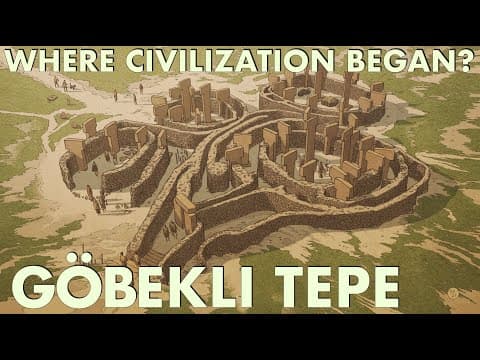
Long-form documentary treatment. Predates the current excavation team’s move away from the sanctuary reading, and frames the site accordingly.
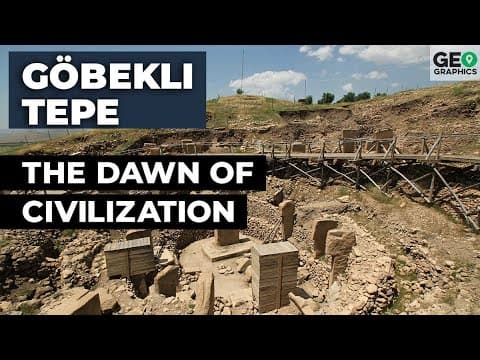
General overview of the site and its dating.
Latest developments
1 Jul 2018
Inscribed as a World Heritage Site
Inscribed at the 42nd session of the World Heritage Committee in Manama under criteria (i), (ii) and (iv). The inscription accelerated visitor infrastructure at the site, which is now a management problem in its own right: the protective canopy, walkways and access roads all sit on an almost entirely unexcavated mound.
1 May 2019
The cereal-processing study reframes the food question
Publication of the ground-stone analysis moved the argument from whether large groups gathered at the site to how they were fed while they were there, and gave the feasting hypothesis its first quantitative footing.
1 Aug 2024
The calendar story circles the world in a week
The 2024 Time and Mind paper produced a global news cycle announcing the oldest known calendar. Nothing new had been excavated; the claim was a fresh reading of a pillar exposed in the 1990s, resting on an interpretive framework the site’s excavators had already rejected in print in 2017.
7 Oct 2025
The 2025 season closes with a statue and a lot of scaffolding
A human statue was recovered from a wall between Enclosures B and D, apparently placed there deliberately. The season’s larger story was conservation: the exposed enclosures have now been open for up to thirty years and the work has shifted towards holding them together.
What we could not settle
Loose ends we are still working on.
- 01
Where are the dead?
No burials have been found at Göbekli Tepe. Human remains are present only as fragmented bone in fill deposits and adjacent areas — including the three modified crania. A site occupied or intensively used across a millennium and a half should have a cemetery somewhere. Nothing in the excavated area or the survey has produced one.
- 02
How many enclosures are actually under the mound?
Geophysics gives a floor of twenty and more than 200 pillars, but the excavators note that only very large structures register at all. The real number could be substantially higher and cannot be established without digging, which is not going to happen soon and should not.
- 03
Were Enclosures B, C and D standing at the same time?
The geometric planning argument requires it and does not demonstrate it. Neither side has produced stratigraphic or radiometric evidence settling contemporaneity, and both have acknowledged as much in print.
- 04
Did people live on the ridge year-round, seasonally, or not at all?
The water installations and grinding equipment argue for occupation; the absence of clear domestic structures in Layer III and the feasting-scale food processing argue for periodic gathering. These are not mutually exclusive and the excavation has not separated them.
- 05
Was any of the cereal at the site domesticated?
The 2019 morphometric data are consistent with wild einkorn and barley, and could indicate early domesticated barley. "Could indicate" is where the evidence stops, and it matters, because a domesticated grain at Göbekli Tepe would change the direction of the whole monuments-before-farming argument.
- 06
Why do the carvings ignore what the builders ate?
Gazelle dominates the bone assemblage and is almost absent from the reliefs, which favour predators, scorpions, snakes, boar and birds. The mismatch is real, it is well documented, and no explanation for it has better standing than any other.
- 07
Do the carvings encode anything at all?
Every decoding of Pillar 43 assumes the imagery is a message with a recoverable referent. It may be. It may also be iconography whose meaning was carried in practice and speech and is simply gone. There is no test currently available that distinguishes these, and the record may not contain one.
Got something to add?
A question, a source we missed, a correction, or something you saw yourself — all of it is welcome here. You do not need to be an expert, and you are allowed to disagree with us.
Nobody has yet — go on.
Sources
Sources
Open them and check for yourself. Where a record is public, it is linked.
Göbekli Tepe — World Heritage List inscription
UNESCO World Heritage Centre · 1 Jul 2018
Tepe Telegrams — the Göbekli Tepe Research Project
Deutsches Archäologisches Institut
Göbekli Tepe — The first 20 years of research
Deutsches Archäologisches Institut, Tepe Telegrams · 2 Jun 2016
How old is it? Dating Göbekli Tepe
Deutsches Archäologisches Institut, Tepe Telegrams · 22 Jun 2016
Looking beneath the surface: geophysical surveys at Göbekli Tepe
Deutsches Archäologisches Institut, Tepe Telegrams · 18 Jul 2018
A Sanctuary … or so fair a House? — the excavators’ reply to Banning
Deutsches Archäologisches Institut, Tepe Telegrams · 24 Jan 2017
Modified human crania from Göbekli Tepe provide evidence for a new form of Neolithic skull cult
J. Gresky, J. Haelm & L. Clare; Science Advances 3(6) · 28 Jun 2017
Cereal processing at Early Neolithic Göbekli Tepe, southeastern Turkey
L. Dietrich et al.; PLOS ONE 14(5) · 1 May 2019
Geometry and architectural planning at Göbekli Tepe, Turkey
G. Haklay & A. Gopher; Cambridge Archaeological Journal 30(2) · 1 May 2020
Decoding Göbekli Tepe with archaeoastronomy: what does the fox say?
M. B. Sweatman & D. Tsikritsis; Mediterranean Archaeology and Archaeometry 17(1) · 1 Jan 2017
More than a vulture: a response to Sweatman and Tsikritsis
J. Notroff, M. Kinzel, O. Dietrich, L. Dietrich, C. Lelek Tvetmarken, L. Clare & J. Schlindwein; Mediterranean Archaeology and Archaeometry 17(2) · 3 Jul 2017
M. B. Sweatman; Time and Mind 17(3–4) · 6 Aug 2024
E. B. Banning; Current Anthropology 52(5) · 1 Oct 2011
J. Peters & K. Schmidt; Anthropozoologica 39(1), 179–218 · 1 Jan 2004
2025 dig season concludes at famed ancient Turkish site Gobeklitepe
Anadolu Agency · 7 Oct 2025
Survey work in southeastern Anatolia — the 1963 report recording Göbekli Tepe, in Prehistoric Research in Southeastern Anatolia I
P. Benedict, in H. Çambel & R. J. Braidwood (eds), Istanbul University — no stable public link; held in university and institute libraries · 1 Jan 1980 · no public copy located
See also
Everything this piece touches
Other case files
 Case File 051
Area 51
1955–present · Groom Lake, Lincoln County, Nevada
A flight test range the United States denied existed for forty years, in litigation, against men who had worked there. It was acknowledged in a presidential memorandum in 1995 and named in a CIA history in 2013. What it was for is documented. What it is for now is not.
5 documents · 0 images · 1 videos
 Case File 018
MKULTRA
1953–73 · United States and Canada
Twenty years of CIA research into drugs, hypnosis and behavioural control. The records were destroyed in 1973; what survives does so by a filing error, and it is enough.
0 documents · 0 images · 0 videos
 Case File 017
The Patterson–Gimlin film
1967 · Bluff Creek, northern California
Fifty-nine seconds of 16mm film shot on 20 October 1967. Two hoax claimants, one missing camera original, and a reel surfaced in 2026 that nobody outside the production has examined.
13 documents · 0 images · 1 videos
 Case File 009
Rendlesham Forest
1980 · Suffolk, England
December 1980, Suffolk. Three nights, two airbases, and a memorandum that has been argued over ever since. Britain’s most examined case.
0 documents · 1 images · 2 videos
 Case File 031
Nimitz Tic Tac
2004 · Pacific Ocean
November 2004, off the coast of Baja California. Radar, FLIR and aircrew accounts from the USS Nimitz carrier strike group, assembled in one place.
0 documents · 0 images · 4 videos
 Case File 024
Roswell
1947 · New Mexico
July 1947, Lincoln County, New Mexico. The recovery that produced two official explanations, decades of testimony and one of the most heavily documented disputes in the field.
0 documents · 1 images · 1 videos
0 comments