

Case File 017 · Open — new material unexamined
The Patterson–Gimlin film
1967 · Bluff Creek, northern California
- Documents
- 13
- Images
- 0
- Videos
- 1
- Witnesses
- 4
Overview
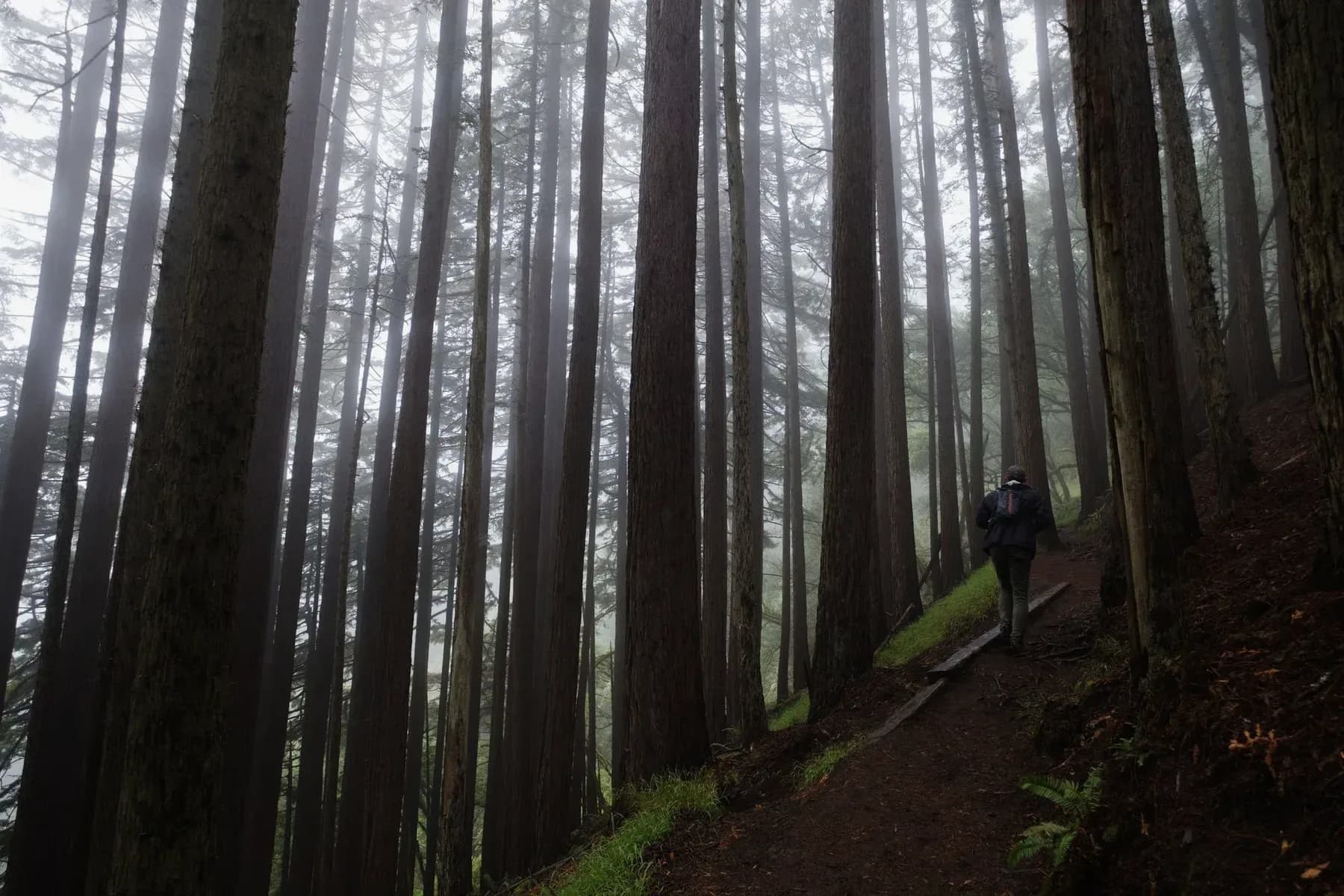
On the afternoon of 20 October 1967, Roger Patterson and Bob Gimlin filmed a large bipedal figure walking away from them along a sandbar at Bluff Creek, in the Six Rivers National Forest of northern California. The result runs a little under a minute on 16mm Kodachrome II, shot handheld with a rented Cine-Kodak K-100. Frame 352 of it is among the most reproduced images of the twentieth century.
It is the only piece of alleged sasquatch evidence that a serious anatomist has ever analysed and declined to dismiss. It is also the only one with two named men on the public record claiming to have faked it, and a third — the filmmaker’s own son — saying in 2026 that he watched his father burn the costume.
What makes the case unusual is that it is, in principle, decidable. Almost everything turns on two physical objects: the camera-original reel, which would settle the frame rate and therefore the biomechanics, and a costume, which would settle everything. Neither has been produced. The camera original has not been publicly seen since 1980 and no suit has ever surfaced, in sixty years of looking, from either of the men who say they made or wore one.
This file separates what is documented — the film, the dated photographs of the trackway, the casts, the analyses — from what is asserted. The asserted material is substantial on both sides, and none of it has been resolved by examination of an object.
Timeline
27 August 1958
The Bluff Creek tracks that named the animal
Bulldozer operator Jerry Crew found large humanoid prints on a road cut at Bluff Creek. He cast one on 3 October; the Humboldt Times ran the photograph on 5 October 1958 under the word "Bigfoot". This is why Patterson went to Bluff Creek nine years later rather than anywhere else.
13 May 1967
Patterson rents the camera
Patterson hired the Cine-Kodak K-100 from Sheppard’s Camera Shop in Yakima, Washington. He did not return it on time; a warrant was issued on 17 October 1967, three days before the filming. He returned the camera in working order in 1969 and the charge was dismissed.
20 October 1967, early afternoon
The encounter
Riding upstream along the east bank, Patterson and Gimlin reported a figure at a bend behind a logjam, initially about 25 feet away. Patterson’s horse reared; by his account he lost roughly twenty seconds getting clear of the saddle and to the camera. He filmed while running, closing to within 60 to 90 feet. The subject walked away and was gone in under two minutes.
20 October 1967, evening
The first people told
The pair reached Al Hodgson’s variety store in Willow Creek, some 54 road miles south, at about half past six, and Patterson telephoned the Times-Standard in Eureka from there. The call is the earliest fixed point in the record outside the two men’s own accounts.
21 October 1967, before dawn
The prints covered against rain
Gimlin returned to the site around five in the morning to cover the trackway with bark and cardboard before heavy rain. The pair then left the area, fearing the creek would wash the sandbar out.
23 October 1967
A Forest Service employee photographs the trackway
Lyle Laverty of the US Forest Service visited the site and photographed the prints. He said he had been in the area on 19 and 20 October and had seen nothing of the kind. His photographs are the earliest documentation of the trackway by anyone other than Patterson and Gimlin.
26 October 1967
First substantial screening
The film was shown at the University of British Columbia. Seven further showings to scientific bodies followed through 1968, in Vancouver, New York, Washington DC and Atlanta.
Late October 1967
Titmus casts the trackway
Taxidermist Robert Titmus returned to the site about nine days after the filming and cast ten successive prints, mapping the line of travel rather than picking out the best two. It is the only attempt anyone made to record the trackway as a sequence.
December 1971
Grieve sees the film in London
René Dahinden took the film to Europe and showed it to D. W. Grieve, a reader in biomechanics at the Royal Free Hospital School of Medicine. Grieve’s written analysis became the strongest technical argument the case has.
January 1972
Patterson dies
Roger Patterson died of Hodgkin’s lymphoma, aged 38, maintaining to the end that the film was genuine. Everything said about his conduct since has been said about a man who could not answer.
1972
Napier publishes against the film
The primatologist John Napier, formerly of the Smithsonian, published Bigfoot: The Yeti and Sasquatch in Myth and Reality. He accepted that a large unknown North American primate was possible and concluded that this film was not evidence of one.
1980
The last confirmed sight of the original
Dahinden had Cibachrome images made from the camera-original film at a southern California vault. The original has not been publicly accounted for since; by the mid-1990s it was reported missing from storage.
30 January 1999
Heironimus claims the suit
Bob Heironimus, of Yakima, issued a press release through his lawyer Barry Woodard stating that he had worn the costume in the film and had never been paid the thousand dollars he says he was promised.
16 August 2002
A costume-maker claims the suit
Philip Morris, of Morris Costumes in Charlotte, North Carolina, said on WBT radio that he had sold Patterson a gorilla suit by mail order in 1967, with modifications requested to broaden the shoulders and lengthen the arms.
2004
The hoax case is put in print
Greg Long published The Making of Bigfoot, based on interviews begun in 1995, and Kal Korff and Michaela Kocis set out the Heironimus and Morris accounts in the Skeptical Inquirer. Neither produced the costume.
2011
The film site is relocated
The exact filming location was re-established after decades in which regrowth following the 1964 flood had made it unfindable. Ground-truthed distances from the relocated site feed the later image analyses.
12 March 2026
A second reel is shown at SXSW
The documentary Capturing Bigfoot, directed by Marq Evans, premiered at South by Southwest presenting a 40-second 16mm clip that the production dates to 1966 and reads as a rehearsal. Clint Patterson, Roger’s son, appears in it saying the film was faked.
Key people
Roger Patterson
Filmmaker; died January 1972
Had published a book on the subject in 1966 and went to Bluff Creek specifically to film a sasquatch. He was in debt, had not paid for the camera, and came back within months with the footage. He never retracted.
Bob Gimlin
Horseman; the surviving eyewitness
Born 18 October 1931, two days before the filming. He has told the same account for nearly sixty years, sued successfully in the 1970s for a share of the proceeds he had been denied, and was still appearing publicly in 2026.
Bob Heironimus
Claimed wearer of the costume
A Yakima acquaintance of Patterson. Went public on 30 January 1999. His description of the suit — heavy, horsehide-smelling — does not match the mail-order gorilla suit Philip Morris says he supplied, which is the central difficulty with the two accounts.
Philip Morris
Costume maker, Morris Costumes, Charlotte NC
Said in 2002 that he sold Patterson the suit. He has never produced a duplicate, an invoice, an order record or a pattern, and his 2004 attempt at a recreation did not reproduce the subject’s proportions.
D. W. Grieve
Reader in biomechanics, Royal Free Hospital School of Medicine
Analysed the gait in 1971–72 and made his conclusion explicitly conditional on the frame rate: at 16 or 18 frames per second a normal human could not produce the observed pattern; at 24 it is indistinguishable from a human walk. He declined to choose between the speeds.
John Napier
Primatologist, formerly of the Smithsonian Institution
The most senior scientist to examine the case at the time. He accepted the possibility of an unknown North American hominid and still judged that the evidence, taken together, indicated a hoax — his phrase was "a hoax of some kind".
Jeff Meldrum
Anatomist, Idaho State University; died 2025
Assembled over 300 track casts at ISU and co-authored the two 2013 image analyses in The Relict Hominoid Inquiry. His death was announced in September 2025; the future of the cast collection has not been publicly settled.
Marq Evans
Director, Capturing Bigfoot (2026)
Received the 16mm reel in June 2022 from Teresa Brooks, an Olympic College film instructor, who found it in the locked safe of her late father Norm Johnson — a Boeing film-lab worker in the relevant years.
Evidence
Each item carries a status. Where something is contested or has been debunked, it says so.
The Patterson–Gimlin film
VerifiedFilm
A genuine 16mm Kodachrome II reel of about 954 frames — published frame counts vary between 952 and 954 — shot in autumn 1967 at a site since relocated. That the artefact is what it is claimed to be is not seriously disputed by anyone, including those who say it records a costume. What it shows is the entire argument.
The camera-original reel
UnexaminedFilm
The exposure and edge characteristics of the original would establish the frame rate, and the frame rate decides the biomechanics. It was last publicly accounted for in 1980, when Cibachrome images were made from it at a southern California vault, and was reported missing by the mid-1990s. No full technical examination has ever been published.
Lyle Laverty’s photographs of the trackway, 23 October 1967
VerifiedPhysical
A US Forest Service employee photographed the prints three days after the filming and stated he had seen nothing there on 19 and 20 October. This is the only documentation of the trackway by someone with no stake in the film, dated within days, and it establishes that a trackway existed. It does not establish what made it.
The two plaster casts made on the day
ContestedPhysical
Patterson and Gimlin cast what they judged the best right and left prints on 20 October 1967, at roughly 14 to 15 inches long. They were made by the two interested parties, at a site where only they had been, on ground that takes an impression easily. Their evidential value depends entirely on trusting the men who made them.
Titmus’s casts of ten successive prints
ContestedPhysical
Robert Titmus cast a run of ten prints about nine days later and recorded the line of travel. A sequence is harder to fake than a single good impression, because depth, stride and weight transfer have to vary consistently along it. Against this: nine days of weather had passed, and Titmus was a committed proponent rather than a neutral examiner.
Claimed dermal ridges in casts from the Bluff Creek area
DebunkedPhysical
The strongest physical claim made for the casts was that they preserve dermatoglyphic ridge detail no hoaxer could produce. Matt Crowley showed experimentally that casting plaster into fine dry substrate produces near-identical desiccation ridges as it dries, and reproduced the features of the Onion Mountain cast — made by John Green in the same area in 1967 — from scratch. The specific ridge argument does not survive this. It says nothing either way about the film.
Bob Heironimus’s account
ContestedTestimony
A named man, locally connected to Patterson, who has not varied his claim since 1999 and who described the arrangement in circumstantial detail. He was also recalling events more than thirty years old, has produced no object, and describes a costume materially unlike the one Morris says was supplied.
Philip Morris’s costume account
ContestedTestimony
Morris ran a real and substantial costume business and gave a specific account of the sale and the modifications requested. He has never produced a record of the transaction or a garment matching the film subject, and his account surfaced three years after Heironimus’s rather than independently of it.
The reel presented in Capturing Bigfoot (2026)
UnexaminedFilm
A 40-second 16mm clip, given to the director in June 2022, said on the basis of markings on the stock to have been produced and developed in 1966, and read by the production as a rehearsal. If the dating holds, it ends the case. No independent laboratory has published on the stock, the edge codes or the provenance chain, and the film itself is the only published account of it.
The 1958 Bluff Creek tracks
DebunkedPhysical
The tracks that made Bluff Creek famous and drew Patterson to it. On Ray Wallace’s death in 2002 his family produced the carved wooden feet they said he had used, and Wallace had been the contractor on the road where the prints appeared. Researchers have argued the surviving Jerry Crew cast does not match the feet the family displayed, but the site’s reputation for faked tracks predates the film by nine years and is part of its context.
Witness accounts
Patterson said he saw the figure at about 25 feet, was thrown from a rearing horse, lost some twenty seconds getting to his camera and then filmed while running towards it. He gave the subject’s height first as six and a half to seven feet and later as around seven and a half. He repeated the account without material change until his death in January 1972.
Gimlin has described crossing the creek on horseback, dismounting with a rifle and deliberately not raising it, and following the figure until it went round a bend some 300 yards on. He put the height at about six feet — notably lower than Patterson’s estimate, and he has never revised it upwards to match.
Heironimus stated in a press release issued through his lawyer that he had worn the suit for Patterson on the agreement of a thousand dollars, that he was never paid, and that he had grown tired of keeping it to himself. He has repeated the claim consistently since, and has never produced the costume.
Speaking in Capturing Bigfoot, Clint Patterson said his mother had told him years earlier that the film was faked, and that he had watched his father burn the costume in a barrel behind the family house. It is the first account of the costume’s fate from inside the household, and it is testimony rather than an object.
The argument
Both sides, given equal room. The alternative explanations are not an afterthought.
Supporting the claim
The only technical analysis by a specialist did not go against it
Grieve, a biomechanist with no interest in the subject, found that at 16 or 18 frames per second the observed gait cannot be produced by a normal human being. That is a testable proposition about a physical system, made by a qualified person, and it has never been overturned — only stranded on the unresolved question of the film speed.
The trackway was documented by someone with no stake in it
Lyle Laverty photographed the prints on 23 October and said the ground had been clear three days earlier. A hoax therefore has to include not just a costume but a long trackway pressed into soft sand at plausible depths and stride, laid in a remote drainage, in the same window. That is a materially larger undertaking than walking past a camera.
Sixty years of attempted duplication have not produced a match
Morris’s own 2004 recreation did not reproduce the subject’s proportions, and no costume house since — with vastly better materials — has produced a garment that reads the same on 16mm. The 2013 analyses by Munns and Meldrum argue that the visible muscle displacement and limb proportions exceed what 1967 costuming could deliver. If it was a suit, it was a remarkable one.
The hoax claimants contradict each other
Heironimus describes a heavy horsehide-smelling suit; Morris describes a mail-order gorilla costume with altered shoulders and arms. Two confessions that do not describe the same object are weaker than one, not stronger, and neither man has ever produced the thing he says he made or wore.
Alternative explanations
A man in a costume — the plain reading
The strongest version of this is not about the film at all; it is about the circumstances. A man who had written a book on the subject the previous year, was in debt, was carrying a camera he had not paid for and was under warrant for it, went to the one place in America already famous for Bigfoot tracks with the declared intention of filming a Bigfoot, and returned with the only such footage ever obtained. Two named men later said they supplied and wore the suit. His widow and son have since said the family knew. No competing account explains the concentration of coincidences.
The frame rate is unknown, and the case rests on it
Grieve’s finding is conditional and the condition is unverifiable. Patterson said he found the dial at 18 fps afterwards; the K-100’s dial had no click stops and 16 is the adjacent setting. At 24 frames per second — the other speed the camera was commonly used at — the walk is not distinguishable from a human’s and every anomaly in the gait dissolves. The only person who reported the setting is the person with an interest in the answer, and the reel that would settle it is missing.
The tracks prove less than they appear to
Bluff Creek had a nine-year documented history of faked prints before Patterson arrived, and in 2002 the family of the contractor working there produced the wooden feet. The claimed dermal ridges — long the most technical argument for the casts — were reproduced from scratch as a drying artefact of the casting plaster. What remains is soft sand, at a site where only two interested men had been, until a Forest Service employee arrived three days later.
The 1966 reel, if it is what it is said to be
A rehearsal reel predating the film by a year would not merely support a hoax; it would demonstrate one, because there is no innocent reason to have filmed a costumed figure walking through woodland in 1966. This is the most consequential claim made about the case in fifty years and it is currently supported by a single documentary’s account of its own material. It deserves either independent examination or the scepticism that unexamined evidence has always earned here.
Video
Interviews and documentary material relating to this case.
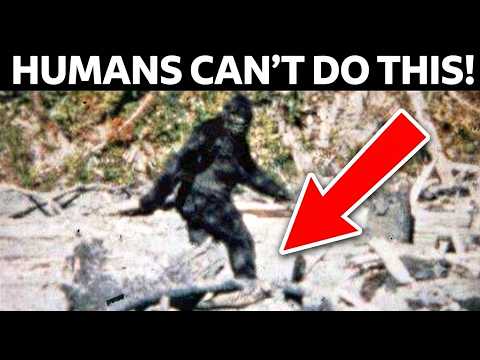
A frame-by-frame treatment of the gait. It argues the proponent case; the frame-rate objection above applies to all of it.
Latest developments
1 Jan 2013
Two image analyses published in The Relict Hominoid Inquiry
Bill Munns and Jeff Meldrum published assessments of the film image in volume 2 of the Idaho State University journal — one on surface anatomy and subcutaneous tissue, one on the integrity of the image itself. They argue the subject’s proportions and soft-tissue movement exceed 1967 costuming. The journal is edited by proponents, which is a fair criticism of the venue and not of the measurements.
1 Jan 2024
Sasquatch report density is matched to black bear density
Floe Foxon, publishing in the Journal of Zoology, found that the geographic distribution of sasquatch reports across North America tracks black bear population density. It is not about the film, but it is the most substantial peer-reviewed result on the wider phenomenon and it points at misidentification.
11 Sept 2025
Jeff Meldrum’s death announced
The anatomist who did more than anyone to keep the physical evidence inside an academic setting died of brain cancer. Over 300 track casts had been assembled in his laboratory at Idaho State University; no public arrangement for the collection has been announced.
12 Mar 2026
Capturing Bigfoot premieres at SXSW
Marq Evans’s documentary presented a 40-second 16mm clip dated by the production to 1966 and read as a rehearsal for the Bluff Creek film, together with Clint Patterson’s account of the costume being burned. Response within the field was immediate and divided; the material has not been independently examined.
Join the discussion
Still open on this one:
- 01
Where is the camera-original reel?
Last publicly accounted for in 1980 and reported missing by the mid-1990s. It is the object that would fix the frame rate and end the central technical dispute, and no chain of custody for it has been published.
- 02
What frame rate was the camera actually running at?
Patterson reported 18 fps after the fact; 16 and 24 are both live possibilities. Grieve’s conclusion, and therefore the whole biomechanical case, changes completely between them. Without the original this is not currently answerable.
- 03
What is the provenance chain and dating basis of the 1966 reel?
The production says the stock carries markings placing its production and development in 1966, and that it came from the safe of a Boeing film-lab worker. As of this writing no laboratory report, edge-code reading or independent examination has been published.
- 04
Why has no costume ever been produced?
Two men have claimed to have made or worn it and a third says he saw it burned. Sixty years on, the object at the centre of the hoax account has never been seen by anyone outside those accounts.
- 05
Do the original Patterson and Titmus casts survive, and who holds them?
Track casts from the era are dispersed across private collections and the Idaho State University holdings assembled by Jeff Meldrum, whose death was announced in September 2025. No published inventory establishes where the 1967 Bluff Creek casts now are.
- 06
Was any part of the encounter recorded by the second reel?
Patterson shot more than the famous sequence and the material was screened in 1967 and 1968. What survives of the rest, and in what generation of copy, is not documented in any public catalogue.
Be the first to comment
Sources
Sources
Open them and check for yourself. Where a record is public, it is linked.
Exposing Roger Patterson’s 1967 Bigfoot Film Hoax
Kal K. Korff and Michaela Kocis, Skeptical Inquirer 28(4) · 1 Jul 2004
Experiments Cast Doubt on Bigfoot Evidence — Matt Crowley on desiccation ridges
Skeptical Inquirer
Analysis: Integrity of the Patterson–Gimlin Film Image
Bill Munns and Jeff Meldrum, The Relict Hominoid Inquiry 2 (Idaho State University) · 1 Jan 2013
Bill Munns and Jeff Meldrum, The Relict Hominoid Inquiry 2 (Idaho State University) · 1 Jan 2013
The Relict Hominoid Inquiry — journal archive
Idaho State University
Virtual Footprints Archive — 3D scans and provenance for track casts
Idaho State University
Frame 352, and all that — assessment of the Grieve and Napier analyses
Darren Naish, Tetrapod Zoology · 1 Nov 2006
Bigfoot: If it’s there, could it be a bear?
Floe Foxon, Journal of Zoology (Zoological Society of London), doi:10.1111/jzo.13148 · 1 Jan 2024 · no public copy located
Bigfoot: The Yeti and Sasquatch in Myth and Reality
John Napier, Jonathan Cape — no authorised copy online · 1 Jan 1972 · no public copy located
The Making of Bigfoot: The Inside Story
Greg Long, Prometheus Books — no authorised copy online · 1 Jan 2004 · no public copy located
Capturing Bigfoot — SXSW review
Richard Whittaker, The Austin Chronicle · 15 Mar 2026
The Hollywood Reporter · 12 Mar 2026
The director of Capturing Bigfoot on the 1966 reel and the Patterson family
AOL / People · 13 Mar 2026
See also
Everything this piece touches
Other case files
 Case File 009
Rendlesham Forest
1980 · Suffolk, England
December 1980, Suffolk. Three nights, two airbases, and a memorandum that has been argued over ever since. Britain’s most examined case.
0 documents · 1 images · 2 videos
 Case File 031
Nimitz Tic Tac
2004 · Pacific Ocean
November 2004, off the coast of Baja California. Radar, FLIR and aircrew accounts from the USS Nimitz carrier strike group, assembled in one place.
0 documents · 0 images · 4 videos
 Case File 024
Roswell
1947 · New Mexico
July 1947, Lincoln County, New Mexico. The recovery that produced two official explanations, decades of testimony and one of the most heavily documented disputes in the field.
0 documents · 1 images · 1 videos
0 comments