

Teotihuacan: the city whose builders we cannot name
A city of over a hundred thousand people, laid out on a grid, north-east of modern Mexico City. We do not know what its inhabitants called themselves, what language they spoke, or who ruled them.
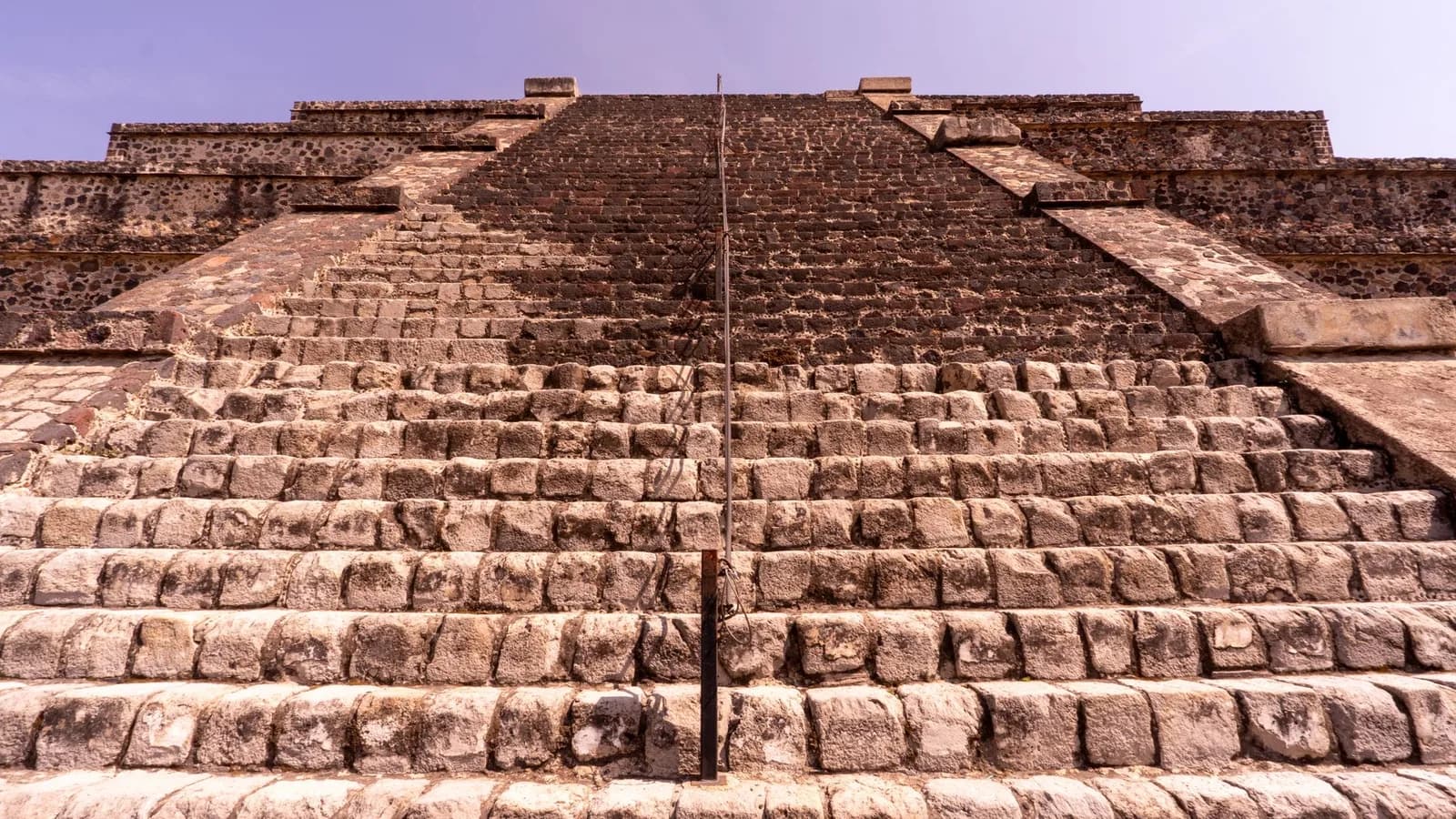
At its height Teotihuacan held perhaps 125,000 people, making it one of the largest cities in the world.
Teotihuacan covered around twenty square kilometres and housed perhaps 125,000 people at its height, in the first centuries AD. It was one of the largest cities on earth at the time. It had apartment compounds, workshops, drainage, and a monumental axis nearly four kilometres long.
And we do not know who built it. Not in the way we know about Rome or Egypt — we do not have their name for themselves, their language, or a king list.
What is documented
The archaeology, in enormous detail. The Pyramid of the Sun and Pyramid of the Moon, the Avenue of the Dead, the Temple of the Feathered Serpent. Residential compounds housing extended households, many with painted murals.
Occupation from around 100 BC, monumental construction through the first two centuries AD, a peak around AD 400, and a violent collapse in the sixth or seventh century in which the ceremonial centre was burned.
Trade goods from across Mesoamerica. Evidence of a multi-ethnic population, with distinct Zapotec and Maya neighbourhoods identifiable from ceramics and burial practice.
Why we know so little about the people
They left almost no readable writing. Teotihuacan has signs and symbols, some of which may be a script, but nothing has been deciphered and there is no bilingual text to work from.
That is the whole of it. Contemporary Maya cities left inscriptions naming rulers and recording dates, so we know Maya dynastic history in detail. Teotihuacan, a larger and arguably more influential city, is archaeologically rich and historically silent.
What is genuinely strange
The absence of rulers. There are no royal portraits, no named kings, no obvious dynastic tombs of the kind found everywhere else in Mesoamerica.
The art is overwhelmingly corporate — deities, processions, abstract motifs — rather than individual. Some archaeologists argue for collective or council rule; others think royal burials exist and have not been found.
For a city of that size and duration, the lack of a single identifiable ruler is a real anomaly and it is an anomaly within archaeology, not outside it.
The apartment compounds
The part of Teotihuacan that has changed archaeology most is not the pyramids. It is the housing.
Over two thousand walled residential compounds have been identified. Each held an extended household or several — a set of rooms around open courtyards, with drainage, plastered floors and, in many cases, painted murals. People were buried beneath the floors of the rooms they had lived in.
Nothing else in the ancient Americas looks like this. It is planned urban housing on a grid, built to a standard, occupied for generations. Whoever ran the city was housing a large population deliberately rather than letting it accrete.
What excavation keeps producing
Tunnels. A passage beneath the Temple of the Feathered Serpent, sealed for over eighteen centuries and rediscovered in 2003, was excavated over the following years and contained thousands of offerings — including metallic spheres, jaguar remains, worked shell and liquid mercury.
The mercury attracts attention. Its likeliest purpose is symbolic, representing water or the underworld, and mercury has been found at other Mesoamerican sites in ritual contexts.
Sacrificial burials at the Feathered Serpent pyramid, with the hands bound, are also documented — over a hundred individuals, apparently dedicatory.
Join the discussion
Still open on this one:
- 01
Is the Teotihuacan sign system a script?
If it is and it were deciphered, the city would move from prehistory into history. It is the single most consequential open question at the site.
- 02
Who ruled it?
No royal tomb has been securely identified. Either they were never buried in the manner of their neighbours, or the tomb has not been found.
Be the first to comment
Sources
Open them and check for yourself. Where a record is public, it is linked.
Pre-Hispanic City of Teotihuacan
UNESCO World Heritage Centre
British Museum
Related
Psychic Phenomena
The Nine: who — or what — were they?
On New Year’s Eve 1952, in a laboratory in Maine, a voice announced itself as one of nine. Over the next forty years it reached a credentialled scientist, a celebrity psychic, a bestselling book and the creator of Star Trek. This is what is documented, and what is not.
Psychic Phenomena
New Year’s Eve 1952: the first session with the Nine
The founding event of the whole Nine phenomenon happened in a Maine farmhouse on 31 December 1952. Here is what the record supports about that evening, and how much of the familiar account was written down much later.
Psychic Phenomena
D. G. Vinod: the man at the beginning of the Nine
Every version of the Nine story starts with Dr D. G. Vinod in a trance in Maine. He is also the person that story then almost entirely forgets. Why the first channel is the biggest hole in the record.
Psychic Phenomena
Andrija Puharich: the doctor who kept turning up
A qualified physician, an inventor with real patents, an army medical officer — and the constant in forty years of the strangest story in American parapsychology. Puharich is the reason the Nine keep touching institutions.
0 comments