

Skara Brae: a Neolithic village with the furniture still in it
A storm stripped the sand off a Bay of Skaill dune in 1850 and revealed eight stone houses with beds, dressers and hearths still standing. It is older than the pyramids and better preserved than anything of its age in Europe.
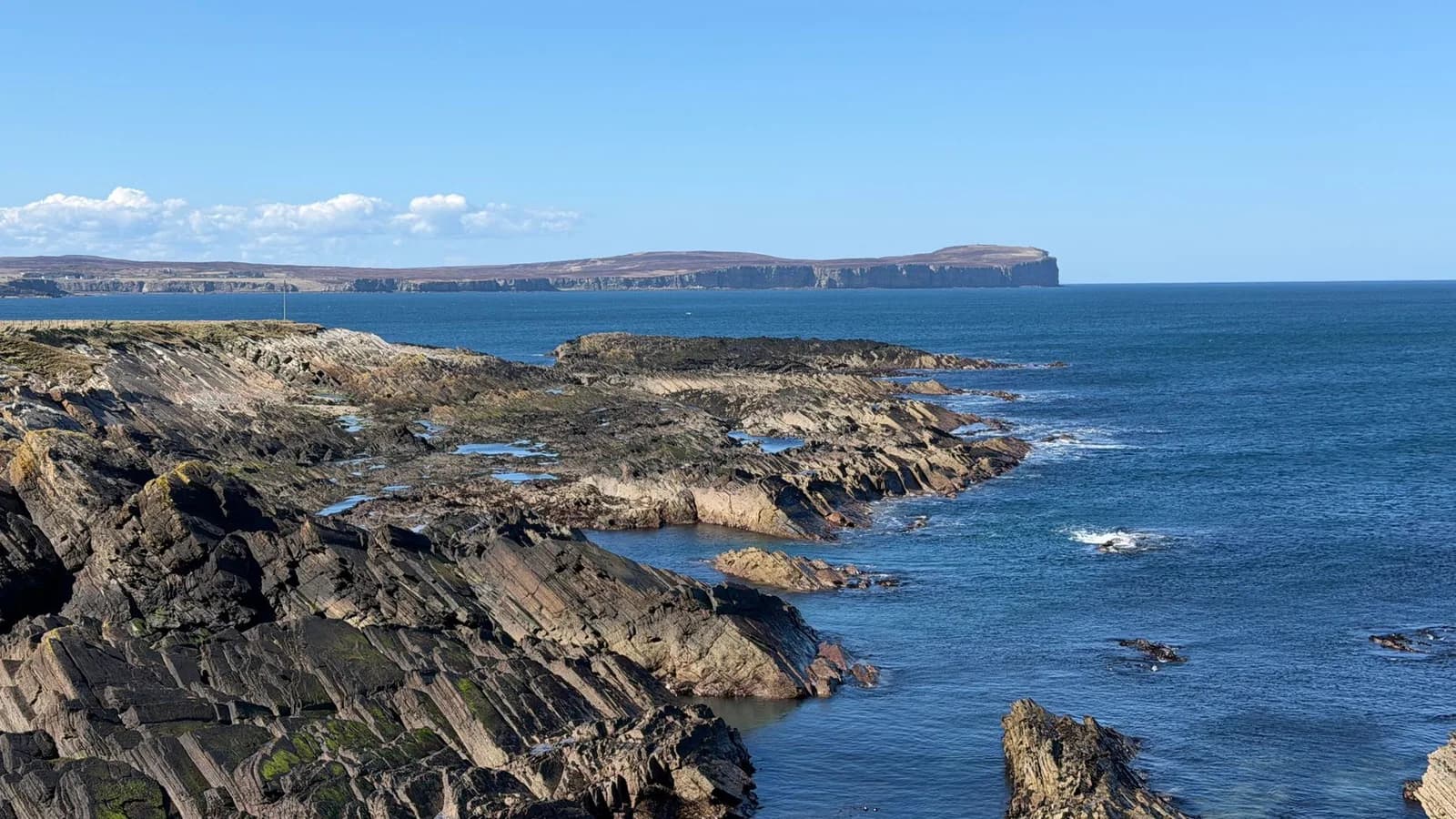
Skara Brae was occupied for roughly six centuries from about 3180 BC.
In the winter of 1850 a severe storm stripped turf and sand from a dune at the Bay of Skaill on Orkney's west coast. Under it was a village.
Skara Brae consists of eight surviving stone-built houses connected by covered passages, occupied for roughly six hundred years from about 3180 BC. It predates Stonehenge's sarsens and the Giza pyramids.
Why it survived
Two things: Orkney has almost no timber, so the houses were built of flagstone, including the furniture. And the whole village was buried in windblown sand, which sealed it.
The result is a Neolithic interior that can be walked through. Stone dressers stand against the wall opposite the entrance of each house. Stone bed frames sit either side of a central hearth. There are storage recesses, drains beneath the floors, and what appear to be tanks — possibly for keeping shellfish bait alive.
What was found in them
Tools of bone and stone, pottery of the Grooved Ware type, beads, and carved stone objects with incised geometric decoration whose function is unknown.
Animal bone and shell show a diet of cattle, sheep, fish and shellfish, with barley and wheat cultivated. This was a settled farming community, not a camp.
The drains
Beneath the floors of the houses run stone-lined channels leading away from the settlement.
Some of the small cells built into the walls of individual houses connect to them directly. The most economical reading is a form of indoor sanitation, drained away from the living space.
If that is what they are, they are among the earliest such arrangements known anywhere — in a village of a few dozen people, at the northern edge of Neolithic Europe, five thousand years ago.
The Grooved Ware connection
The pottery style used at Skara Brae, known as Grooved Ware, is now understood to have appeared in Orkney before spreading south through Britain and Ireland, where it is found at Stonehenge and Durrington Walls. The traffic in ideas ran from the far north down, not from the south up — which reverses the assumption that held for most of the twentieth century.
Why it ended
This is where the popular account overreaches. The village is often said to have been abandoned suddenly in a catastrophic storm, with people fleeing and leaving possessions behind.
The evidence does not require that. Abandonment appears to have been gradual, over a period, with houses going out of use at different times. The dramatic single-storm story appears to derive from the circumstances of the site's rediscovery rather than from its excavation.
Join the discussion
Still open on this one:
- 01
What are the carved stone balls for?
Hundreds have been found across Scotland, finely worked, with no wear pattern indicating use. They are among the most distinctive unexplained artefacts in British prehistory.
Be the first to comment
Sources
Open them and check for yourself. Where a record is public, it is linked.
UNESCO World Heritage Centre
Related
Psychic Phenomena
The Nine: who — or what — were they?
On New Year’s Eve 1952, in a laboratory in Maine, a voice announced itself as one of nine. Over the next forty years it reached a credentialled scientist, a celebrity psychic, a bestselling book and the creator of Star Trek. This is what is documented, and what is not.
Psychic Phenomena
New Year’s Eve 1952: the first session with the Nine
The founding event of the whole Nine phenomenon happened in a Maine farmhouse on 31 December 1952. Here is what the record supports about that evening, and how much of the familiar account was written down much later.
Psychic Phenomena
D. G. Vinod: the man at the beginning of the Nine
Every version of the Nine story starts with Dr D. G. Vinod in a trance in Maine. He is also the person that story then almost entirely forgets. Why the first channel is the biggest hole in the record.
Psychic Phenomena
Andrija Puharich: the doctor who kept turning up
A qualified physician, an inventor with real patents, an army medical officer — and the constant in forty years of the strangest story in American parapsychology. Puharich is the reason the Nine keep touching institutions.
0 comments