

Rapa Nui: how the statues walked, and what really happened to the island
Nearly a thousand statues on a remote Pacific island, and a story about ecological suicide that has been substantially revised. Both the moving and the collapse turn out to be better understood than the legend.
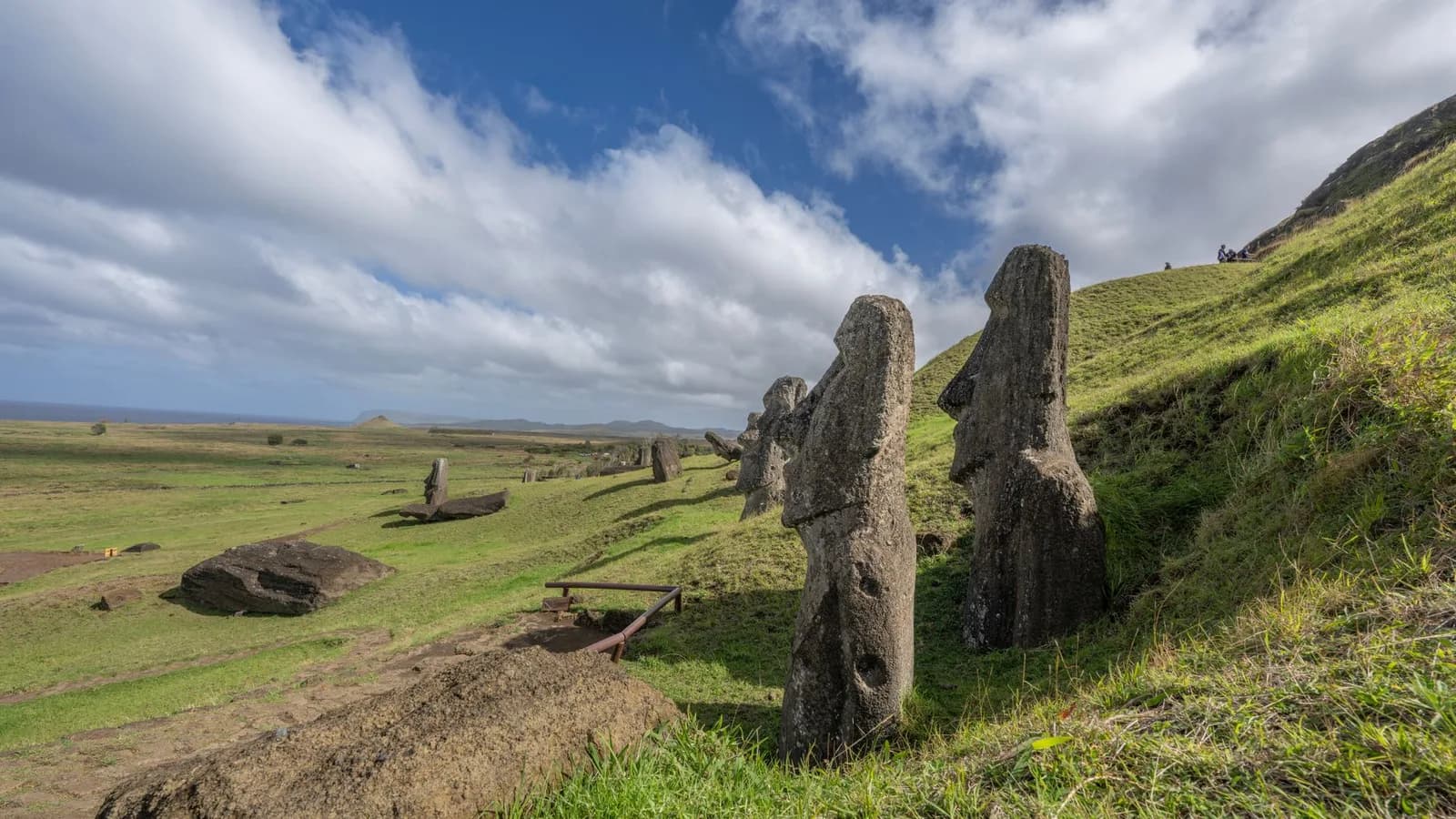
Nearly a thousand moai were carved on Rapa Nui, most from the quarry at Rano Raraku.
Rapa Nui — Easter Island — lies over three thousand kilometres from the nearest inhabited land. Its people carved nearly a thousand monolithic figures, the moai, and moved many of them kilometres from the quarry to platforms around the coast.
Two questions have driven the popular account: how the statues were moved, and what happened to the society that made them. Both have moved a long way in the last twenty years.
Who arrived, and when
Polynesians, in one of the great feats of open-ocean navigation. Dating has been argued over — estimates have ranged across several centuries — with current evidence generally supporting settlement around AD 1200, later than older estimates.
The moai were carved mostly between the thirteenth and fifteenth centuries, overwhelmingly from volcanic tuff at the Rano Raraku quarry, where hundreds remain in various stages including one unfinished figure over twenty metres long.
How they were moved
Islanders said, consistently, that the moai walked.
That was treated as myth for a long time. Then experimental archaeology tested it: a team using ropes and a small number of people rocked an upright replica side to side, walking it forward in a controlled shuffle. It worked, and it moved a multi-tonne statue over open ground.
It also explains features of the moai themselves — a forward lean and a D-shaped base, both of which make the walking method work and neither of which makes sense for a statue designed to be dragged flat.
Statues abandoned along the old roads are found in positions consistent with having fallen while upright and in transit.
The collapse story, revised
The familiar version: the islanders cut down every tree to move statues, destroyed their own environment, starved, and collapsed into warfare. It has been told as a parable about ecological self-destruction.
The deforestation is real. The island was once forested with a large palm and lost it. But the causal chain has been substantially challenged.
Polynesian rats, arriving with the settlers, ate palm seeds in quantities that would suppress regeneration regardless of human cutting. Analysis of nut shells shows heavy rat predation.
And there is little evidence for the population crash before European contact that the story requires. Studies of agricultural features and settlement suggest a population that adapted — rock gardens, stone mulching — rather than one that starved.
The rock gardens
The strongest evidence against the collapse story is agricultural, and it is easy to miss because it looks like rubble.
Large areas of Rapa Nui are covered with deliberately broken and scattered rock. This is lithic mulching: stones placed on and worked into the soil to reduce evaporation, moderate temperature, protect against wind, and release minerals as they weather.
It is labour-intensive, it is effective, and it is the response of a society adapting successfully to poor soil and deforestation rather than one collapsing in the face of it.
Studies of the extent of these gardens have been used to estimate carrying capacity, and the figures are consistent with a stable population rather than a crashed one.
Why the revision matters
Because the collapse story was told for decades as established fact and used as a moral lesson, and the evidence for it was thinner than the telling suggested.
The islanders were not fools who destroyed their world for statues. They sustained a society for centuries on one of the most isolated habitable places on earth, adapted to deforestation, and were then devastated by outsiders.
Join the discussion
Still open on this one:
- 01
When was the island actually settled?
Estimates have shifted by centuries as dating methods improved. The current consensus is later than the older one, and it is not closed.
- 02
Can rongorongo be deciphered?
Perhaps two dozen objects survive, which may simply be too little text. It is the most likely of the undeciphered scripts to be a genuine writing system and the least likely to have enough material.
Be the first to comment
Sources
Open them and check for yourself. Where a record is public, it is linked.
UNESCO World Heritage Centre
British Museum
Related
Psychic Phenomena
The Nine: who — or what — were they?
On New Year’s Eve 1952, in a laboratory in Maine, a voice announced itself as one of nine. Over the next forty years it reached a credentialled scientist, a celebrity psychic, a bestselling book and the creator of Star Trek. This is what is documented, and what is not.
Psychic Phenomena
New Year’s Eve 1952: the first session with the Nine
The founding event of the whole Nine phenomenon happened in a Maine farmhouse on 31 December 1952. Here is what the record supports about that evening, and how much of the familiar account was written down much later.
Psychic Phenomena
D. G. Vinod: the man at the beginning of the Nine
Every version of the Nine story starts with Dr D. G. Vinod in a trance in Maine. He is also the person that story then almost entirely forgets. Why the first channel is the biggest hole in the record.

Psychic Phenomena
Andrija Puharich: the doctor who kept turning up
A qualified physician, an inventor with real patents, an army medical officer — and the constant in forty years of the strangest story in American parapsychology. Puharich is the reason the Nine keep touching institutions.
0 comments