

Puma Punku: the stonework, and what tools actually made it
Blocks with flat faces, sharp internal angles and repeated identical forms, in the Bolivian highlands. The precision is real. The claim that it cannot be explained is not.
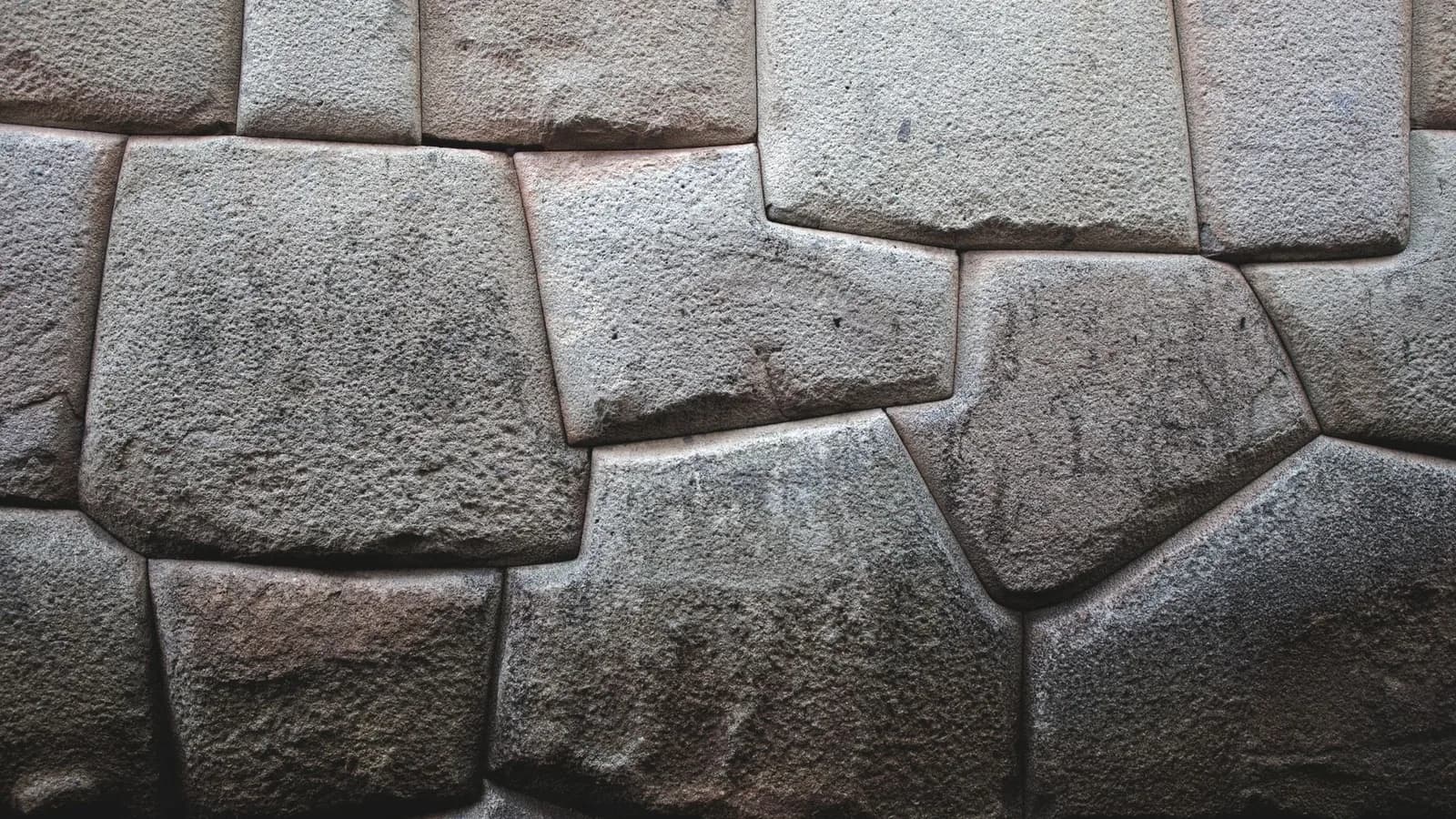
Puma Punku is part of the Tiwanaku complex near Lake Titicaca, at around 3,800 metres.
Puma Punku is a section of the Tiwanaku site in Bolivia, on the high plateau near Lake Titicaca. It is famous for a set of stone blocks with flat surfaces, precise internal right angles, drilled holes and repeated identical shapes.
The stonework is genuinely impressive. Almost everything said about its inexplicability is not.
What is documented
The site is dated to roughly the sixth century AD, with the wider Tiwanaku complex spanning several centuries around that. Dating comes from radiocarbon on organic material in the construction fill and from the site’s ceramic sequence.
The famous H-blocks are andesite, a volcanic rock. Much of the larger platform stone is sandstone. The sandstone came from a quarry about ten kilometres away; the andesite from further, across or around the lake.
How the shapes were made
This has been investigated experimentally, which is the part the popular accounts omit.
Stone hammers of harder rock for roughing out. Grinding with sand and water as an abrasive for flat faces — a slow method that produces very flat surfaces indeed, because the abrasive finds high points first.
The repeated identical forms, which are often cited as evidence of machining, are more economically explained by templates. A cut-out guide of the required profile, applied to each block, produces standardised components — and standardisation is exactly what you want for modular construction, which is what the H-blocks are.
The drilled holes are consistent with bow or pump drilling with an abrasive slurry, a technique documented across the ancient world.
The condition of the site
Puma Punku is heavily disturbed, and this is rarely mentioned. It was quarried for building material for centuries, dynamited by treasure hunters, and disrupted by early excavation.
The blocks lying scattered are not in their original arrangement. Reconstructions of what the structure looked like are inference, and the popular image of an inexplicably shattered site is largely a record of what happened to it after it was built.
Why the claim persists
Because the stonework really is very good, and because most people have never seen what patient abrasive grinding produces. Precision reads as machine work to eyes trained on machines.
The Tiwanaku were a major Andean civilisation with monumental architecture, an agricultural system supporting a large population, and long-distance trade. Attributing their best work to somebody else is the oldest error in this field.
Join the discussion
Still open on this one:
- 01
How was the andesite transported?
The genuinely unresolved logistical question. Experimental archaeology has addressed cutting far more thoroughly than moving.
Be the first to comment
Sources
Open them and check for yourself. Where a record is public, it is linked.
British Museum
Tiwanaku archaeological research
UNESCO World Heritage Centre
Related
Psychic Phenomena
The Nine: who — or what — were they?
On New Year’s Eve 1952, in a laboratory in Maine, a voice announced itself as one of nine. Over the next forty years it reached a credentialled scientist, a celebrity psychic, a bestselling book and the creator of Star Trek. This is what is documented, and what is not.
Psychic Phenomena
New Year’s Eve 1952: the first session with the Nine
The founding event of the whole Nine phenomenon happened in a Maine farmhouse on 31 December 1952. Here is what the record supports about that evening, and how much of the familiar account was written down much later.
Psychic Phenomena
D. G. Vinod: the man at the beginning of the Nine
Every version of the Nine story starts with Dr D. G. Vinod in a trance in Maine. He is also the person that story then almost entirely forgets. Why the first channel is the biggest hole in the record.
Psychic Phenomena
Andrija Puharich: the doctor who kept turning up
A qualified physician, an inventor with real patents, an army medical officer — and the constant in forty years of the strangest story in American parapsychology. Puharich is the reason the Nine keep touching institutions.
0 comments