

The Baghdad battery: a jar that has never been shown to be one
A ceramic jar with a copper cylinder and an iron rod, found near Baghdad. Replicas can be made to generate a small voltage. That is a long way from establishing what it was for.
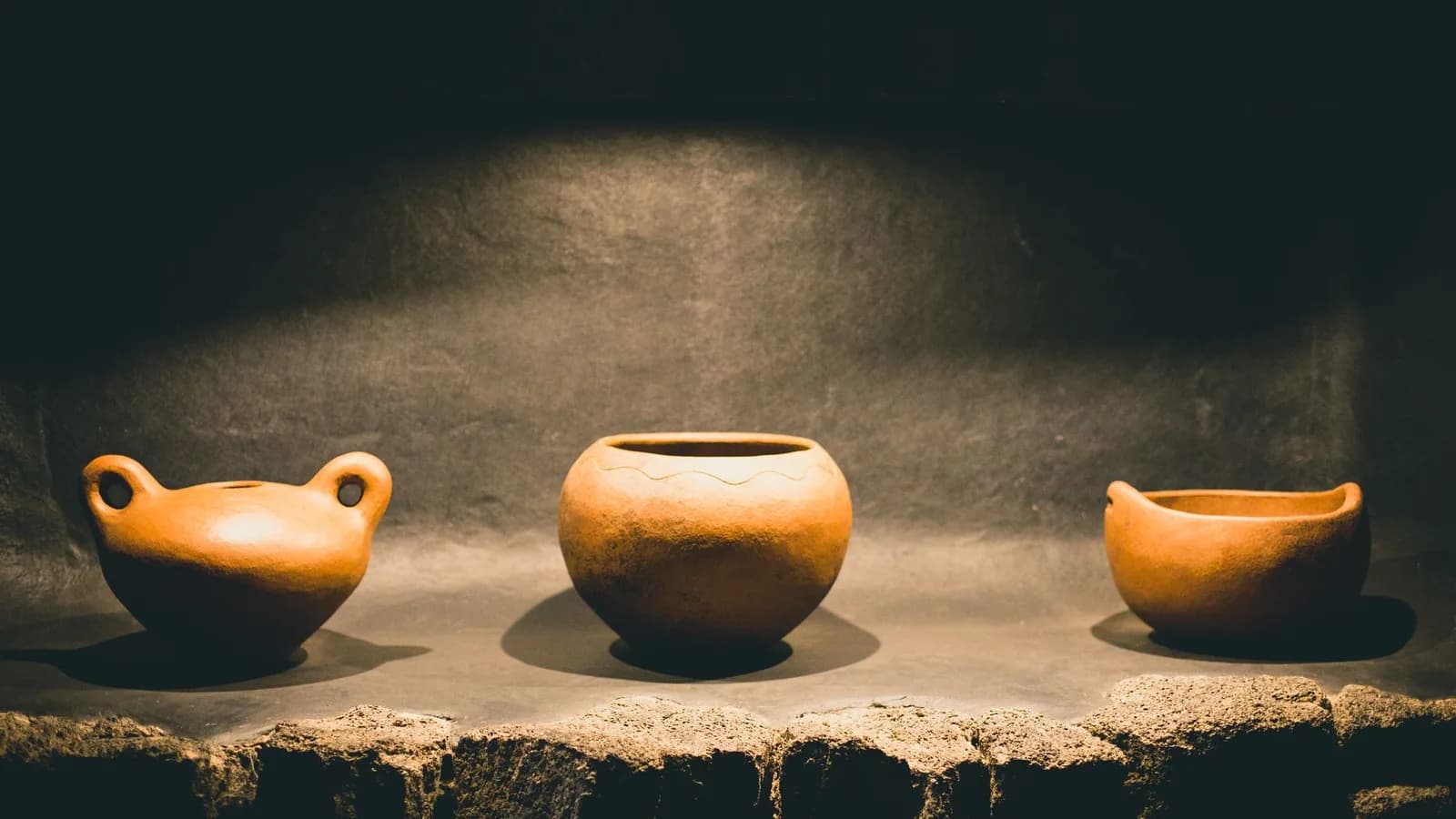
The vessels are ceramic jars containing a copper cylinder and an iron rod.
The object is a ceramic jar roughly thirteen centimetres tall containing a rolled copper cylinder with an iron rod inside it, held in place with asphalt. It is associated with finds near Khujut Rabu, outside Baghdad, and dated variously to the Parthian or Sasanian period.
In 1938 the German archaeologist Wilhelm König, then at the Baghdad museum, suggested it could function as a galvanic cell. The idea has been in circulation ever since.
What is true
If you fill a replica with an acidic electrolyte — vinegar or grape juice — copper and iron in contact with it will produce a potential difference. Roughly half a volt has been reported in reconstructions.
That is not in dispute. Dissimilar metals in an electrolyte make a cell; this is chemistry, and it will happen whether anyone intends it or not.
The objections
They are practical and they are strong.
There are no wires. No conductor, no connector, and no artefact from the region that a current could plausibly have been run to. A power source with nothing to power is an odd thing to build.
The asphalt seal covers the top completely. A working cell needs its terminals accessible and needs the electrolyte replaced as it is consumed. A sealed jar is the wrong shape for a battery and the right shape for a container.
And there is no text. Mesopotamian and Persian written records are extensive and describe crafts in detail. Nothing describes anything resembling electrical practice.
What the scroll-case reading rests on
It is not a guess made to dispose of an inconvenient object. It comes from comparison.
Similar assemblies — ceramic vessel, metal cylinder, sealed top — have been recovered from sites in the region, and some contained the remains of rolled organic material. Papyrus and parchment decay to almost nothing in most conditions, leaving a corroded metal tube in a jar.
Storing a sacred or legal document in a sealed metal cylinder inside a ceramic jar is an entirely ordinary practice attested across the ancient Near East and Mediterranean.
The likelier reading
The assembly closely resembles known storage vessels for sacred scrolls, in which a rolled document is held inside a metal cylinder and sealed. Similar objects have been recovered from the region containing degraded organic material.
On that reading the copper cylinder is a scroll case, the iron rod is a fixing, the asphalt is the seal, and the object is a container that has lost its contents. The corrosion sometimes cited as evidence of acid is consistent with ordinary decay of organic material.
Join the discussion
Still open on this one:
- 01
Has any object of the period been tested for electrodeposition?
A single confirmed electroplated artefact would change the case entirely. None has been reported, and the analytical methods to detect it are routine.
Be the first to comment
Sources
Open them and check for yourself. Where a record is public, it is linked.
British Museum
Related

Psychic Phenomena
The Nine: who — or what — were they?
On New Year’s Eve 1952, in a laboratory in Maine, a voice announced itself as one of nine. Over the next forty years it reached a credentialled scientist, a celebrity psychic, a bestselling book and the creator of Star Trek. This is what is documented, and what is not.
Psychic Phenomena
New Year’s Eve 1952: the first session with the Nine
The founding event of the whole Nine phenomenon happened in a Maine farmhouse on 31 December 1952. Here is what the record supports about that evening, and how much of the familiar account was written down much later.

Psychic Phenomena
D. G. Vinod: the man at the beginning of the Nine
Every version of the Nine story starts with Dr D. G. Vinod in a trance in Maine. He is also the person that story then almost entirely forgets. Why the first channel is the biggest hole in the record.
Psychic Phenomena
Andrija Puharich: the doctor who kept turning up
A qualified physician, an inventor with real patents, an army medical officer — and the constant in forty years of the strangest story in American parapsychology. Puharich is the reason the Nine keep touching institutions.
0 comments