

Baalbek: the largest worked stones ever moved, and who moved them
Three blocks in a Roman temple platform in Lebanon weigh around 800 tonnes each. A larger one still lies in the quarry. Roman engineering accounts for them, and the quarry is the reason we know.
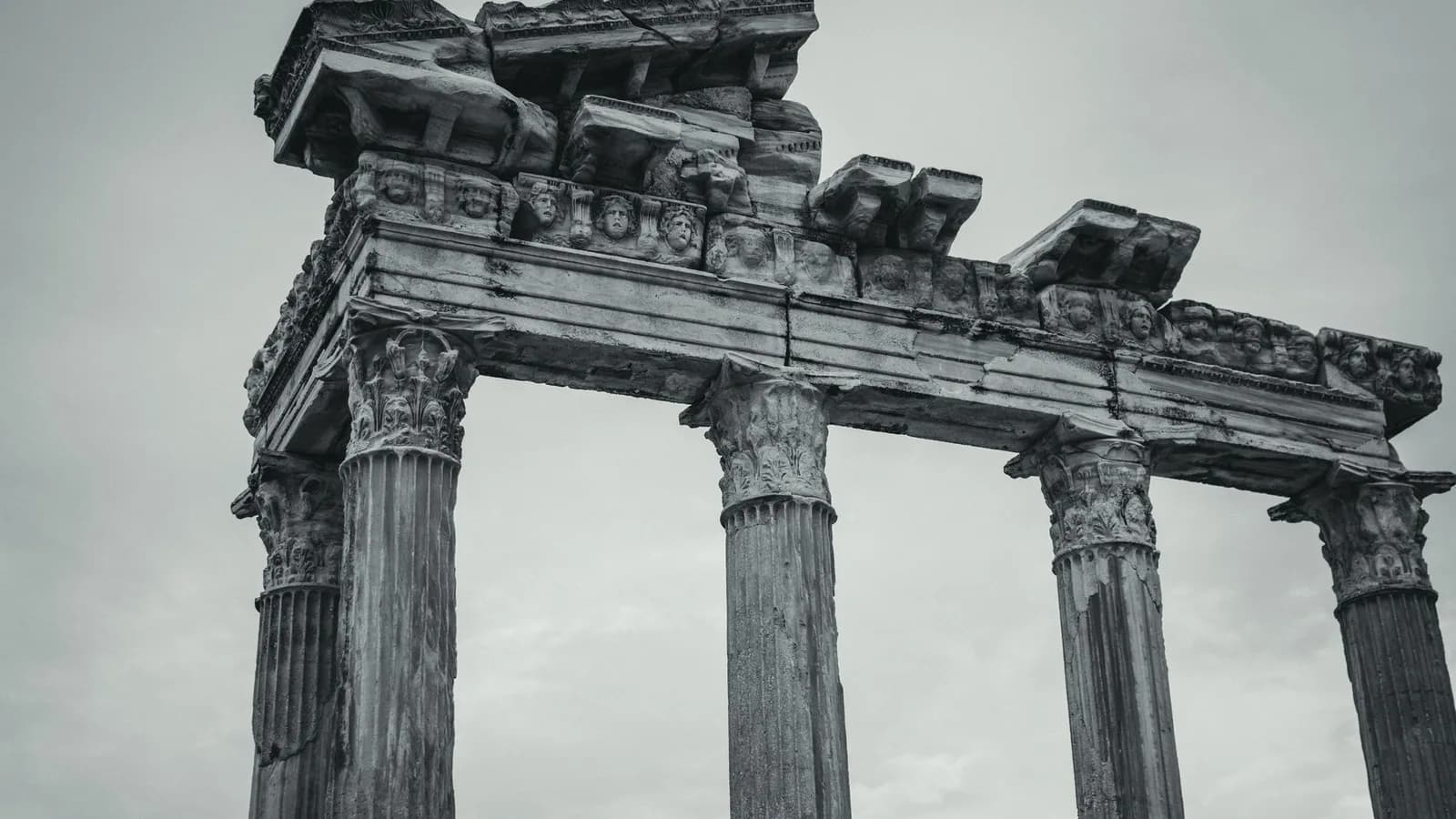
The temple complex at Baalbek in Lebanon was built over roughly two centuries from the first century BC.
The temple complex at Baalbek in the Beqaa valley contains the largest worked stone blocks ever moved by people. Three in the podium wall — the trilithon — weigh in the region of 800 tonnes each. In the quarry, less than a kilometre away, lie larger blocks still, one estimated at over 1,600 tonnes.
The scale is not disputed and it is genuinely staggering. The attribution is also not disputed among archaeologists, and the reason is the quarry.
What the quarry tells you
It is the single most informative thing at the site, and it is why the mystery mostly dissolves on the ground.
The unfinished blocks are still attached to bedrock, with the cutting channels around them visible. The tool marks are visible. The method of separation — cutting a trench, then splitting from beneath — is visible in progress.
You can see the technique being used, frozen at the point the work stopped. There is no ambiguity about how the blocks were made.
The Roman context
The complex is Roman, built over roughly two centuries from the first century BC, on a site with earlier religious use. The dating is established from construction, inscriptions and the archaeological sequence.
Roman engineering at this scale is documented elsewhere. They moved obelisks from Egypt to Rome. They had capstans, compound pulleys, treadwheel cranes, and enormous quantities of organised labour.
Moving 800 tonnes is a problem of scale rather than of principle: rollers, sledges, prepared trackways, and very large numbers of people and animals pulling through multi-part pulley systems. Estimates of the workforce required are large and not impossible.
What is genuinely uncertain
The specific method used at Baalbek. The Romans left no account of this particular operation, and the archaeological evidence for the transport route is limited.
Reconstructions are informed inference from known Roman capability rather than from documentation of what was done here. That is a real gap and it is the honest place to put the uncertainty.
Why it is worth visiting in the mind
Because it is a case where the mystery and its answer are within walking distance of each other. The blocks that prompt the question and the quarry that answers it are part of the same site.
Join the discussion
Still open on this one:
- 01
What route did the trilithon blocks take?
Under a kilometre, over a slope. The prepared trackway has not been definitively identified archaeologically, which is the most tractable open question at the site.
Be the first to comment
Sources
Open them and check for yourself. Where a record is public, it is linked.
UNESCO World Heritage Centre
British Museum
Related
Psychic Phenomena
The Nine: who — or what — were they?
On New Year’s Eve 1952, in a laboratory in Maine, a voice announced itself as one of nine. Over the next forty years it reached a credentialled scientist, a celebrity psychic, a bestselling book and the creator of Star Trek. This is what is documented, and what is not.
Psychic Phenomena
New Year’s Eve 1952: the first session with the Nine
The founding event of the whole Nine phenomenon happened in a Maine farmhouse on 31 December 1952. Here is what the record supports about that evening, and how much of the familiar account was written down much later.
Psychic Phenomena
D. G. Vinod: the man at the beginning of the Nine
Every version of the Nine story starts with Dr D. G. Vinod in a trance in Maine. He is also the person that story then almost entirely forgets. Why the first channel is the biggest hole in the record.

Psychic Phenomena
Andrija Puharich: the doctor who kept turning up
A qualified physician, an inventor with real patents, an army medical officer — and the constant in forty years of the strangest story in American parapsychology. Puharich is the reason the Nine keep touching institutions.
0 comments