

Are the greys us? The future-human hypothesis
The idea that UFO occupants are our own descendants, visiting their evolutionary past. It has a real anthropologist behind it and a genuine anatomical starting point — and the history of the image undoes most of it.
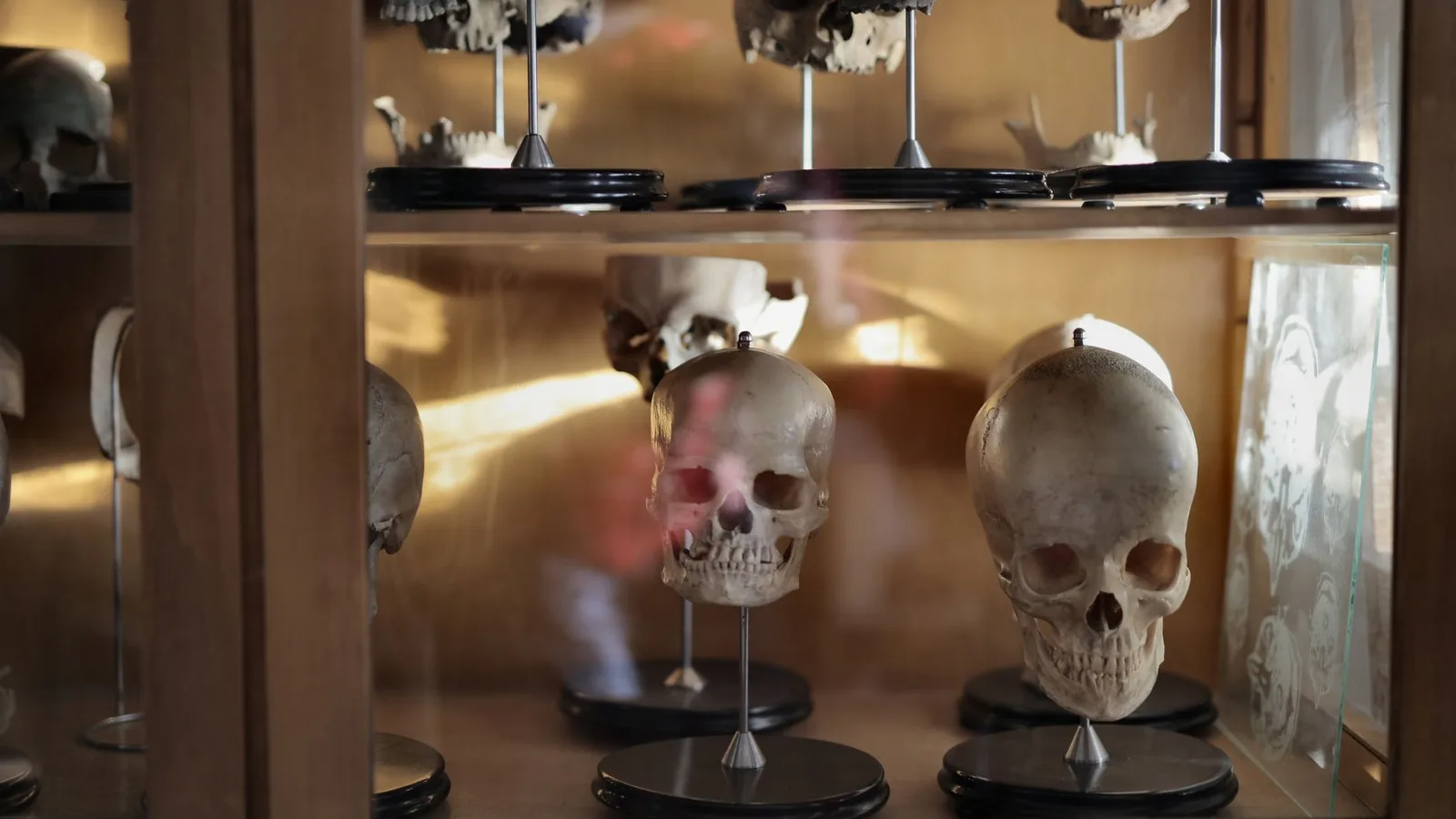
Photo by Andrea Piacquadio on Pexels
One reading of the UFO occupant reports is that the visitors are not from another star at all. They are from here, and from later — human descendants travelling back to study their own ancestry.
It is more interesting than it sounds, it has a credentialled advocate, and the strongest objection to it is not the physics. It is a magazine article published in 1893.
What a grey is said to look like
The standard description: short, slight, grey or grey-white skin, hairless, an enlarged and rounded cranium, a reduced face with a vestigial nose and mouth, and very large dark eyes.
That description is not evenly distributed through the history of the subject. Early occupant reports vary enormously — tall figures, human-looking figures, hairy figures, figures in suits. Antônio Villas-Boas in 1957 described people, not greys.
How humans have actually changed
The anatomical starting point is real and worth stating properly.
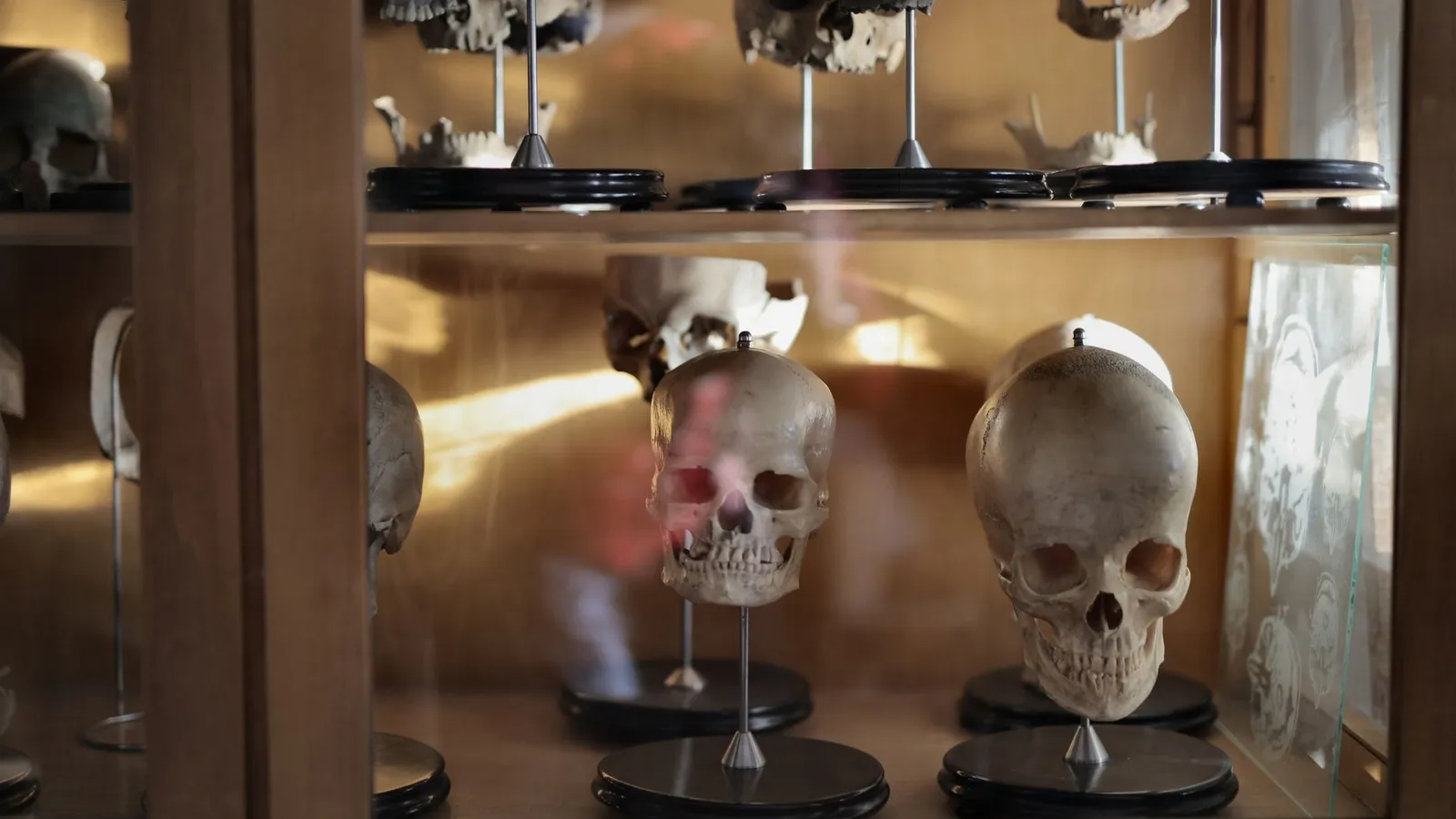
Across roughly two million years of Homo, average cranial capacity increased substantially. The face became less projecting and less robust: a reduced brow, a smaller jaw, smaller teeth, a flatter facial profile. The braincase in our own species is markedly globular compared with earlier Homo.
Body robusticity declined. Hair coverage reduced. Bipedalism was established long before any of it.
Bigger braincase, smaller face, lighter build, less hair. Extend those four lines and something grey-shaped appears at the end of them.
Why that extrapolation fails
Three reasons, and the first is decisive on its own.
Brain size has been going the other way. Cranial capacity in humans of the last ten to thirty thousand years is somewhat smaller than in late Pleistocene populations. The trend the hypothesis extends forward reversed before recorded history began, and why it did is still argued about.
Evolution is not a direction. The changes described were responses to specific pressures — diet, cooking, tool use, thermoregulation, obstetrics. Remove or alter those pressures and nothing continues by momentum. Selection has no memory of where it was heading.
And the popular reasoning is not evolutionary at all. Less manual work does not shrink bodies. More thinking does not enlarge brains. Screens and dim light do not enlarge eyes. These are Lamarckian intuitions — use and disuse within a lifetime — and museums covering human origins caution against them explicitly, because they are the commonest misunderstanding visitors arrive with.
Masters and the extratempestrial model
The serious modern version is Michael P. Masters, a biological anthropologist at Montana Technological University, whose book Identified Flying Objects appeared in 2019.
His argument is that the hominin trends above, continued, produce something resembling the reported occupants; that a descendant species would explain why the visitors are humanoid at all; and that time is a more tractable barrier than interstellar distance. He calls them extratempestrials.
The appeal is real. Every other hypothesis has to explain why beings from an independent biosphere are bipedal, bilaterally symmetrical, two-eyed, and roughly our size. Descent explains that in one move.
What it would explain
On the hypothesis, several recurring elements of the abduction literature acquire a motive.
Interest in human reproduction and genetics, because we are the ancestral population. Interest in nuclear weapons and environmental damage, because our future is their history. Observation rather than open contact, because interference has consequences for the observer.
Reported variation between occupants — near-human, short grey, taller grey — becomes different points of origin along one lineage.
Could a craft be a time machine?
This is where the hypothesis trades one impossible problem for a worse one.
General relativity does contain solutions with closed timelike curves — paths through spacetime returning to their own past. The Gödel universe, the interior of a rotating black hole, an infinite rotating cylinder, a traversable wormhole with separated mouths. These are genuine mathematics, not hand-waving.
None has been shown to be physically realisable. They require conditions that either cannot exist, cannot be constructed, or need exotic matter with negative energy density in quantities nobody can produce. Hawking's chronology protection conjecture proposes the laws of physics forbid it outright; the conjecture is unproven in either direction.
Interstellar travel is an engineering problem of appalling difficulty. Backwards time travel may not be a problem at all, in the sense that it may simply not be a thing that happens.
The 1893 problem
And here is the objection the hypothesis has to answer first, which is historical rather than scientific.
In 1893 H. G. Wells published a speculative essay, The Man of the Year Million, in the Pall Mall Gazette. He extrapolated the evolutionary trends then understood and described the result: an enlarged cranium, greatly enlarged eyes, a reduced face and mouth, a diminished body, no hair.
That is the grey. Described as a human descendant. Fifty-four years before Kenneth Arnold, sixty-eight years before Betty and Barney Hill.
What would actually settle it
The best question in this whole area, and the reason it is worth covering at all: what would distinguish a descendant of ours from an independent lifeform?
Biochemical handedness. Terrestrial life uses left-handed amino acids and right-handed sugars, an arbitrary choice frozen in at the origin of life here. A descendant would share it. An independent origin would have no reason to.
Genetics. A descendant's genome would sit inside the human tree — same chromosome architecture, same endogenous retroviral insertions at the same loci, the fossilised viral infections our ancestors survived.
Microbiology. A gut flora descended from ours. Anatomy carrying our specific inherited compromises — the recurrent laryngeal nerve's absurd detour, the blind spot, a birth canal shaped by bipedalism.
Got something to add?
A question, a source we missed, a correction, or something you saw yourself — all of it is welcome here. You do not need to be an expert, and you are allowed to disagree with us.
What we are still chasing
- 01
Was Wells drawing on a specific scientific source?
The 1893 essay reflects late-Victorian evolutionary thinking. Establishing exactly whose work he was extending would fix the true origin point of the image, which is the most answerable question here.
- 02
Why did human cranial capacity decrease in the Holocene?
Proposals include reduced body size, changes in diet, social distribution of cognition, and self-domestication. Unresolved, and directly relevant to any claim about where the trend is going.
- 03
When does the grey morphology first appear in an encounter report, as opposed to in fiction?
This is a bibliographic question that can be answered from the case literature, and nobody appears to have done it systematically.
If you can get anywhere near one of those, we would genuinely like to know.
Nobody has yet — go on.
Sources
Open them and check for yourself. Where a record is public, it is linked.
Human Origins — What does it mean to be human?
Smithsonian National Museum of Natural History
Natural History Museum, London
US National Archives
Related

Intelligence
The CIA's Secret Mind Control Experiments on Charles Manson | Tom O'Neill
Tom OâNeill on the twenty-year investigation behind CHAOS, including what he found on Jolly West and what he never managed to prove.
Intelligence
Tom O'Neill CHAOS: Charles Manson, The CIA & The 60s
A long interview with the author of CHAOS on Manson, the CIA and the sixties.
Intelligence
"Chaos: Charles Manson, the CIA, and the Secret History of the Sixties"
A news segment on CHAOS and the questions it raises about the official Manson account.
Intelligence
Tom ONeill Reveals NEW Charles Manson Evidence, Chaos 2: Mind Control Program Gone Right or Wrong?
OâNeill on material gathered since CHAOS was published.
0 comments