

Patterson–Gimlin film: the stabilisation work that changed the debate
Fifty-odd seconds of 16mm film shot in northern California in 1967. The argument now turns less on what it shows than on how fast the camera was running.
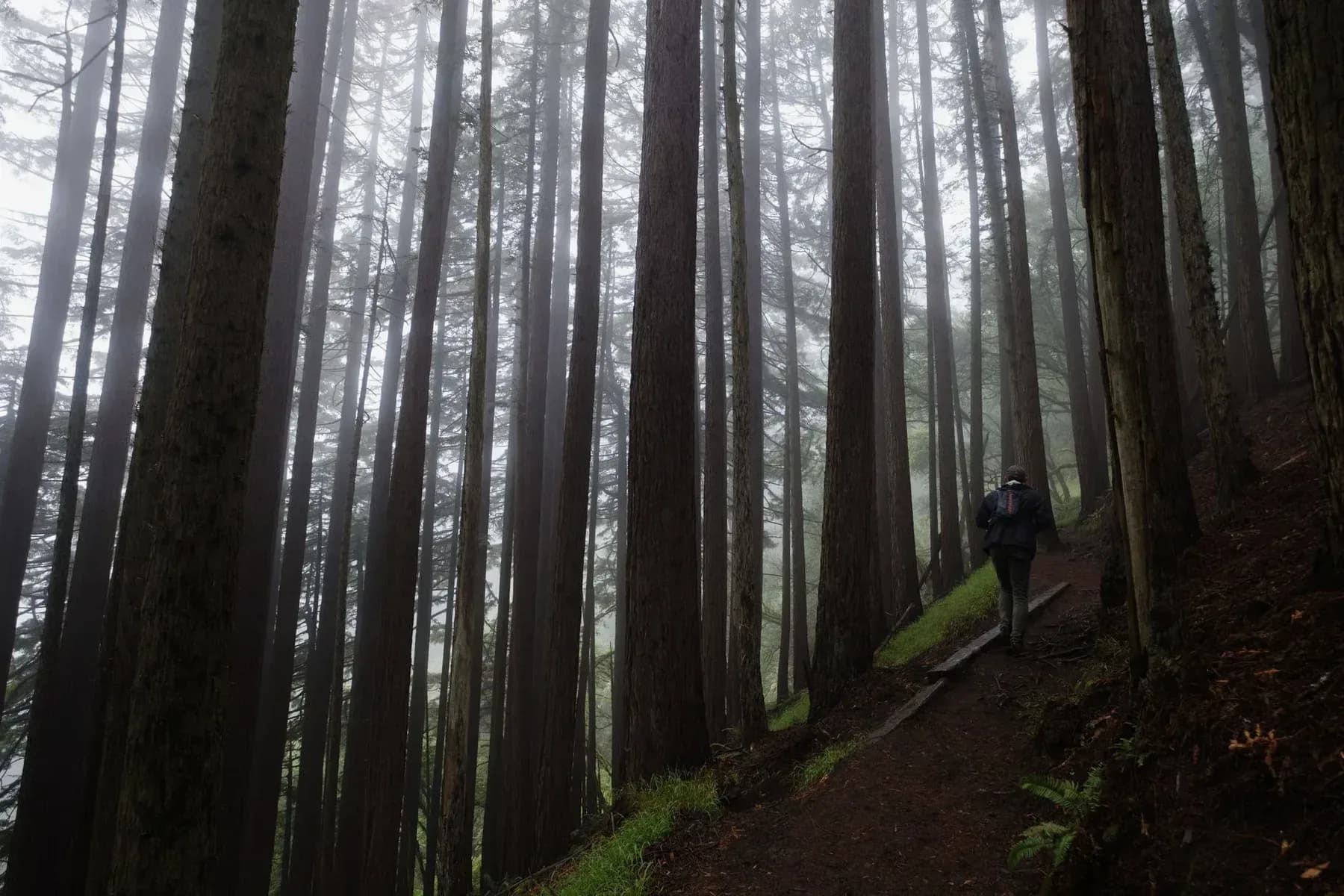
Photo by Rachael Porter on Pexels
On 20 October 1967, Roger Patterson and Bob Gimlin filmed a large bipedal figure walking across a sandbar at Bluff Creek in northern California. The footage runs under a minute on 16mm colour film, shot handheld with a Cine-Kodak K-100. A single frame from it is among the most reproduced images of the twentieth century.
Almost six decades later there is no agreement on what it shows. There is, however, a great deal of agreement on what would settle it — which makes the film unusually tractable compared with most evidence in this field.
Why the camera speed matters
Patterson did not record the frame rate, and the K-100 could be set to several. The film was almost certainly shot at either 16 or 24 frames per second, and which one it was changes everything downstream: the subject's walking speed, stride length, and the frequency of the arm swing all scale with it.
At one speed the gait falls outside the range comfortably produced by a human of that height; at the other it does not. Researchers on both sides have built careful analyses on top of an assumption they cannot verify, which is why the argument has proved so durable.
The claims of authorship
Two men have claimed involvement in a hoax. Bob Heironimus said he wore the suit; the costume-maker Philip Morris said he supplied it. Neither account has been corroborated by physical evidence, and details of the two claims sit awkwardly together.
The original camera-original film would answer several of these questions, including the frame rate, from the exposure characteristics. Its whereabouts and condition have been described inconsistently for decades, and no full technical examination has been published.
That absence is the real story of the Patterson–Gimlin film. It is one of the few pieces of evidence in this subject that could, in principle, be resolved by ordinary laboratory work on a physical object — and that work has never been done.
Join the discussion
Still open on this one:
- 01
Where is the camera-original film, and what condition is it in?
Accounts of its custody differ. No published technical examination exists.
- 02
Can the frame rate be recovered from the film itself?
Exposure and grain characteristics may carry the answer, if the original is available.
- 03
Why has no suit matching the subject ever been produced?
Two hoax claims exist; neither has been supported by the costume.
Be the first to comment
Sources
Open them and check for yourself. Where a record is public, it is linked.
Bluff Creek film, 20 October 1967
Roger Patterson and Bob Gimlin · 20 Oct 1967 · no public copy located
Related

Government Disclosure
UFO Experts Explain Why Disclosure Is Finally Breaking Open
UFO Experts Explain Why Disclosure Is Finally Breaking Open — via Best of Danny Jones.

Secret Societies
Secret Societies In The Shadows: The Freemasons
The oldest and most documented of the secret societies — and the gap between what is recorded and what is claimed.
0 comments
Sign in to join the discussion. Free, no subscription.